


The basic facts. Seasonal affective disorder is a depressive disorder with a seasonal pattern — depression that recurs at the same time each year, most commonly autumn through early spring at northern latitudes. The condition was first formally described by Norman Rosenthal and colleagues at the National Institute of Mental Health in 1984. They named it, characterized the pattern, and tested the first version of what's now the standard treatment.
That treatment is morning bright-light exposure. Two thousand lux to start, more recently standardized at 10,000 lux, for around 30 minutes shortly after waking. The mechanism appears to involve resetting the circadian phase that drifts later in winter — shorter days produce delayed melatonin onset and offset, which correlates with the depressive features. Bright morning light advances the rhythm back to a healthier alignment.
The treatment works. Multiple meta-analyses have confirmed effects matching first-line antidepressants for this specific condition. The catch is that the implementation matters enormously, and most people doing light therapy at home are doing it in ways that wouldn't have produced benefit in the trials.
This piece walks through the actual protocol, the other interventions with real evidence, and the popular options that are weaker than they look.
What SAD Actually Is
The DSM-5 doesn't have "seasonal affective disorder" as a standalone diagnosis. It's a specifier added to major depressive disorder or bipolar disorder when the pattern is seasonal. The clinical criteria require:
- A regular temporal relationship between depressive episodes and a particular time of year
- Full remission during other seasons
- The pattern occurring in at least two consecutive years
- Substantially more lifetime seasonal episodes than non-seasonal ones
The winter-pattern type is the common one. A summer-pattern variant exists, with different features (more agitation, less weight gain, less hypersomnia) and different treatments. The interventions discussed here are for winter SAD specifically.
Prevalence varies dramatically by latitude. Rosenthal's original work in Washington DC found around 2% prevalence; studies in Finland and similar latitudes have reported up to 10%. Subsyndromal "winter blues" — milder symptoms not meeting full criteria — affects substantially more people in northern populations.
Risk factors include female sex (women are diagnosed 2–3 times more often than men), younger adulthood (though it can present at any age), family history, and northern latitude. People who move from lower to higher latitudes often develop SAD within a few years of relocating.
Why It Happens
The dominant explanation is circadian phase delay. In winter, light onset shifts later. Melatonin secretion shifts with it. The result, for vulnerable individuals, is a chronic mismatch between internal clock and external day — essentially mild jet lag that doesn't resolve.
This delayed-phase model is supported by:
- Most patients with winter SAD show phase-delayed dim-light melatonin onset
- Light therapy in the morning produces phase advance, which correlates with symptom improvement
- Evening light tends to delay phase further and either doesn't help or worsens symptoms
- The condition is more common at higher latitudes where seasonal light variation is more extreme
Several other mechanisms have been proposed and likely contribute. Serotonin signaling is sensitive to light. Vitamin D status drops in winter at high latitudes. Behavioral changes in winter (less outdoor time, more sedentary, social isolation) reinforce the depressive state. The picture is multifactorial. The phase-delay model gives us the most actionable intervention.
The Light Therapy Protocol — Done Right
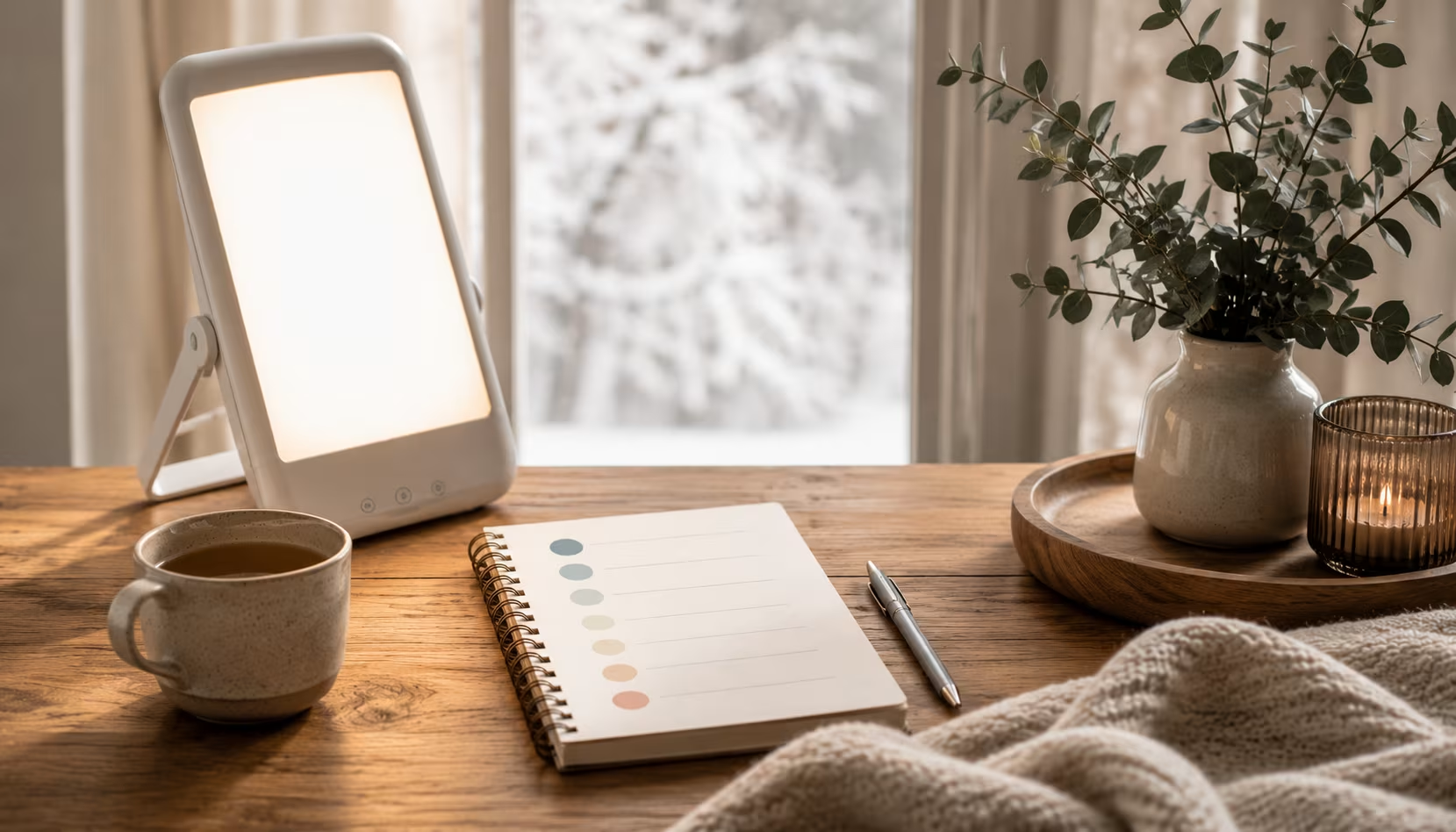
The protocol that was actually tested and shown to work:
Light box specifications
- 10,000 lux at the distance used
- Full spectrum white light, with UV filtered out
- A box large enough that minor head movements don't move you out of the effective zone (typically 25 × 60 cm or larger)
Distance and angle:
- Position the light box 40–60 cm from your face
- Light should enter the eyes obliquely, not straight on (you're not staring at the light; you're reading, working, or eating while it illuminates your peripheral vision)
- Eyes open, lamp at eye level or slightly above
Duration
- 30 minutes per session is the standard for 10,000 lux
- 45–60 minutes for 5,000 lux
- 1–2 hours for 2,500 lux
Timing:
- Within the first 1–2 hours after waking
- Consistent time each day
- Continued throughout the affected season
Onset
- Begin before symptoms appear if possible (often early autumn at higher latitudes)
- Continue daily through the symptomatic season
- Stop in spring as natural light returns
This is a clinical protocol, not a lifestyle recommendation. Trials that showed efficacy used these parameters. Modified versions — shorter exposure, longer distance, brighter ambient light alone, midday rather than morning — have less consistent effects.
What Goes Wrong With DIY Light Therapy
Several common implementation errors that reduce or eliminate benefit:
Wrong brightness
The 2,500-lux "happy light" sold to office workers may not reach the therapeutic threshold if used for the conventional 30 minutes. Cheaper lamps marketed as SAD treatment sometimes deliver well below their advertised lux at usable distance.
Wrong distance
A 10,000-lux lamp at the manufacturer's measurement distance (often 20 cm) delivers far less at the 60 cm where it's actually usable. Lux drops roughly with the square of distance. The lamp two meters across the room delivers a fraction of its rated output.
Wrong timing
Evening light therapy is the most common mistake. It can phase-delay further and disrupt sleep. The same lamp at 8 PM may be net harmful where it would have been helpful at 7 AM.
Wrong consistency
Using the lamp some days and not others undermines the phase-resetting effect that requires daily exposure.
Wrong duration
Five minutes of bright light produces some effect but not the full intervention. Trials used 30 minutes minimum for the standard 10,000-lux protocol.
Confusion about staring at the light
You're not supposed to stare directly. Eyes should be open, light should enter peripherally, but reading or working while the box illuminates the room from beside you is the standard arrangement.
A useful check: read the actual study protocols (Rosenthal et al., 1984; subsequent NIMH work). The trial that established the treatment used specific parameters. Anything substantially different is an experimental modification, not the validated intervention.
Dawn Simulators as an Alternative
A different version of light therapy uses gradually brightening light during the last 30–60 minutes of sleep. The lamp dims at evening and brightens before alarm, simulating dawn at a chosen time year-round.
The evidence is reasonable, though smaller than for traditional light therapy. Several trials have shown comparable efficacy in milder SAD; severe cases may need the higher-intensity post-waking protocol.
The appeal it works during a time most people are sleeping anyway. No 30-minute morning sitting required. No early-morning compliance challenge. For people who struggle with traditional light therapy compliance, dawn simulation is a reasonable second-line option.
The catch less robust evidence than the 10,000-lux protocol. For moderate-to-severe SAD, the traditional approach has more support.
Other Treatments With Evidence
Light therapy isn't the only option. Several others have evidence:
Cognitive Behavioral Therapy for SAD (CBT-SAD)
A specific adaptation of CBT for seasonal patterns. Rohan and colleagues have done extensive trials showing CBT-SAD produces effects comparable to light therapy at 6-week follow-up and better effects in subsequent winters (the skills generalize across years; the light requires re-implementation each season).
Antidepressants
SSRIs and the SNRI venlafaxine have evidence for SAD. Bupropion XL is FDA-approved specifically for prevention of SAD when started in autumn. The medications work, with the standard caveats about side effects and the slower onset (several weeks).
Combined approaches
Light therapy plus CBT-SAD, or light therapy plus medication, produces benefit beyond either alone in some studies.
Behavioral activation
A treatment originally developed for general depression, focused on increasing engagement with rewarding activities. Has some evidence in SAD specifically, particularly combined with other approaches.
Outdoor exercise
Several trials suggest that walking outdoors in morning light produces benefit, possibly through combining light exposure with exercise effects. The total light exposure outdoors on a cloudy winter day still substantially exceeds typical indoor lighting and can be therapeutic if duration is adequate (45+ minutes).
For people who don't respond fully to light therapy, the combined approaches matter. This isn't a single-treatment condition.
The Vitamin D Question
Vitamin D supplementation gets recommended widely for SAD. The actual evidence is weaker than the recommendation volume suggests.
A 2014 systematic review by Frandsen and colleagues found mixed results across trials. Some small studies showed benefit; larger trials and meta-analyses found smaller or null effects. The effect, where it exists, is modest compared to light therapy.
The explanation likely involves several factors. Vitamin D deficiency is common at high latitudes in winter, and depression and low vitamin D status are correlated — but correlation doesn't establish that supplementation reverses the depression. People in clinical depression have many altered biomarkers; treating any one of them doesn't necessarily treat the depression.
A reasonable position: vitamin D supplementation makes sense at higher latitudes through winter for general health reasons (bone, immune function, the documented effects). Whether it specifically helps SAD is unclear, and you shouldn't substitute it for light therapy or evidence-supported treatments.
If you take it, the standard dose is 1,000–2,000 IU daily. Higher doses are sometimes appropriate for documented deficiency but require blood-level monitoring.
Exercise and Outdoor Time

Outdoor morning activity is the underrated intervention for SAD. It stacks several mechanisms:
- Bright light exposure (even cloudy winter days deliver more lux than indoor lighting)
- Exercise effects on mood and circadian rhythm
- Engagement with the natural environment
- Behavioral activation
- Social interaction if it's a group walk or class
A 45-minute outdoor walk during the brightest part of the morning can deliver 5,000–20,000 lux of light alongside the exercise benefit. For many people with mild-to-moderate SAD, this substitutes adequately for a light box. For severe cases, it complements other treatments.
The challenge in winter is consistency. Cold, wet, dark, and time pressures all push against outdoor mornings. The people who do it consistently report substantial benefit. The people who try a few times and quit don't.
When SAD Isn't SAD
Several things look like SAD but aren't, or aren't only:
Year-round depression with seasonal worsening
Some people have persistent low mood that simply gets worse in winter. The seasonal pattern is real, but the underlying condition is broader.
Vitamin deficiency-related depression
Iron deficiency, B12 deficiency, and thyroid dysfunction all produce depressive symptoms and may worsen in winter (when diets often shift toward more processed food).
Sleep apnea
Worse in winter for some people (different sleeping positions, weight changes, alcohol shifts) and produces fatigue, low mood, and cognitive symptoms that mimic SAD.
Holiday-stress depression
December and January can be hard for non-seasonal reasons — family, finances, social isolation, anniversary effects. The pattern overlaps with SAD but the treatment differs.
Substance use shifts
Winter alcohol consumption increases for many people, and alcohol is a depressant. What looks like SAD sometimes resolves with several weeks of sobriety.
If your "SAD" doesn't respond to standard treatment, consider a broader evaluation. A primary care visit with basic labs (CBC, ferritin, B12, TSH, vitamin D) catches several of these. A mental health evaluation distinguishes the patterns.
Sources
Rosenthal, N. E., et al. (1984). Seasonal affective disorder: a description of the syndrome and preliminary findings with light therapy. Archives of General Psychiatry, 41(1), 72–80.
Golden, R. N., et al. (2005). The efficacy of light therapy in the treatment of mood disorders: a review and meta-analysis of the evidence. American Journal of Psychiatry, 162(4), 656–662.
Rohan, K. J., et al. (2007). Cognitive-behavioral therapy, light therapy, and their combination in treating seasonal affective disorder. Journal of Affective Disorders, 99(1-3), 51–58.
Rohan, K. J., et al. (2016). Outcomes one and two winters following cognitive-behavioral therapy or light therapy for seasonal affective disorder. American Journal of Psychiatry, 173(3), 244–251.
Frandsen, T. B., et al. (2014). Vitamin D supplementation for treatment of seasonal affective symptoms in healthcare professionals: a double-blind randomised placebo-controlled trial. BMC Research Notes, 7, 528.
Lewy, A. J., et al. (2006). The circadian basis of winter depression. Proceedings of the National Academy of Sciences, 103(19), 7414–7419.
Pjrek, E., et al. (2020). The efficacy of light therapy in the treatment of seasonal affective disorder: a meta-analysis of randomized controlled trials. Psychotherapy and Psychosomatics, 89(1), 17–24.
Frequently Asked Questions
Does light therapy actually work for seasonal depression?
Yes — light therapy has reasonably strong evidence for seasonal affective disorder, particularly in winter-pattern depression at higher latitudes. The effect size in trials matches first-line antidepressants for this specific condition. The catch: most people doing light therapy at home are doing it wrong. The lamp brightness, distance, and morning timing all matter.
How bright does a SAD lamp need to be?
10,000 lux is the standard target for the treatment protocol. Some 2,500 lux lamps work but require longer exposure. Many of the desk lamps marketed as 'happy lights' don't reach the therapeutic threshold and are essentially decorative. Check the specifications, not the marketing.
When should I use the light box?
Morning — within the first hour or two of waking — is the standard. Most studies that found benefit used morning timing specifically. Afternoon and evening use can disrupt sleep without providing the antidepressant effect. The timing isn't optional; it's how the intervention works.
How long does it take to feel better?
Most people who respond notice changes within the first 1–2 weeks of consistent use. If there's no benefit by 4 weeks of correct protocol, the light isn't the right tool for you, or something else is going on. Don't double the dose; reassess.
Will vitamin D help my SAD?
Probably less than the wellness market suggests. The evidence for vitamin D supplementation specifically improving SAD is weaker than the evidence for light therapy or for the antidepressants used in SAD treatment. Vitamin D matters for several reasons, but if you're targeting winter depression, it's not the highest-leverage intervention.


0 Comments
Leave a comment
Your email won't be published. Required fields are marked with *.