


The 5x5 is the most-prescribed beginner strength program in modern lifting and one of the most reliable training systems ever developed. Variations of the structure — five sets of five reps at the same weight on a small number of major barbell lifts — have produced strong novice and early-intermediate lifters since the 1970s. The current popular versions (StrongLifts 5x5, Starting Strength 3x5, GZCLP) share the same DNA: linear progression on the main lifts, three full-body sessions per week, recovery-friendly structure.
This is a guide to what the program actually is, how to run it properly, and the common misunderstandings that cause it to fail.
The Core Structure
The standard 5x5 program runs three full-body sessions per week (typically Monday, Wednesday, Friday) with alternating workouts:
Workout A:
- Squat: 5 sets of 5
- Bench Press: 5 sets of 5
- Bent-Over Row: 5 sets of 5
Workout B:
- Squat: 5 sets of 5
- Overhead Press: 5 sets of 5
- Deadlift: 1 set of 5 (deadlifts are usually 1 set, not 5)
Sessions alternate A, B, A in week 1; B, A, B in week 2; A, B, A in week 3 and so on.
Total session time typically 45–75 minutes including warm-up. The structure is deliberately minimal — five lifts total in rotation, three sessions per week.
Some variations add accessory work (curls, tricep extensions, pull-ups, dips) at the end of each session. The original Stronglifts 5x5 added "auxiliary" exercises after the main work. Starting Strength is more minimalist.
The Lifts
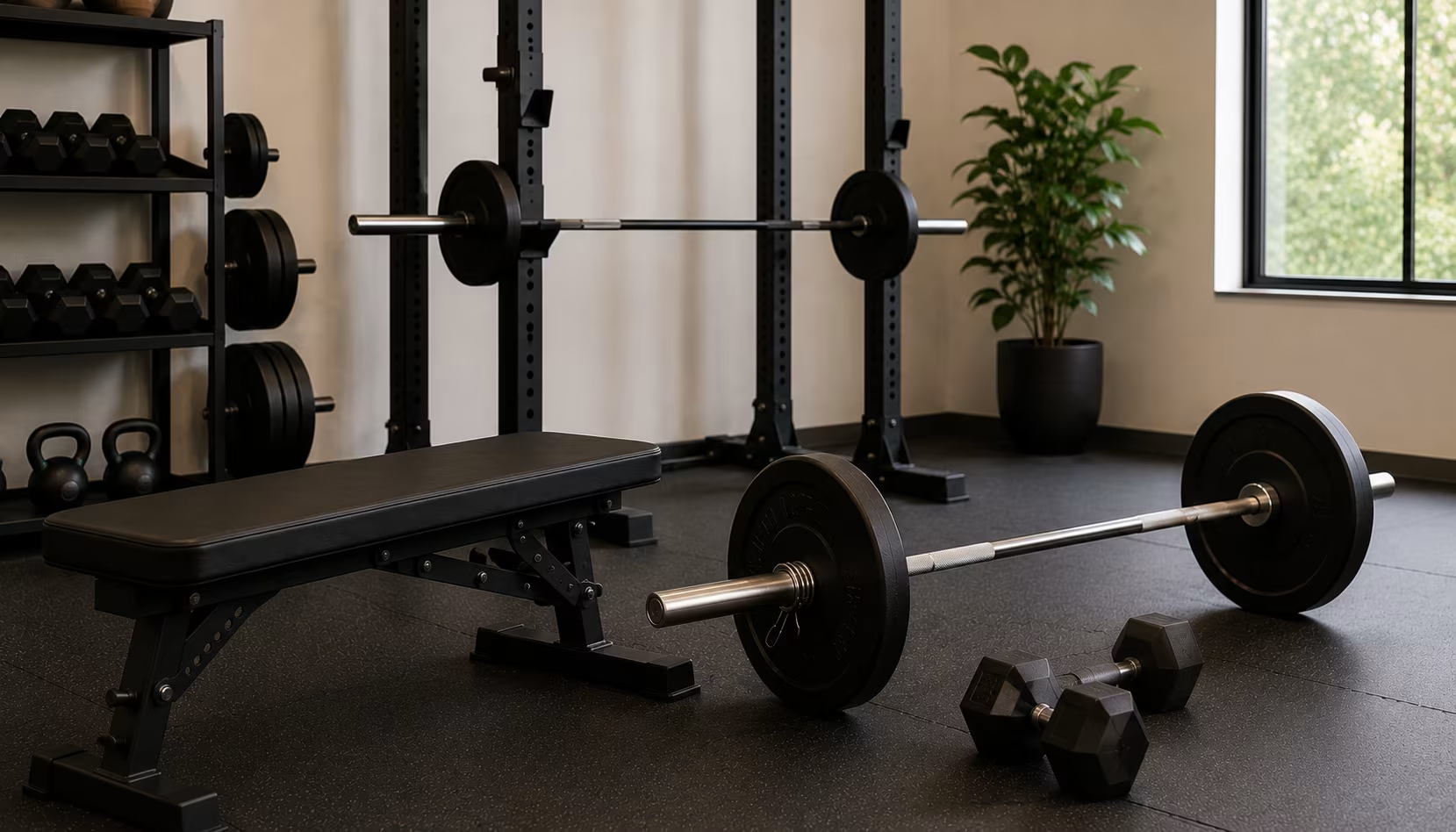
Squat (back squat) — the cornerstone of the program. Performed three times per week, every session. This is unusual for most programs but works for beginners because the recovery cost at light-to-moderate loads is manageable and the high frequency drives both technique acquisition and strength gain.
Bench press — the upper body push. Performed twice per week alternating with overhead press.
Overhead press — the second upper body push. Builds shoulder, upper back, and core strength.
Bent-over row — the upper body pull. Critical for shoulder health balance with all the pressing.
Deadlift — performed once per week, single set of 5 (after the alternating session structure positions it on B days every other week).
Some programs add pull-ups, chin-ups, or dips. These are valuable but not strictly required by the program structure.
Why Linear Progression Works for Beginners
Linear progression — adding weight every session — works because beginner adaptation is fundamentally different from intermediate or advanced adaptation.
Beginners gain strength primarily through neural adaptations (motor unit recruitment, intermuscular coordination) which adapt quickly. The first 6–12 months of consistent training produce neural gains of roughly 40–60%, far outpacing the muscle hypertrophy of the same period.
Recovery from each session is rapid because the absolute loads are low and the cumulative training stress is modest. A beginner who squats 60 kg for 5×5 can recover and add 2.5 kg by the next session, two days later.
Technique is improving simultaneously, which produces "free" strength gains independent of muscle. Better bracing, better bar path, better motor pattern all add capacity without requiring physiological change.
These three factors combine to allow what looks impossibly fast progress: 5 kg per week on lower body lifts for the first 8–12 weeks, slowing to 2.5 kg per week over the next 12–16 weeks.
Linear progression stops working when neural gains plateau (around 6–18 months of consistent training depending on the lifter), at which point the body needs different programming to continue progressing.
Loading and Adding Weight
Starting weights depend on lifting experience:
- True novice with no recent lifting: start with empty barbell on most lifts
- Some lifting experience returning: start at 40–60% of estimated 1RM
- Some current capability: start at 60–70% of estimated 1RM, allowing room to progress
Adding weight:
- Lower body lifts (squat, deadlift): add 5 kg (10 lb) per session in early phase
- Upper body lifts (bench press, overhead press, row): add 2.5 kg (5 lb) per session
When using 2.5 kg microplates (1.25 kg per side), the same micro-progression continues longer. Microloading — adding 1 kg per session on upper body lifts instead of 2.5 — can extend linear progression by months for some lifters.
When You Fail a Set
A "failure" is when you can't complete all 5 reps for all 5 sets at the prescribed weight. The standard protocol:
1st failure: try again next session. Maybe you were tired, dehydrated, slept badly. Don't drop weight yet.
2nd failure (at the same weight): take a small step back. Deload by 10–15% and rebuild over 2–3 sessions.
3rd failure (after the deload, at the deloaded weight): this suggests linear progression is genuinely done. Time to transition to an intermediate program.
A "missed rep" isn't always a "failed set." If you get 5/5/5/5/4 on the last set, repeat that weight next session and aim for 5/5/5/5/5. A genuine failed set is when you've stalled completely on multiple sets across multiple sessions.
Programming Considerations
Rest between sets: 2–5 minutes. Beginners often rush and underrest, then can't complete the prescribed reps. The sets are heavy enough that recovery time matters.
Warm-up: 2–3 progressive sets before the working weight. For example, before 5x5 at 80 kg, warm up with empty bar × 5, 40 kg × 5, 60 kg × 3, 70 kg × 1, then 80 kg × 5 × 5.
Nutrition: linear progression works best with consistent eating, including adequate protein (1.6–2.2 g/kg) and at least maintenance calories. Trying to lose weight while running 5x5 can stall progression early.
Sleep: 7–9 hours nightly. Insufficient sleep is the single most common reason for stalled 5x5 progress.
Form review: have someone (coach, training partner, or film) check your form periodically. Linear progression rewards good technique and penalizes bad technique disproportionately as weights climb.
How Long to Run 5x5
Typical timelines for staying on 5x5:
- 3–6 months: most novice lifters before first major slowdown
- 6–12 months: with smaller increments and microloading
- 12 months+: rare and indicates either very gradual progression or possible programming issues
The lifters who run 5x5 for 18+ months are usually progressing very slowly and would benefit from transitioning to an intermediate program. The lifters who stall in 8 weeks usually have recovery, nutrition, or technique problems rather than program failure.
Realistic strength benchmarks at the end of 6 months of 5x5 (assuming reasonable starting strength and consistent training):
- Squat: 1x bodyweight or higher
- Deadlift: 1.5x bodyweight or higher
- Bench press: 1x bodyweight (men) / 0.6–0.75x bodyweight (women)
- Overhead press: 0.5–0.6x bodyweight
- Row: similar to bench press
Hitting these numbers is realistic; some lifters surpass them substantially; some fall short due to body type or recovery factors. The benchmarks aren't requirements but useful sanity checks.
What Comes After
When 5x5 stops working, common intermediate programs:
- Madcow 5x5 — 5x5 evolution that uses weekly progression rather than per-session
- Texas Method — three-day-per-week intermediate program with volume, recovery, and intensity days
- 5/3/1 — Wendler's program built around monthly cycles and percentage-based programming
- GZCL methods — flexible templates from Cody LeFever
- Conjugate (Westside Barbell) — for serious strength athletes
- PHUL/PHAT/PPL — bodybuilding-leaning intermediate programs
The right next program depends on your goal: continue building max strength (Madcow, Texas Method, 5/3/1), shift toward hypertrophy (PHUL, PPL), or specialize (Smolov for squats, Sheiko for powerlifting).
Common Mistakes
Adding accessories that crash recovery: novice lifters who add 20 sets of arm work and 5 conditioning sessions per week on top of 5x5 stall progress quickly. Stick to the main lifts in early phases.
Skipping sessions: 5x5 assumes 3 sessions per week. Missing one regularly disrupts the progression rhythm.
Cherry-picking lifts to like: doing the squat, bench, and deadlift but skipping rows because they're "boring" produces imbalanced development.
Ego-loading the squat: trying to add 10 kg per session beyond the prescribed progression. Doesn't work; produces poor sets and form breakdown.
Misinterpreting "stalled": if you've added weight twice in three weeks, you're still progressing — not stalled. Stall is multiple consecutive missed sessions.
Switching programs at 4 weeks: not enough time to evaluate. Give 5x5 at least 12 weeks before considering alternatives.
Adding too much weight in fear of "ego lifting": starting too light extends the linear progression but delays meaningful loads. Start at a level appropriate to your experience and progress from there.
Failing to deload when stalled: the deload after the second failure is critical. Skipping it and continuing to push at the failed weight reinforces a stuck pattern.
Frequently Asked Questions
Is 5x5 a good beginner program?
Yes for most novice lifters. It produces fast strength gains, teaches the major barbell lifts, and uses linear progression that matches the rapid initial adaptation curve. Most beginners can run 5x5 programs for 3–6 months with consistent progress.
What's the difference between StrongLifts 5x5 and Starting Strength?
StrongLifts 5x5 uses 5 sets of 5 reps on the main lifts. Starting Strength uses 3 sets of 5 for the main lifts (with 5 sets of 3 for deadlifts). StrongLifts has more volume; Starting Strength has more intensity per set. Both work for beginners; the difference is small over 3-6 months.
When should I switch from 5x5?
When linear progression stops working — typically when you've failed to add weight for 2-3 consecutive sessions despite proper recovery, sleep, and nutrition. For most lifters, this happens between 3 and 9 months of consistent 5x5 work. After failing twice, deload 10% and continue. After failing again, transition to an intermediate program.
Can I do cardio while running 5x5?
Light cardio (1-2 sessions per week, under 30 minutes at moderate intensity) is compatible with 5x5 progression. Heavy cardio or high-volume running may impair recovery and progression. For overall fitness, 5x5 with some cardio is fine. For maximizing strength gains, prioritize lifting recovery.
Do I need to add weight every workout?
The classic 5x5 progression adds 2.5 kg (5 lb) per session for upper body lifts and 5 kg (10 lb) per session for lower body lifts during the early phase. After 6-12 weeks, most lifters slow to weekly increments or every-other-session increments. Failing to add weight occasionally is normal and not cause for program change.
Sources and verification
Check current details with these primary or subject-authority sources before acting on the information.





0 Comments
Leave a comment
Your email won't be published. Required fields are marked with *.