


The barbell bench press is the canonical upper body exercise in most lifting cultures and the single most common cause of pressing-related shoulder problems. The combination of a fixed grip width, fixed bar path, and high absolute loads creates conditions that aggravate the shoulder complex in lifters with even mild rotator cuff or AC joint issues. For some lifters the bench press is fine. For others it's a chronic problem.
This is a guide to seven alternatives that build the same musculature (chest, triceps, anterior deltoid, serratus anterior) with substantially less shoulder stress.
Why Bench Press Causes Shoulder Problems
The barbell bench press creates several conditions that stress the shoulder:
Fixed grip width: the lifter's hands are locked in a specific position regardless of individual shoulder anatomy. Lifters with narrow shoulders find standard widths uncomfortable; lifters with broader shoulders sometimes can't fit a competition-legal grip.
Internal rotation under load: the typical bench press involves substantial humeral internal rotation, particularly with elbows flared. The repeated loading of this position is implicated in subacromial impingement.
Bar path constraints: the bar must move in a slight diagonal from above the shoulder to mid-chest. Lifters whose anatomy doesn't naturally fit this path compensate with shoulder motion that adds stress.
Lack of scapular movement: when the upper back is pinned to the bench, scapular movement is reduced. The shoulder relies more on the joint itself and less on the surrounding stabilizers.
High absolute loads: the bench press allows heavier weights than most other pressing variations. The shoulder is exposed to more cumulative load.
For shoulder-vulnerable lifters, the alternatives below reduce or eliminate these factors while keeping the training stimulus.
Neutral-Grip Dumbbell Press
The default substitute for shoulder-irritated bench pressers.
Setup: lie on flat or slightly inclined bench (15–30 degrees). Hold dumbbells with palms facing each other (neutral grip). Press in a natural arc.
Why it works: the neutral grip reduces internal rotation stress. Dumbbells move independently, accommodating individual shoulder anatomy. The lighter absolute load reduces cumulative joint stress.
Programming: 3–4 sets of 8–12 reps. Heavier dumbbells when available; otherwise increase reps or sets for volume.
Common mistakes: dropping the dumbbells together at the top (touch and reset is fine), arching excessively, letting the dumbbells drift toward the head rather than over the chest.
Landmine Press
The barbell anchored at one end in a corner or landmine attachment, pressing forward and slightly upward.
Setup: place one end of a barbell in a landmine or corner. Hold the free end at shoulder height with both hands or one hand. Press forward and up.
Why it works: the diagonal path avoids the pure overhead pressing position that aggravates many shoulders. Single-arm variations also build core stability and address asymmetries.
Variations:
- Two-arm landmine press: both hands on the bar
- One-arm landmine press: standing, single arm
- Half-kneeling one-arm: more demanding on core
- Tall-kneeling: removes lower body contribution
Programming: 3–4 sets of 8–12 reps. Excellent for high frequency because it's gentle on joints.
Floor Press
A bench press performed lying on the floor instead of a bench. The upper arm hits the floor at the bottom of the range, stopping descent before the shoulder reaches a deep stretched position.
Setup: lie on the floor. Press a barbell or dumbbells. Elbows touch the floor lightly at the bottom.
Why it works: removes the deepest portion of the bench press range, the portion where impingement and AC joint stress are highest. Trains the triceps and chest at the strongest portion of the lift.
Programming: 3–5 sets of 5–8 reps. Can be loaded heavier than full-range bench because the limiting joint range is removed.
Common mistakes: bouncing elbows off the floor, lifting the head, arching excessively.
Close-Grip Bench Press
A bench press variation with hands placed inside shoulder width, typically 8–10 cm narrower than competition grip.
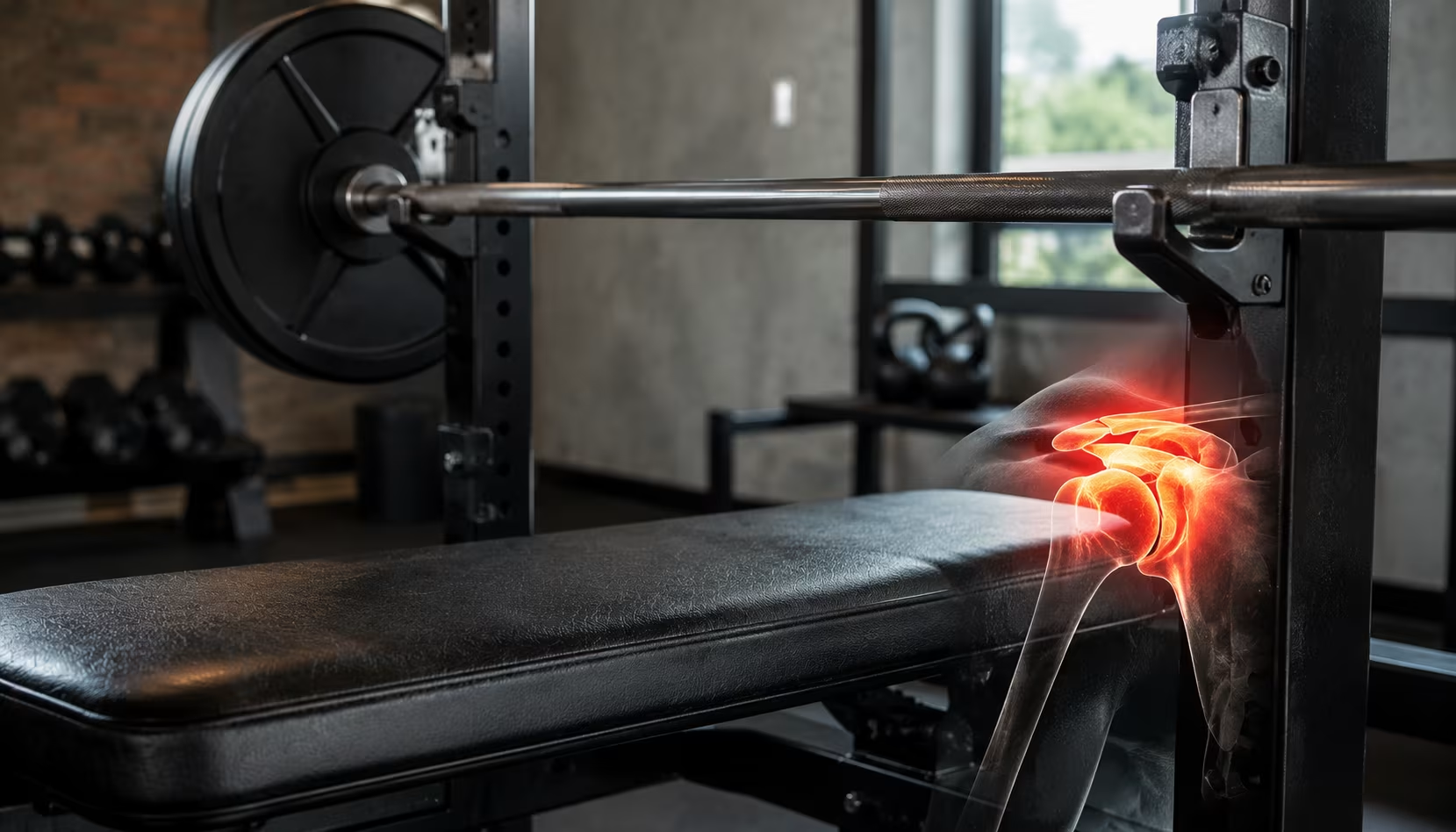
Setup: standard bench press with grip narrowed to shoulder width or slightly inside.
Why it works: the narrower grip reduces stress on the shoulders by keeping elbows tucked closer to the body. Emphasis shifts to the triceps and serratus, with less anterior deltoid involvement.
Programming: 3–4 sets of 6–10 reps. Often used as a secondary press after a primary chest exercise.
Common mistakes: gripping too narrow (which stresses wrists), flaring elbows during the lift (defeats the purpose).
Incline Press at 30 Degrees
A moderately inclined bench (around 30 degrees) shifts more emphasis to the upper chest and front deltoid, but the angle change also alters the shoulder loading pattern.
Setup: bench inclined to 30 degrees (some benches allow specific adjustment; "halfway between flat and full upright" is the rough target). Use dumbbells with neutral grip or pronated grip.
Why it works: the angle reduces stress on the AC joint specifically. The neutral hand position option further reduces internal rotation stress.
Programming: 3–4 sets of 8–12 reps with dumbbells; 3–4 sets of 6–10 with barbell.
Note: full incline at 60+ degrees becomes essentially an overhead press, with different shoulder loading. The 30-degree incline is the most shoulder-friendly version.
Push-Up Variations
The push-up is often underrated by experienced lifters but offers excellent chest training with scapular freedom that the bench press lacks.
Setup variations by difficulty:
- Standard push-up: hands shoulder-width, body straight, full range of motion
- Decline push-up: feet elevated, more upper chest emphasis, harder
- Deficit push-up: hands on parallettes or blocks, allowing chest to descend below hand level, deeper range
- Weighted push-up: weighted vest or plate on back, scaling difficulty
- Single-arm push-up: extreme difficulty, useful for advanced trainees
- Ring push-up: stabilization demand, particularly trains shoulder stability
Why they work: the scapulae are free to move during push-ups, distributing load through the shoulder complex differently than bench press. Excellent for serratus anterior development, which protects against shoulder issues.
Programming: vary by ability. 3–4 sets of however many reps the variation allows. For advanced lifters, weighted variations or harder bodyweight variations make push-ups a genuine strength exercise.
Chest-Supported Machine Press
Hammer Strength-style machine presses with the chest supported.
Setup: chest against the pad, handles at chest level, press forward and slightly up.
Why it works: chest support eliminates the need for shoulder stabilization, allowing the chest, triceps, and front deltoid to do the work without stress on the shoulder joint. Fixed path is appropriate here because the load is supported rather than free.
Programming: 3–4 sets of 8–12 reps. Excellent for high volume because of the low stabilization cost.
Limitation: machine availability varies. Not all gyms have quality Hammer Strength presses.
Programming These as Substitutes
For a lifter who needs to substitute the bench press temporarily or permanently, several approaches work:
Direct substitution: drop barbell bench press, add one of the alternatives at similar volume. Easy and works.
Variety rotation: cycle through different alternatives every 4–6 weeks. Floor press one block, neutral-grip dumbbell next, landmine after that. Maintains training variety and avoids overuse of any single pattern.
Layered approach: keep modified bench press (close grip, slight decline, paused) as the strength expression. Add high-volume work from the alternatives (push-ups, dumbbells, machine) for hypertrophy.
The week structure:
- Day 1: heavier compound press (landmine, close-grip, or neutral DB depending on shoulder status)
- Day 2 (4 days later): higher-rep work with alternative (incline DB, machine, push-up variation)
This produces 2 weekly chest/pressing sessions with different stimulus types, supporting both strength and hypertrophy without aggravating the shoulder.
For lifters returning to barbell bench press after rehab, the progression is typically:
- Weeks 1–4: alternatives only, focus on rehab
- Weeks 5–8: alternatives plus modified bench (close-grip, slight decline, paused, light loads)
- Weeks 9–12: gradual return to standard bench press at 60–80% of pre-injury working weights
- Weeks 13+: full return as tolerated
Frequently Asked Questions
Is the barbell bench press bad for shoulders?
Not inherently. But the fixed grip width, fixed bar path, and high loads make barbell bench press the most common cause of pressing-related shoulder issues. For lifters with good shoulder health and reasonable mobility, it's fine. For lifters with chronic shoulder issues or specific anatomical constraints, alternatives often work better.
Do dumbbells build less chest than barbells?
Dumbbells often build more chest per set than barbells because the longer range of motion produces more muscle stretch and the independent path allows better activation. Barbells allow higher absolute loads but the actual hypertrophy stimulus is comparable or favors dumbbells for chest specifically.
What's the most shoulder-friendly chest exercise?
The neutral-grip dumbbell press on a slight incline is the standard answer. The neutral grip reduces internal rotation stress, the dumbbells allow natural movement of the shoulder, and the slight incline shifts some load toward the front deltoid in a more shoulder-friendly position.
Should I do push-ups instead of bench press?
Push-ups train similar movement and develop scapular control that bench press doesn't. They're excellent at any training level: beginners can use them as a primary exercise; advanced lifters can use weighted, deficit, or ring push-ups for genuine difficulty. They complement rather than fully replace bench pressing for most lifters.
Will I lose chest strength if I stop bench pressing?
Strength is specific to the movement pattern, so your bench press number will decline if you don't bench press for several months. But chest muscle size and pushing strength will be maintained or improved with the alternatives below, assuming adequate volume and progression.





0 Comments
Leave a comment
Your email won't be published. Required fields are marked with *.