


The wrist gets ignored in most strength programs. Push-ups, presses, and pulls all load it heavily, but the dedicated work is usually limited to a few stretches before training and the assumption that the wrist will just adapt. For most desk-bound adults who decide to start gymnastics-influenced training or who pick up a serious pressing program after years away, the wrist becomes the limiting factor faster than any other joint. Strong shoulders, strong chest, strong legs, but the wrists can't tolerate the bodyweight or load required to train the rest properly.
The fix isn't complicated, but it does require frequent, consistent work that most people don't have patience for. Wrists adapt slowly. Connective tissue takes weeks longer than muscle to build capacity. A program that skips dedicated wrist prep will plateau at exactly the loads where the wrist's tolerance becomes the bottleneck.
This piece walks through what wrist function requires for the most common training contexts, what to do for prep and ongoing strength, and how to think about timelines.
Wrist Anatomy in Brief
The wrist is eight small bones (the carpals) arranged in two rows, articulating with the forearm bones (radius and ulna) above and the metacarpals (palm bones) below. The complexity is the reason wrist motion is multi-axis and the reason any single move loads multiple structures.
The functional motions:
- Extension (back of hand toward forearm) — about 70–80 degrees in most adults, up to 90+ in trained gymnasts
- Flexion (palm toward forearm) — about 70–80 degrees
- Radial deviation (thumb side) and ulnar deviation (pinky side) — about 20 and 30 degrees respectively
- Pronation and supination — happens at the forearm but transfers to wrist position
For handstand and bench press specifically, extension is the dominant requirement. The hand is on the floor (handstand) or under the bar (bench), the body is above, and the wrist has to extend significantly to position the forearm vertical over the hand.
The musculature involved:
- Wrist flexors on the palm side of the forearm
- Wrist extensors on the back of the forearm
- Smaller intrinsic hand muscles
- The forearm rotators (pronator and supinator)
Most adults under-train all of these. Lifters who train grip get some carryover but rarely train wrist extension directly.
What Handstands Demand
A clean handstand requires:
Wrist extension around 90 degrees
The arm has to be vertical when balanced over the hands. With the forearm vertical and the hand flat on the floor, the wrist is fully extended.
Strength to maintain that extension under bodyweight
The wrist is loaded with the entire bodyweight in handstand. The extensors hold the position; the flexors prevent collapse forward.
Tolerance for the position over time
A handstand might be held for 30 seconds to several minutes. The wrist needs to tolerate sustained loading, not just brief loading.
The ability to make balance corrections through fingers and wrist
Balancing a handstand involves pressure shifts through the hands — pressing into fingers to fall backward, into heel of hand to fall forward. This requires fine motor control and strength through the whole range.
The reason most adults can't hold a handstand isn't shoulder weakness or balance. It's that their wrists can't tolerate 90 degrees of extension under load for any meaningful duration.
What Bench and Press Demand
Bench press and overhead press make different demands:
Wrist alignment over the forearm
The bar should track over the wrist, which should track over the elbow. Misalignment puts shear force across the wrist joint.
Sufficient extension to allow the bar to sit in the heel of the hand
When the bar sits too high (toward the fingers), the wrist bends back excessively and the load transfers to the small bones and tendons inappropriately. The bar should sit lower in the palm, with the wrist held in slight extension rather than bent fully back.
Strength to hold position under heavy load
A 100 kg bench press loads each wrist with 50 kg. The wrist musculature has to maintain alignment without yielding to the load.
Endurance across multiple sets
Five sets of bench press impose cumulative wrist demand. Sets at the end of the workout suffer if wrist endurance is poor.
Pain in bench press typically comes from one of three patterns: wrists bent too far back (bar too high in palm), wrists collapsing inward (poor coordination), or insufficient connective tissue capacity for the load.
Mobility Drills
A baseline mobility set for wrists:
Tabletop wrist extension
On hands and knees, hands flat on the floor under shoulders. Slowly rock forward and back, keeping hands in contact with the floor. Builds active wrist extension through range under partial bodyweight load. 30 seconds of slow rocking.
Reverse tabletop wrist flexion
Same position, but with fingers pointing toward the knees. Most people find this dramatically harder. 30 seconds.
Wrist circles
On knees with hands on floor, slowly draw circles with the wrists — moving the entire hand in a circular pattern while keeping fingers planted. 10 circles each direction.
Prayer stretch
Palms together in front of chest, fingers pointing up. Slowly lower the wrists while keeping palms together, stretching wrist flexors. 30 seconds.
Reverse prayer
Backs of hands together in front of chest, fingers pointing down. Slowly lift wrists while keeping back-of-hand contact. Stretches wrist extensors. 30 seconds.
Forearm fascia drills
Various wrist and finger pulls, twists, and extensions targeting the deep fascia of the forearm. Search "Tom Merrick wrist prep" or "GMB wrist prep" for video versions.
These mobility drills cost a few minutes daily. The pre-training version (3–5 minutes) increases available range immediately. The dedicated daily practice (10–15 minutes) builds lasting mobility over weeks.
Strengthening Work
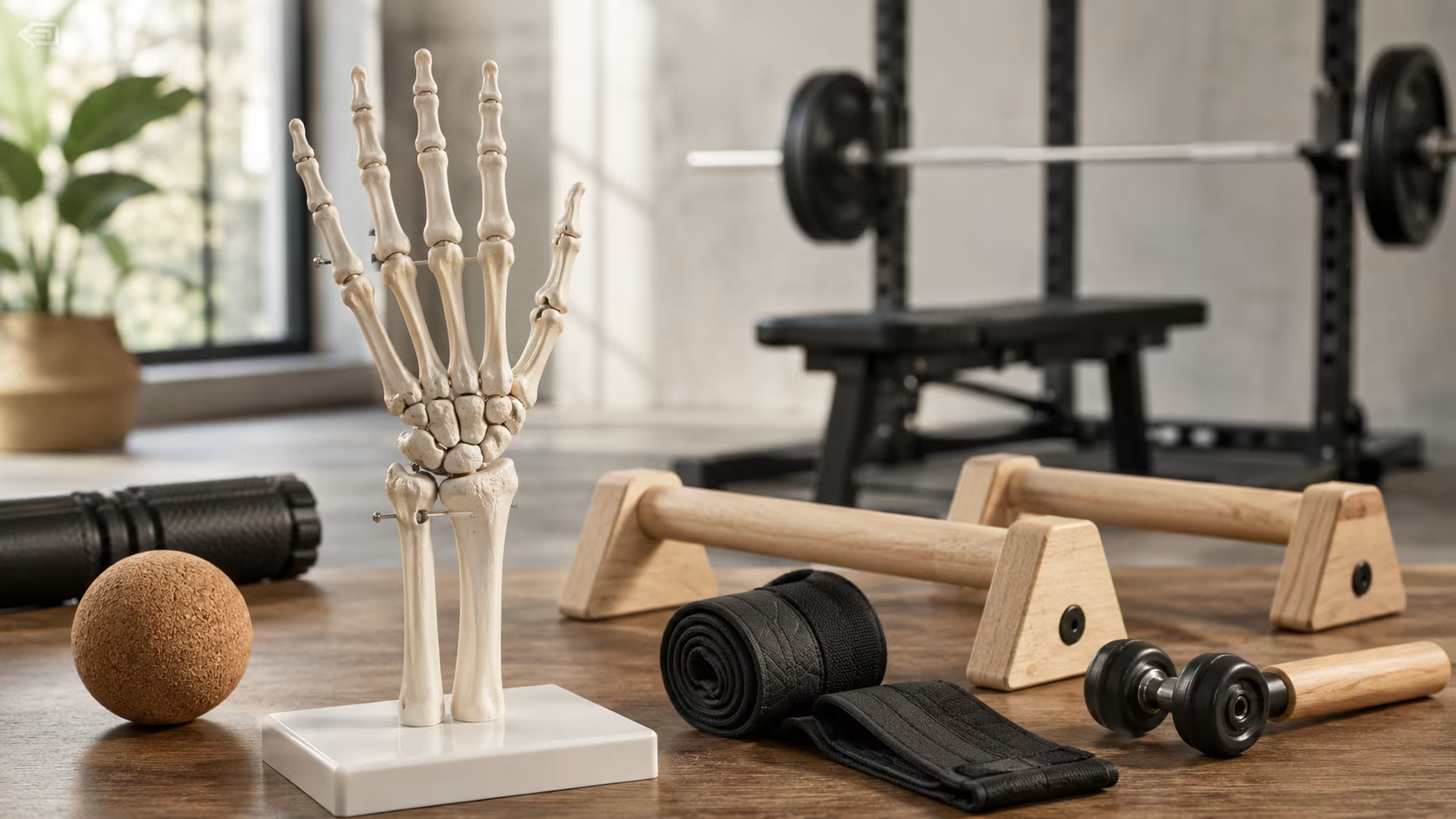
Beyond mobility, the wrist needs direct strengthening:
Wrist curls
Forearm supported on bench or thigh, dumbbell in hand. Lower the weight (wrist extends), curl it up (wrist flexes). 3 sets of 12–15. Both directions — palm up (flexors), palm down (extensors).
Wrist hammer
Hold a hammer or similar long lever with weight only at one end. Rotate the wrist through pronation and supination. The leverage creates challenging load with light absolute weight.
Plate pinches
Hold two weight plates together with fingertips. Pinch grip for time. Builds the strong fingers and thumb work that supports wrist stability.
Wrist roller
A bar with a rope attached and weight at the end. Roll the bar with hands to wind the rope up, raising the weight. Then unwind. Devastating for wrists in the best way. 1–2 sets to completion.
Reverse wrist curls with thumb extension
Wrist extensors with the thumb actively extended (instead of held close to fingers). Targets the smaller extensors. Light weight, 15–20 reps.
Hand grip work
Captains of Crush or similar grippers, deadhang holds, farmer carries. Not wrist-specific but supports wrist function through grip strength.
Wrist push-ups (advanced)
Push-up position on the backs of the hands instead of palms. Massive wrist extension load. Start partial range, build to full ROM over weeks.
A reasonable weekly dose: dedicated wrist strengthening 2–3 sessions per week, 10–15 minutes each. Daily mobility prep separately.
Conditioning the Connective Tissue
Connective tissue — ligaments, tendons, fascia — adapts more slowly than muscle. Wrist work has to be approached with patience for this reason.
The general principle: ligaments and tendons respond well to moderate loads applied frequently with appropriate recovery. They respond poorly to either insufficient loading (no adaptation stimulus) or excessive sudden loading (injury before adaptation).
For wrist conditioning specifically:
Daily exposure
Brief daily wrist prep produces more adaptation than longer infrequent sessions. The frequency matters more than the volume.
Gradual progression
Adding 5% per week to wrist loading is reasonable. Jumping intensity 30–50% week-to-week often produces tendinopathy or capsule irritation.
Multidirectional loading
Train wrist flexion, extension, and rotation. Single-direction work produces imbalanced adaptation.
Eccentric emphasis
Slow eccentric work appears to be particularly useful for tendon health. 3–4 second lowering phases on wrist curls and extensions.
Patience with timeline
8–12 weeks for substantial tendon and ligament adaptation. Some sources suggest up to 6 months for full structural change. The early gains feel like muscle gains; the deeper adaptation takes longer.
Prep Before Heavy Sessions
A specific 3–5 minute wrist prep before any session involving substantial wrist loading:
- 10 wrist circles each direction
- 30 seconds tabletop rocks (palm and reverse)
- 20 wrist curls with light weight or band
- 20 wrist extensions with light weight or band
- 10 prayer stretch holds, 5 seconds each
- 10 reverse prayer holds, 5 seconds each
- Hand opening and closing with deliberate finger spread
This warms up the joint, increases blood flow to the surrounding tissue, and reminds the nervous system that the wrist is being used. The session-level wrist function improves measurably with this brief prep compared to going in cold.
For handstand-focused sessions, add several minutes of supported handstand position (against a wall, against a partner) to load the wrist in the specific position you'll be training. The neural pattern of bodyweight loading at full extension is itself part of the prep.
Wrist Wraps and When to Use Them
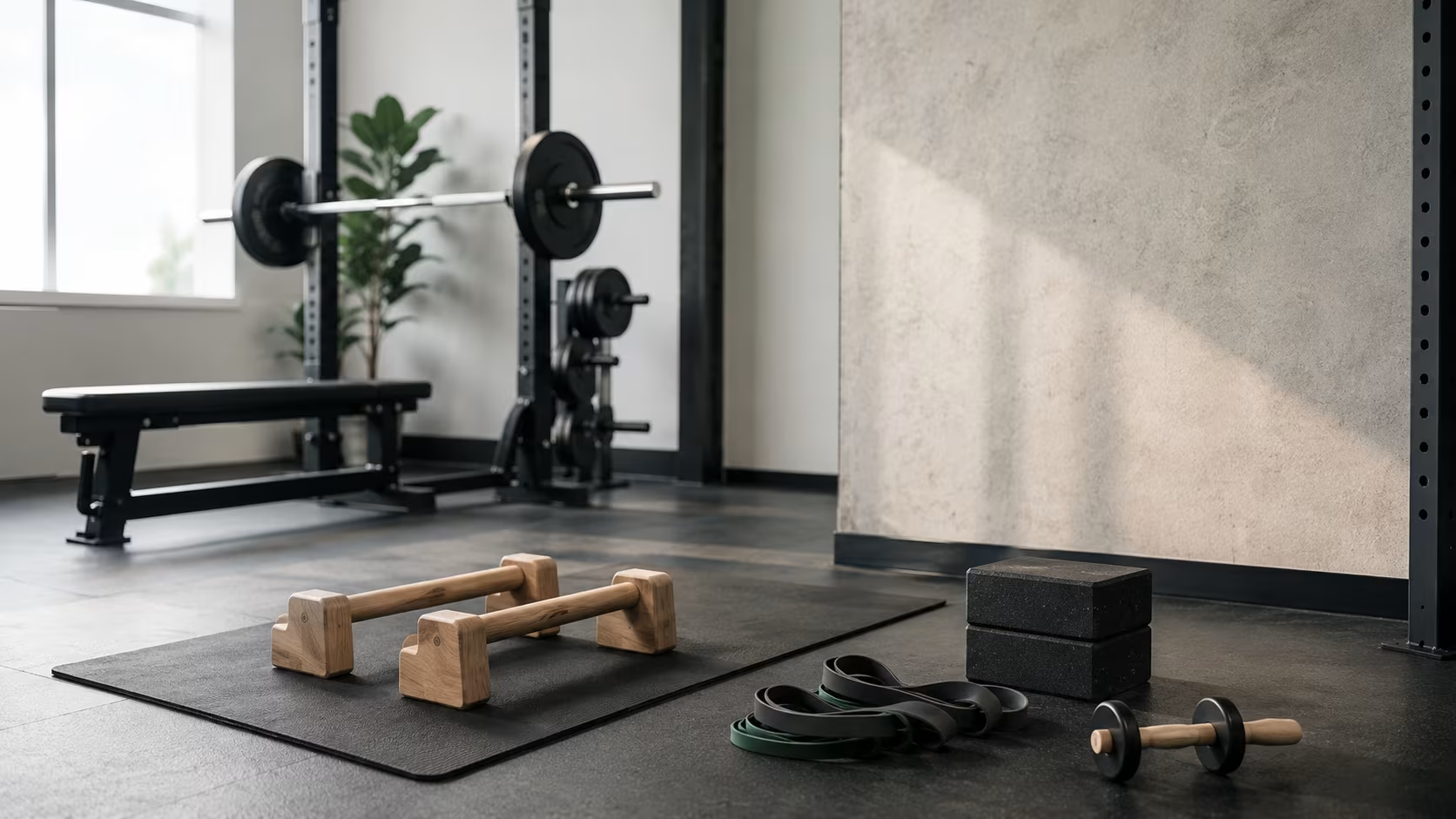
Wrist wraps are a tool, not a substitute for wrist strength. Used appropriately, they support heavy training. Used inappropriately, they delay the development of wrist capacity.
When wraps make sense:
- Heavy bench press at 80%+ of 1RM
- Heavy overhead press at 80%+ of 1RM
- Front squats and clean variations where the bar sits in the rack position
- Olympic lifting where the wrist is loaded in extended positions at high load
- During specific rehab phases where you need to load other tissues without overloading the wrist
When wraps are excessive:
- Light warmup sets
- Bodyweight exercises
- Most accessory and isolation work
- Throughout entire training sessions
- For lifters new to training (delay learning to manage wrist position properly)
How to use them
Wrap around the wrist, not the forearm, with the bottom edge of the wrap at the wrist crease. Tight enough to support; loose enough to allow circulation and some natural motion. Different brands have different stiffness; powerlifting wraps are stiffer than typical wraps and require some practice to use.
The principle: support your training; don't outsource it to equipment. Develop the wrist strength to do most work without wraps, then add them strategically for the heaviest efforts.
When Wrist Pain Means More Than Mobility
A few patterns where wrist pain isn't just about mobility or training prep:
TFCC injury
Triangular fibrocartilage complex tear on the pinky side of the wrist. Pain with ulnar deviation, often after a fall on outstretched hand or chronic stress in gymnasts. Imaging diagnoses; conservative treatment first, surgery for persistent cases.
Carpal tunnel syndrome
Median nerve compression at the wrist. Numbness, tingling, weakness in the thumb-index-middle finger distribution. Often worse at night. Requires medical evaluation; many cases respond to conservative management.
De Quervain's tenosynovitis
Inflammation of tendons at the thumb side of the wrist. Pain with thumb motion and ulnar deviation. Often related to repetitive use (phones, infants). Conservative treatment effective in most cases.
Wrist fracture from fall
Scaphoid fractures particularly easy to miss. Tenderness in the "anatomical snuff box" (the depression at the thumb side of the wrist) after a fall warrants imaging even if pain seems minor — missed scaphoid fractures cause significant long-term problems.
Arthritis
Joint pain that's worse in the morning, improves with movement, returns with overuse. Multiple types; needs evaluation.
Repetitive stress injuries
Tenosynovitis, lateral epicondylitis (tennis elbow) that refers to wrist, various overuse syndromes. Mobility work and load management usually help; persistent cases need professional input.
For pain that persists more than 2–3 weeks despite appropriate modification and prep work, or for pain with neurological features (numbness, weakness), or for pain after specific trauma, get evaluation. The wrist's complexity means self-diagnosis often misses.
Sources
Stadlbauer, T., et al. (2017). Reliability of clinical wrist range of motion measurements. Journal of Wrist Surgery, 6(2), 167–172.
Kim, S. T., et al. (2014). Wrist extension strength and forearm muscle activity during the bench press. Journal of Strength and Conditioning Research, 28(8), 2196–2202.
Magnusson, S. P., Langberg, H., & Kjaer, M. (2010). The pathogenesis of tendinopathy: balancing the response to loading. Nature Reviews Rheumatology, 6(5), 262–268.
Bohm, S., Mersmann, F., & Arampatzis, A. (2015). Human tendon adaptation in response to mechanical loading: a systematic review and meta-analysis of exercise intervention studies on healthy adults. Sports Medicine - Open, 1, 7.
Esplugas, M., et al. (2014). Wrist anatomy: a review of recent advances. Hand Clinics, 30(1), 1–11.
Atroshi, I., et al. (2011). Carpal tunnel syndrome: a systematic review and meta-analysis of randomized controlled trials. BMJ, 343, d3030.
Frequently Asked Questions
Why do my wrists hurt during handstands?
Most wrist pain in handstands comes from inadequate extension range and weak wrist musculature for the bodyweight load. The wrist needs around 90 degrees of extension to balance over the hands cleanly. Many adults can passively reach 80 degrees but can't actively hold weight at end range. The combination of mobility and strength building usually resolves it within 6–10 weeks.
Should I use wrist wraps for bench press?
Conditionally yes for heavy bench and overhead pressing. The wraps stabilize the wrist in extension and prevent the bar from rolling back into the heel of the hand. They aren't a fix for weak wrists; they're equipment for heavy loads. Don't use them as an everyday crutch — that delays building the actual wrist strength you need.
How long does it take to build wrist strength for handstands?
6–12 weeks of consistent daily prep for most adults starting from a typical desk-worker baseline. Strong people often expect faster progress and get frustrated when their wrists don't catch up to their other capacity. Wrist connective tissue adapts more slowly than muscle. The work is consistent and not glamorous.
What's the difference between wrist mobility and wrist strength?
Mobility is the available passive range — how far the wrist can move when something else moves it. Strength is the active capacity through that range — how much force the wrist musculature can produce. Both matter. Mobility without strength produces a wobbly handstand. Strength without mobility produces force at the wrong angle, often into pain.
Why do my wrists pop or click during workouts?
Painless popping and clicking is usually harmless — typically from synovial fluid in the joint or tendons crossing bony landmarks. Persistent painful clicking, especially with a sense of catching or locking, warrants assessment. The wrist has eight carpal bones with complex motion patterns; some clicking is just the joint working.





0 Comments
Leave a comment
Your email won't be published. Required fields are marked with *.