


The compound-versus-isolation debate has tilted decisively toward compounds in the past 15 years of fitness culture, and for good reasons. Compound lifts produce more strength gain per minute of training, build more total muscle, and develop coordinated athleticism that isolation work doesn't transfer to. But the tilt has been overcorrected in places, with some programs eliminating isolation entirely and leaving specific muscle groups undertrained as a result.
This is a guide to using both effectively, with specific decisions about when to prioritize which.
Defining Compound and Isolation
Compound exercises involve multiple joints and multiple muscle groups working together. Examples: squat, deadlift, bench press, overhead press, pull-up, row, lunge, push-up.
Isolation exercises involve a single joint and target a specific muscle group. Examples: biceps curl, triceps extension, lateral raise, leg extension, leg curl, calf raise, face pull.
Machines sit between the two categories. A leg press is technically compound (knee and hip extension) but constrained to a fixed plane. A pec deck isolates the chest. A cable lat pulldown is a compound vertical pull but in a stabilized environment.
The categorization matters less than the functional question: what muscle groups does this exercise train, and what does it require neurologically and mechanically?
What Each Type Does Well
Compounds are best at:
- Building total strength
- Producing systemic anabolic response (testosterone, growth hormone, cortisol response are larger after heavy compounds)
- Training movement patterns that transfer to sport and daily life
- Time-efficient training (multiple muscles per exercise)
- Building structural foundation in beginners
- Allowing high absolute loads, which drives strength adaptation
Isolation exercises are best at:
- Targeted muscle development for specific groups
- Training muscles that don't get adequate stimulus from compounds
- Higher rep ranges with lower joint/spinal stress
- Bodybuilding-style aesthetics work
- Working around injuries (often you can isolate around a problem joint)
- Mind-muscle connection development for stubborn muscle groups
- Older or injury-history lifters who tolerate isolated work better than complex compound patterns
A program built only of compounds neglects specific muscles. A program built only of isolation work neglects coordinated strength and time efficiency. The right answer is both, in proportions that match your goal.
The Time-Efficiency Argument for Compounds
Compounds train multiple muscles per exercise. A heavy squat day trains:
- Quadriceps (primary)
- Glutes (primary)
- Adductors (secondary)
- Hamstrings (stabilizing)
- Erector spinae (stabilizing under load)
- Core (intra-abdominal pressure)
- Upper back (bar support tension)
A heavy deadlift day adds the entire posterior chain plus grip and forearms. Two sessions per week of compound-heavy work covers most major muscle groups with substantial training stimulus.
If training time is limited (3–4 hours per week total), compounds win on every metric: more total muscle stimulated, more strength gain, better hormonal response, fewer exercises to manage.
For most adults with full-time jobs and limited training time, the appropriate split is 80% compound, 20% isolation focused on muscles that need extra work.
The Hypertrophy Argument for Isolation
For pure hypertrophy goals (maximizing muscle mass and aesthetics), isolation work has a real role.
The argument:
- Some muscles don't get adequate stimulus from compounds in their physiological roles (lateral deltoids, biceps, rear deltoids, calves)
- Some muscles need specific high-volume work beyond what compounds deliver (gluteus medius for many people, hamstrings for ACL injury history)
- Stubborn lagging muscles often respond to isolation in ways they don't to compounds
- Lower joint stress allows higher total volume and frequency
Bodybuilding-style training has always heavily integrated isolation work for these reasons. Powerlifting and strength sports rely more on compounds.
For a hypertrophy-focused program, a 50/50 compound-to-isolation split is common. Heavy compound work for 30–45 minutes, focused isolation work for another 30–45 minutes, several times per week.
Specific Muscles That Need Isolation Work
A short list of muscles that get inadequate stimulus from compounds and benefit from direct isolation:
Lateral deltoids (side delts): overhead pressing trains anterior deltoid and triceps primarily; lateral deltoids get minor stimulus. Lateral raises directly target this muscle.
Rear deltoids: typically undertrained even with rowing. Face pulls, reverse flyes, rear delt rows are the dedicated tools.
Biceps: engaged in pulling but not maximally taxed by rowing or pull-ups. Curls (any variation) provide direct stimulus.
Triceps: engaged in pressing but not maximally taxed. The long head of the triceps especially needs targeted work (skull crushers, overhead extensions).
Calves: minimal stimulation from any standard compound. Direct work (standing and seated calf raises) is necessary for development.
Forearms: usually adequate from grip work in pulls and deadlifts, but specific weak-grip lifters benefit from wrist curls and farmer's carries.
Abs and core: heavy bracing in compounds provides some stimulus but most lifters benefit from direct work (hanging leg raises, planks, ab wheel rollouts, Pallof presses).
Gluteus medius (the smaller hip abductors): squats and deadlifts train glute max primarily. The smaller hip stabilizers benefit from lateral band walks, side-lying leg raises, and similar.
For most lifters, 2–4 isolation exercises per week addressing these muscles is enough to fill the gaps without crowding compound work.
Programming Both
Different goals suggest different ratios:
General strength and athleticism: 80% compound, 20% isolation. Sessions focused on heavy main lifts plus 1–2 isolation exercises addressing specific muscle gaps.
Powerlifting: 70–85% compound, 15–30% isolation. The isolation work is supportive, building specific weak points that limit the main lifts.
Hypertrophy / bodybuilding: 50–60% compound, 40–50% isolation. More volume on specific muscle groups, more variation, more pump work.
Beginner: 80–90% compound, 10–20% isolation. Master the main movement patterns first; add isolation work as needed.
Masters athlete (over 50): 60–70% compound, 30–40% isolation. Joint health benefits from including more controlled isolated work.
Rehab or injury return: depends on the injury, but isolation often safer than compounds during early phases.
Common Mistakes
All isolation, no compounds: typical of "machine gym" lifters who never progress to free-weight compounds. Misses time efficiency, neural training, and coordinated strength.
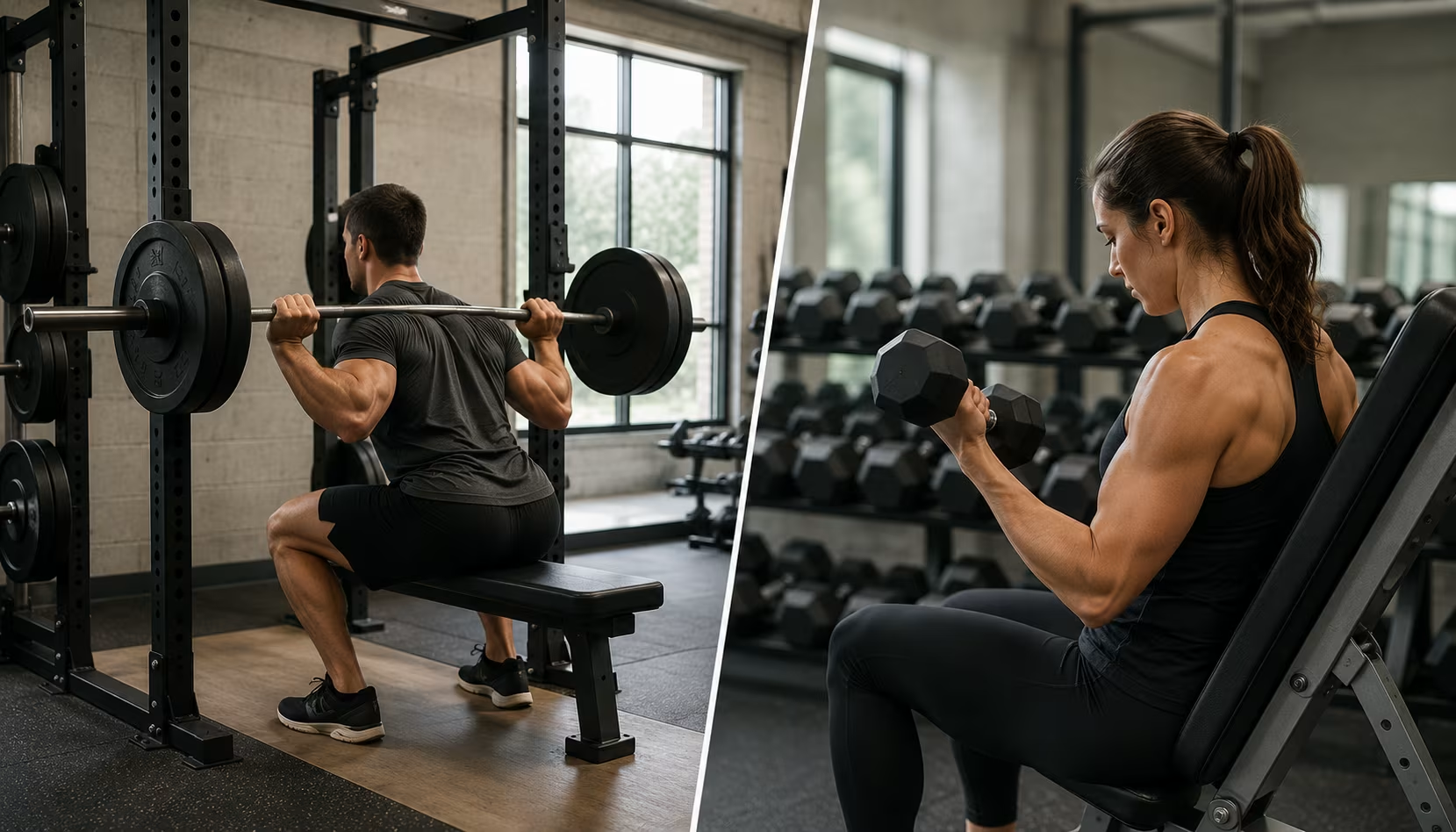
All compounds, no isolation: typical of "strength-only" lifters who develop visible weak points (small calves, lagging arms, undertrained side delts).
Wrong order: doing isolation before compounds in a session reduces compound performance. Compounds first, isolation after.
Too much volume on too many isolation exercises: 5 different bicep variations in one workout is excessive. 2 well-chosen exercises with adequate intensity beat 5 exercises done casually.
Failure on every isolation set: covered in the failure article. Isolation can be taken near failure; you don't have to push every set to limit.
Using machine isolation as compound substitute: machine "compound" alternatives (Smith machine squats, leg press, machine bench) are useful but don't fully replace the stabilizer demands of free-weight versions. Use both rather than substituting.
Skipping isolation when "short on time": the opposite is usually correct: 80% of the strength benefit comes from compounds, but 80% of the aesthetic benefit comes from finishing with targeted isolation. Skip the second exercise of the compound work and keep the isolation if time is tight.
Sample Workout Structures
Strength-focused upper body day (60 minutes):
- Bench press: 5 sets of 5 (heavy)
- Pull-up or row: 4 sets of 8
- Overhead press: 3 sets of 6
- Face pull: 3 sets of 12 (isolation, rear delt)
- Lateral raise: 3 sets of 12 (isolation, side delt)
- Triceps pushdown: 3 sets of 10 (isolation)
Result: 3 heavy compounds, 3 targeted isolations.
Hypertrophy-focused upper body day (75 minutes):
- Bench press: 4 sets of 8
- Incline dumbbell press: 3 sets of 10
- Pull-up: 3 sets of 8
- Seated row: 3 sets of 12
- Lateral raise: 4 sets of 15 (isolation)
- Face pull: 3 sets of 15 (isolation)
- Cable curl: 4 sets of 12 (isolation)
- Triceps overhead extension: 4 sets of 12 (isolation)
Result: 4 compounds, 4 isolations. Hypertrophy emphasis.
Beginner full body (45 minutes):
- Squat: 4 sets of 6
- Bench press: 4 sets of 6
- Bent-over row: 4 sets of 8
- Plank: 3 sets of 30 seconds (core isolation)
- Calf raise: 3 sets of 15 (isolation)
Result: 3 compounds, 2 simple isolation exercises addressing core and calves.
Frequently Asked Questions
Are compound exercises better than isolation exercises?
For overall strength, athletic performance, and time-efficient training, compounds win. For targeted muscle development and weak point training, isolation exercises play a real role. The right ratio depends on the goal: 80% compound / 20% isolation for general strength, 50/50 for hypertrophy focus, 100% compound is rarely optimal for any goal.
Should beginners do isolation exercises?
Beginners should focus most of their training on compound movements where motor learning produces the largest return. Some isolation work is useful for biceps, calves, and abs: these don't get adequate stimulus from compounds alone. But 80%+ of a beginner's training should be compound lifts.
Do isolation exercises help build mass?
Yes, particularly for muscle groups that get less stimulus from compounds (lateral deltoids, biceps, rear deltoids, calves) and for resolving specific lagging body parts. For total muscle mass, the highest-leverage choice is heavy compound work plus targeted isolation for muscles that need it.
How many isolation exercises per workout?
For a typical strength-and-hypertrophy session lasting 60–75 minutes, 2–4 compound exercises followed by 2–4 isolation exercises is a common structure. The exact split depends on training day focus, weekly volume targets, and recovery.
Are machines isolation exercises?
Most machines are between compound and isolation. A leg press involves knee and hip extension simultaneously (compound) but in a fixed-pattern, stabilizer-reduced way. A leg extension is pure knee extension (isolation). The categorization is less important than the function: what muscle groups does the exercise actually train?
Sources and verification
Check current details with these primary or subject-authority sources before acting on the information.





0 Comments
Leave a comment
Your email won't be published. Required fields are marked with *.