

A 2017 Cochrane review (the systematic review standard in evidence-based medicine) examined twelve randomized controlled trials involving 1,080 participants with chronic non-specific lower back pain and concluded that yoga was more effective than no exercise for both pain reduction and functional disability at short and medium-term follow-up. Effect sizes were described as low to moderate but clinically meaningful. The review noted that the evidence did not clearly establish yoga as superior to other forms of exercise (it was comparable to general exercise, not dramatically better) but that it offered advantages in adherence and accessibility for some populations.
This is the most accurate framing of where yoga sits for back pain: it works, it works comparably to other forms of exercise, and it has unique advantages in mind-body integration and breath-movement coordination that may benefit people for whom pain catastrophizing (the tendency to ruminate on and magnify pain) is a significant contributor to disability. The claim that yoga "heals" the spine or "cures" structural pathology is not supported by imaging studies. The evidence that it meaningfully reduces the disability and distress associated with chronic lower back pain is more credible.
What the evidence shows
Chronic non-specific lower back pain (back pain lasting more than twelve weeks without an identifiable structural cause like disc herniation or spondylolisthesis) is the most prevalent form of back pain and accounts for the majority of the disability burden. It's well-established in pain science that the relationship between structural imaging findings (disc degeneration, mild stenosis, facet arthropathy) and pain severity is much weaker than most people assume. A majority of asymptomatic adults over 40 have MRI findings of disc degeneration; many people with severe imaging findings are pain-free while others with minimal findings are severely disabled. Pain is a complex neurological output influenced by tissue state, movement patterns, psychological factors (including fear-avoidance and catastrophizing), and social context.
This makes yoga's combined physical and psychological approach mechanistically appropriate for chronic low back pain in a way it wouldn't be for acute structural injury.
Mechanisms of benefit
Increased tissue extensibility: Yoga systematically stretches the posterior chain (hamstrings, piriformis, erector spinae) and strengthens the core, both of which address common movement limitations in people with lower back pain. A 2016 trial in Annals of Internal Medicine comparing yoga, physical therapy, and education for chronic low back pain found yoga and physical therapy produced comparable reductions in pain and medication use over three months.
Fear-avoidance reduction: People with chronic back pain often have high fear-avoidance beliefs: the conviction that movement will worsen their pain. Yoga, in a careful and supportive environment, provides repeated exposure to controlled movement without the feared catastrophic outcome, reducing avoidance behavior over time.
Central sensitization modulation: Yoga's mindfulness component (breath awareness, deliberate movement, body scanning) has been proposed to reduce central sensitization (the nervous system's learned tendency to amplify pain signals) through top-down regulatory mechanisms, including prefrontal cortex modulation of pain processing. The evidence here is mechanistically plausible but not yet conclusively demonstrated in back pain-specific trials.
Inflammatory markers: Some trials have found reductions in inflammatory cytokines (particularly IL-6 and TNF-alpha) following yoga programs in chronic pain populations, consistent with yoga's broader effects on stress-related inflammation.
What's less clear
Whether yoga works better than general physical therapy, which poses are essential versus optional, and what minimum dose is needed. The trials use very different yoga protocols, making specific recommendations difficult.
How to apply it
This framework is designed for people with chronic non-specific lower back pain and general back stiffness. It is not designed for acute disc herniation, spondylolisthesis, or inflammatory spinal conditions, which require physician and physical therapist guidance first.
Postures with the best evidence for lower back pain
1. Cat-cow (Marjaryasana-Bitilasana): 8–10 slow cycles On hands and knees, alternate between spinal flexion (cat: round the back, head down) and extension (cow: drop the belly, lift the head). The rhythmic movement mobilizes the lumbar facet joints and stretches the paraspinal muscles. Coordinate with breath: exhale into cat, inhale into cow.
2. Supine knee-to-chest (Apanasana): 2 × 60 seconds per side Lie on your back and hug one knee toward the chest, keeping the other leg long. This gently stretches the posterior hip muscles and decompresses the lumbar facet joints on the side being stretched. Keep the lower back relaxed rather than pressing it flat aggressively.
3. Supine spinal twist: 2 × 60 seconds per side Lie on your back, bend one knee and let it fall to the opposite side while the arm extends out. Gentle rotation of the lumbar spine. Avoid forcing range of motion; let gravity do the work. Not appropriate for acute disc herniation where rotation may aggravate symptoms.
4. Reclined pigeon (Supta Kapotasana): 2 × 90 seconds per side Lie on your back, cross one ankle over the opposite knee (figure-four position), and draw both legs toward the chest. This stretches the piriformis, a muscle that when tight can mimic or contribute to lower back pain. Lower back stays on the floor throughout.
5. Legs-up-the-wall (Viparita Karani): 5–10 minutes Lie on your back with legs elevated against a wall, buttocks close to the wall. This passive inversion reduces lumbar compression, allows the paraspinal muscles to fully relax, and has been reported as highly effective for acute low back flare-ups. One of the most accessible postures for people in significant pain.
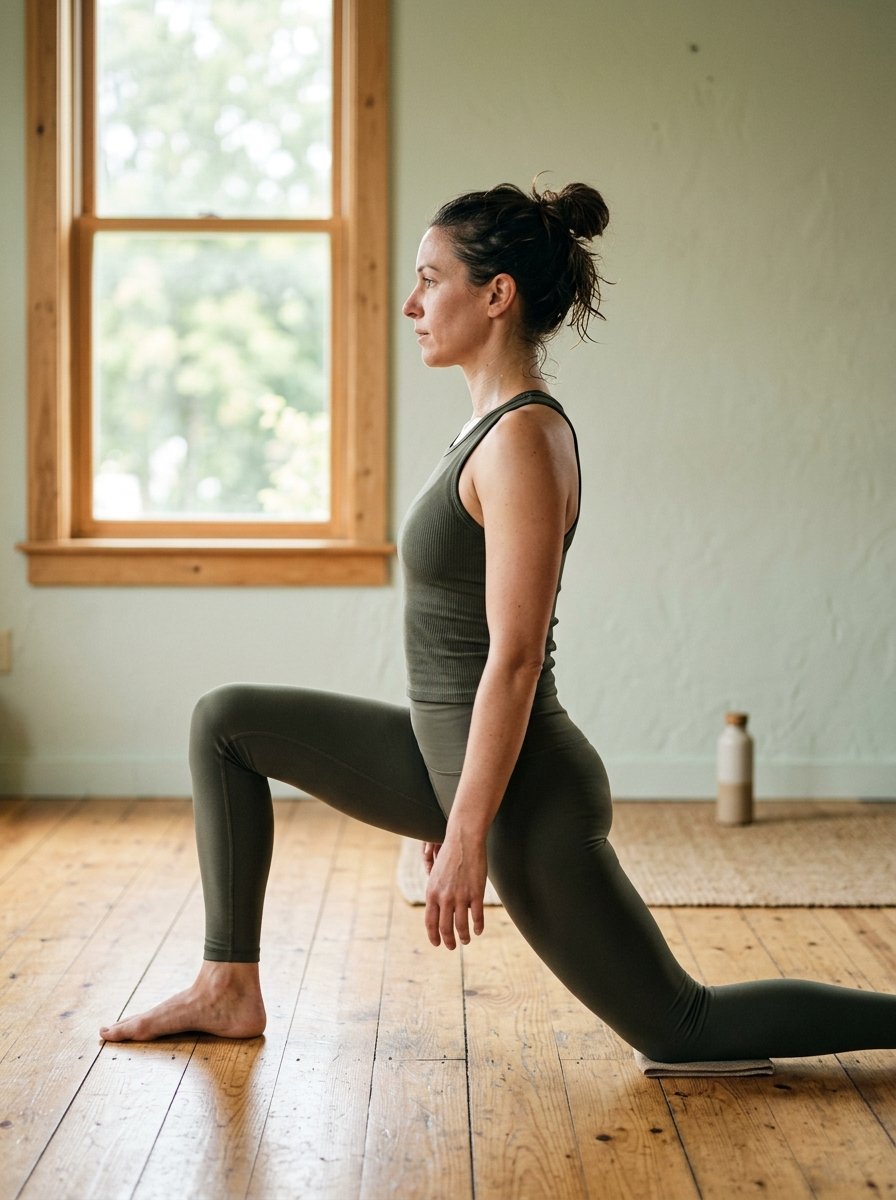
6. Bridge pose: 2 × 12 reps or 2 × 30-second holds Lies on back, knees bent, drive hips up by squeezing glutes. The glute and hamstring engagement inhibits hip flexor overactivation and builds posterior chain strength. Keep the lumbar spine in neutral; avoid excessively arching at the top.
Beginner version
Start with cat-cow, supine knee-to-chest, and legs-up-the-wall only. Practice daily for two weeks before adding other postures.
Progression
Add the remaining postures over weeks three to four. At week six, consider joining a beginner yoga class where the instructor knows you have back pain; in-person feedback is significantly more valuable for posture-specific modifications than video practice.
Common mistakes
Practicing advanced forward folds with straight-leg spinal flexion
Seated forward fold (Paschimottanasana) with straight legs loads the lumbar discs significantly, particularly if hamstrings are tight and the pelvis is unable to anteriorly tilt. Bend the knees until posterior chain flexibility allows a neutral spine throughout the forward fold.
Attempting unsupported headstands or inversions with back pain
Headstands and shoulder stands require axial spinal loading that is inappropriate for people with active back pain or disc pathology. Legs-up-the-wall is the appropriate inversion for this population.
3. Using pain as the "success signal." The principle of "no pain, no gain" is directly counterproductive for chronic back pain management. Postures should produce gentle tension and stretch, not pain. Pain during yoga practice should trigger modification, not endurance.
Practicing once a week and expecting meaningful change
The trials that show yoga's effectiveness for back pain typically use two to three sessions per week as the minimum dose. Once-weekly yoga is better than nothing but unlikely to produce meaningful pain reduction on its own.
Continuing poses that consistently aggravate symptoms
Some poses (deep backbends, spinal twists, certain hip openers) reliably aggravate some people's back pain. If a posture consistently produces pain that lasts more than an hour after practice, modify or avoid it. The system of yoga contains enough postures that omitting problematic ones is always possible.
When to see a professional
Do not use yoga as your primary management tool without medical evaluation if: back pain radiates into the leg, particularly below the knee (this may indicate nerve root involvement requiring imaging); lower back pain is accompanied by bowel or bladder dysfunction (a red flag for cauda equina syndrome requiring immediate evaluation); you've had previous spinal surgery; or back pain followed a significant traumatic mechanism (fall, accident). These situations require physician assessment before exercise of any kind.
Frequently asked questions
Which yoga style is best for lower back pain?
Hatha, Iyengar, and gentle therapeutic yoga styles are most appropriate: slower-paced, alignment-focused, with instructor modifications common. Iyengar yoga has a specific tradition of therapeutic back modification and several clinical trials have used it as the study protocol. Hot yoga carries dehydration risk and the heated environment can mask pain signals that would otherwise indicate problematic poses. Avoid vigorous vinyasa flow if back pain is active and acute.
Is yoga safe with a herniated lumbar disc?
It depends on the level, severity, and specific symptoms of the herniation. Some poses (loaded spinal flexion, deep twists at the lumbar level) are contraindicated for disc herniation and can worsen symptoms. Gentle yoga with an experienced instructor who knows your history, or therapeutic yoga conducted by a physical therapist trained in yoga, is the appropriate approach. Do not self-navigate yoga with a known herniation without professional guidance and imaging context.
Can yoga prevent future back pain episodes?
The evidence suggests yes. People with chronic lower back pain who complete yoga programs show longer pain-free intervals and reduced medication use at six and twelve-month follow-up compared to control groups. The protective mechanism is likely a combination of maintained tissue extensibility, stronger spinal stabilizers, and reduced fear-avoidance beliefs about movement. Maintaining two to three sessions per week ongoing appears necessary to sustain the benefit; the effect diminishes after stopping.
How long before yoga reduces my back pain?
Clinical trials using yoga for chronic lower back pain typically used 12-week programs at two to three sessions per week. Many participants reported meaningful pain improvement by weeks six to eight. Individual response varies; people with high fear-avoidance or pain catastrophizing may take longer to respond and benefit from adding pain education (CBT-based) alongside the yoga practice. Consistency matters more than session length: short daily practice outperforms weekly longer sessions for chronic pain management.





0 Comments
Leave a comment
Your email won't be published. Required fields are marked with *.