

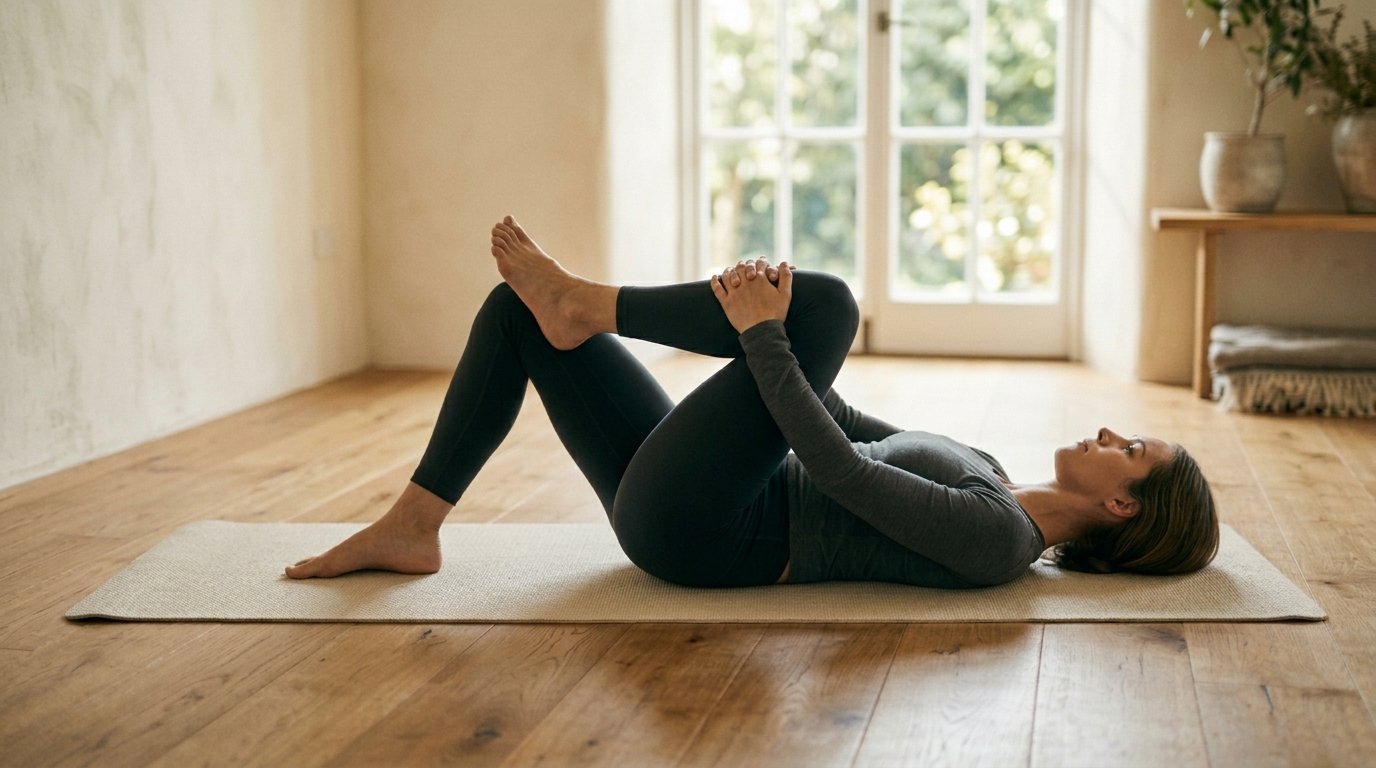
If you work at a desk and have ever had lower back pain or been evaluated by a physical therapist, there's a reasonable chance someone has told you that your hip flexors are tight. This is likely true, and the explanation is usually incomplete. "Tight hip flexors" as a diagnosis tells you approximately where the problem is but very little about what's actually happening or what to do about it, which is why the standard intervention (prolonged passive stretching of the hip flexors) often doesn't produce lasting change.
The hip flexors are a group of muscles that bring the thigh toward the torso: primarily the iliopsoas (iliacus + psoas major), the rectus femoris (one of the four quadriceps), and the tensor fasciae latae. The iliopsoas is the largest and most clinically significant: the psoas major originates on the lumbar vertebrae (L1–L5) and the iliacus originates on the inner surface of the pelvis, and they join to attach to the lesser trochanter of the femur. This origin on the lumbar spine means that a shortened or overactive iliopsoas directly affects lumbar spine position and lower back mechanics.
The problem with a prolonged sedentary position isn't only that the hip flexors shorten: it's that the muscles on the opposite side of the joint (particularly the gluteus maximus and the deep hip external rotators) simultaneously weaken from disuse, creating a muscular imbalance that reinforces the anterior pelvic tilt and lumbar extension typically associated with "tight hips."
What the evidence shows
The Thomas test (a clinical examination technique in which the examiner assesses whether the non-tested hip can extend to neutral while the other hip is flexed against the chest) is the standard assessment for hip flexor shortening. Genuine hip flexor shortening (the tested hip cannot extend to neutral) responds to stretching. But many people who complain of hip flexor tightness don't have meaningful shortening on the Thomas test: their hip flexors are at relatively normal length but are neurologically overactive or simply perceived as tight due to adjacent muscle weakness.
A 2018 systematic review in Physical Therapy found that isolated hip flexor stretching without accompanying hip extensor strengthening produced short-term improvements in hip range of motion but limited carryover to function and pain reduction. The programs that combined hip flexor mobility work with hip extensor and deep abdominal strengthening produced more durable functional improvements. This makes physiological sense: restoring length to a shortened muscle without restoring the strength of its antagonist doesn't change the underlying force balance that created the position in the first place.
The psoas's attachment to the lumbar vertebrae also gives it a role in lumbar stabilization. In people with chronic lower back pain, the psoas frequently shows abnormal recruitment patterns: sometimes underactivating during functional tasks, sometimes hyperactivating as a compensatory stabilizer. This means that psoas-related lower back pain isn't always about length: sometimes the psoas is doing too much stabilizing work because the deeper core muscles (specifically the transversus abdominis and multifidus) are underperforming. Treating this with stretching alone addresses the symptom not the source.
How to apply it
This routine addresses hip flexor tightness from two angles: restoring length where genuinely shortened, and strengthening the antagonists and deep stabilizers that allow the hip flexors to release.
Daily 10-minute routine
1. 90/90 hip flexor stretch with posterior pelvic tilt: 2 × 60 seconds per side Kneel in a lunge position with the front knee at 90° and the back knee on the floor. Rather than simply lunging forward, actively perform a posterior pelvic tilt: tuck the pelvis under, engaging the glutes and deep abdominals. This creates genuine hip flexor stretch by extending the hip while the pelvis is in neutral or slight posterior tilt, rather than compensating with lumbar extension (which is what most people do when they "stretch" their hip flexors). You should feel this at the front of the back hip, not in the lower back.
2. Dead bug: 3 × 8 reps per side Lie on your back with arms reaching toward the ceiling and knees bent to 90° in the air. Slowly lower one arm overhead and the opposite leg toward the floor, keeping the lower back pressed into the ground (no arch). Return and switch. This trains the deep stabilizing muscles (transversus abdominis, multifidus) that, when weak, force the psoas to overwork. It's also a direct neural inhibition of the hip flexors through reciprocal inhibition.
3. Glute bridge: 3 × 12 reps (or single-leg bridge 2 × 8 per side) Lie on your back, feet hip-width apart on the floor, knees bent. Drive hips to the ceiling by squeezing the glutes, hold one second at top, lower slowly. This is the most direct strengthening of the gluteus maximus, the primary antagonist of the hip flexors and the muscle most commonly weakened by prolonged sitting.
4. Couch stretch: 2 × 60 seconds per side The rectus femoris (which crosses both hip and knee) is best stretched with the knee also bent. Kneel facing away from a couch or wall, rear shin resting on the couch seat, front knee at 90°. This position creates genuine stretch of the rectus femoris that the lunge stretch doesn't produce. Maintain the posterior pelvic tilt throughout.
5. Hip 90/90 switches: 2 × 5 per side Sit on the floor with knees bent at 90°, one in front and one to the side. Rotate the knees to the opposite side while keeping the pelvis level and not using the hands to rotate. This is a hip external and internal rotation mobility drill. Perform slowly and stop where you feel resistance; don't force range of motion.
Beginner version
Start with exercises 1 (modified lunge stretch) and 3 (glute bridge) only. Practice daily for two weeks before adding the others.
Progression
Once the routine is established, add resistance to the glute bridge (a barbell, dumbbell, or resistance band around the thighs). Progress dead bug to a stability ball variation. Add single-leg variations to increase the challenge.
Common mistakes
Stretching without strengthening
Stretching a hip flexor that is overactive because the antagonists are weak produces temporary relief at best. The hip flexors return to their default pattern because the underlying force balance hasn't changed.
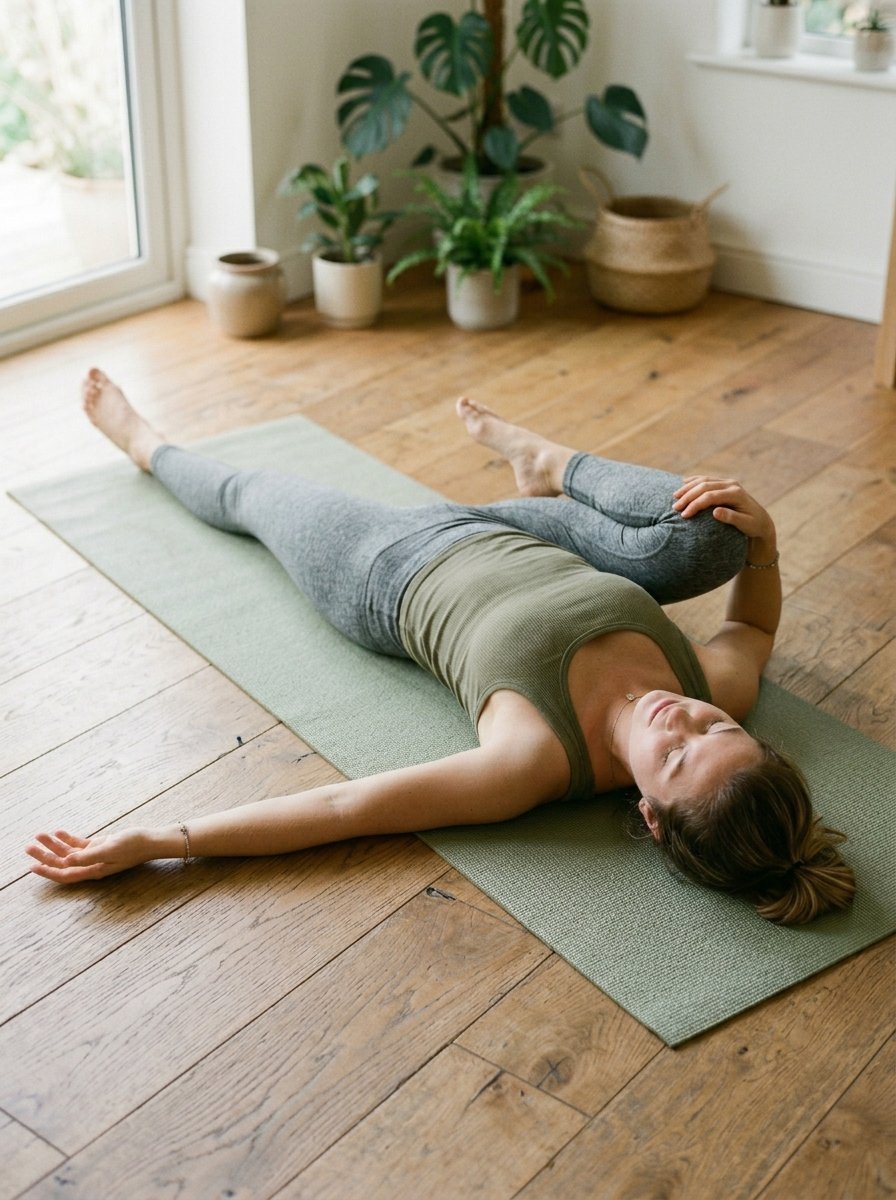
Allowing lumbar extension during hip flexor stretches
The most common error in the lunge stretch: driving the pelvis forward and allowing the lower back to arch, which reduces the actual hip flexor stretch and adds lumbar compression. Cue the posterior pelvic tilt actively.
Stretching aggressively into pain
The hip flexor region includes the hip joint capsule and bursae that can be irritated by aggressive stretching. Mild tension is appropriate; pain into the groin or anterior hip is a reason to stop and get assessed.
Neglecting frequency in favor of duration
Ten minutes daily produces better outcomes for mobility than one hour weekly, because positional adaptation is driven by cumulative time at length, not by single extended sessions.
Diagnosing hip flexor tightness as the source of all lower back pain
Lower back pain has many causes. Hip flexor involvement is common but not universal. If back pain is severe, persistent, associated with radiating leg symptoms, or not improving with these interventions after four to six weeks, seek evaluation.
When to see a professional
Consult a physical therapist or sports medicine physician if: lower back pain is severe (7/10 or above), persistent beyond four weeks, or accompanied by radiating leg pain, numbness, or tingling (which may indicate disc involvement); if hip pain involves groin or anterior thigh pain with weight-bearing (hip impingement or labral pathology warrants imaging); or if a specific activity or movement is consistently producing sharp pain. Self-directed mobility work is appropriate for mild, chronic, functional tightness; it's not appropriate as the primary treatment for structural or acute pathology.
Frequently asked questions
How long before I see improvement in hip mobility?
Consistent daily practice typically produces noticeable improvement in hip extension range of motion within two to four weeks. The lower back tension often associated with hip flexor tightness frequently improves within one to two weeks of daily practice, which can be an early motivating indicator. Full restoration of genuinely shortened hip flexors (where real structural shortening is present) typically takes eight to twelve weeks of consistent mobility and strengthening work.
Is yoga sufficient for hip flexor mobility?
Yoga provides meaningful hip flexor stretching and is a good complement to this routine. It's typically less systematic about the strengthening component, particularly the deep stabilizer and glute strengthening, that produces durable change. Low lunge, pigeon, and warrior series all address hip flexor length effectively. Adding the dead bug and glute bridge exercises from this routine to a yoga practice covers both the length and strength dimensions more completely than stretching alone.
Should I use a foam roller on my hip flexors?
Brief foam rolling of the tensor fasciae latae (outer hip) is a reasonable warm-up before mobility work and may reduce the neural guarding that limits stretch depth. The iliopsoas (the primary hip flexor) is a deep muscle inaccessible to meaningful foam rolling pressure; direct iliopsoas release requires a trained manual therapist. Foam rolling as preparation before this routine has plausible benefit; as a substitute for strengthening, it doesn't produce lasting change.
Can I do this routine with a known disc herniation?
Some elements (the dead bug, done correctly) are commonly used in physical therapy for disc herniation and are generally safe. Others, particularly the couch stretch's lumbar position, may be contraindicated depending on the herniation level and type. Don't apply this routine to a known disc injury without assessment. A physical therapist can evaluate your specific situation and modify the routine appropriately.
Sources and verification
Check current details with these primary or subject-authority sources before acting on the information.




0 Comments
Leave a comment
Your email won't be published. Required fields are marked with *.