


The English word "meditation" is doing too much work. Used in a single sentence, it can refer to twenty-second visualizations from an app, eight-week MBSR programs at hospitals, Tibetan retreats lasting months, Christian contemplative prayer, transcendental meditation, breath-focused practices, body scans, loving-kindness practices, and several flavors of guided imagery. These are not the same thing. They train different mental skills, produce different effects, and have different evidence behind them.
Sorting them out is useful before you start, useful after you start, and useful if you've been practicing for years without quite knowing what you've been doing. Here's a non-mystical map of the major types of meditation, what each one is training, and what the research says.
Two main families: concentration and open awareness
The traditional Buddhist categorization, which has held up reasonably well in modern research frameworks, divides meditation into two broad families.
Concentration practices (samatha) train the mind to hold attention on a single object — the breath, a sound, an image, a sensation. The work is to keep returning attention to the chosen object when it wanders. Over time, the mind becomes able to sustain attention for longer periods with less effort.
Open awareness practices (vipassana, mindfulness) train the mind to observe whatever arises in experience without latching onto any particular content. The attention is broader, the orientation is more receptive, and the work is to maintain the meta-awareness while content flows through.
Most contemplative traditions use both — concentration practices to stabilize the mind, then open awareness practices once stability is established. Modern Western "mindfulness meditation," as taught in clinical settings, tends to blend the two but lean toward open awareness.
A third family worth distinguishing: constructive practices, which deliberately cultivate specific mental states like compassion, gratitude, or equanimity through directed reflection or imagery. Loving-kindness meditation is the most-studied of these.
These categorizations matter because the underlying mental skills trained are different, the immediate effects are different, and the long-term changes — including measurable brain changes — appear to differ across categories.
Focused attention meditation (Samatha)
Focused attention is the simplest meditation to describe and the foundation for most others. The instructions:
- Sit comfortably with the spine upright but not rigid.
- Choose an object of attention — most commonly the sensation of breath at the nostrils or in the belly.
- Rest attention gently on the object.
- When the mind wanders — which it will, repeatedly — notice that it has wandered and return attention to the object.
- Continue for the chosen duration.
That's the whole instruction. Everything else is variation, optimization, and recovery from common errors.
What this trains: the ability to sustain voluntary attention, to notice when attention has wandered, and to return without judgment. These are real mental skills, measurable in lab tasks, and they transfer to other domains of life. People who practice focused attention meditation regularly show improvements in attention regulation, working memory, and the ability to maintain focus under distracting conditions.
The common errors:
Trying too hard
Focused attention is a soft, sustained orientation, not a tight grip. White-knuckle concentration produces tension that interferes with sustained practice. The instruction "place attention on the breath" should feel like resting attention there, not forcing.
Getting frustrated by mind-wandering
The mind wanders. This is what minds do. Each return to the object is the practice; without the wandering there would be nothing to return from. People who quit meditation in the first two weeks often quit because they think the wandering means they're bad at it.
Confusing relaxation with meditation
Focused attention can produce relaxation as a side effect, but the goal is attention training, not relaxation. If you fall asleep frequently in practice, you're either too tired or you're approaching it as a relaxation exercise.
Good starting dose: 10 minutes a day for two weeks, building to 20 minutes a day for at least 8 weeks.
Open monitoring (Vipassana, mindfulness)
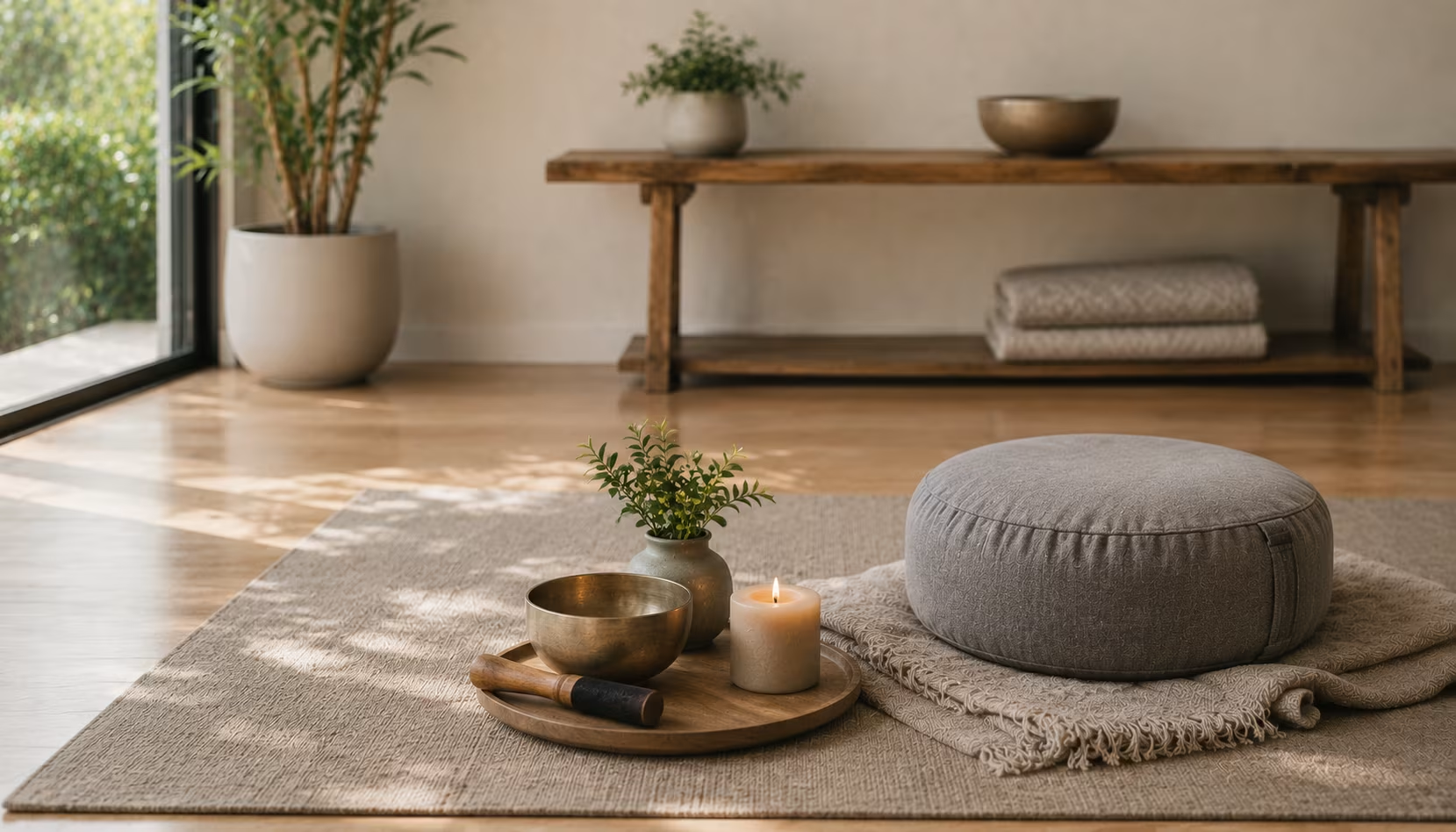
Open monitoring practice trains a different skill: the capacity to observe the contents of experience without identifying with them or getting carried away by them.
The instructions are subtler. Sit comfortably. Allow attention to be broad and receptive. Notice whatever arises — thoughts, sensations, emotions, sounds — without picking and choosing. When you notice you've become caught up in some content, gently let it pass and return to broader awareness.
Modern mindfulness meditation, as taught in MBSR (Mindfulness-Based Stress Reduction) and its many variants, is primarily open monitoring practice with some concentration scaffolding. The Jon Kabat-Zinn definition — "paying attention, on purpose, in the present moment, non-judgmentally" — describes the open monitoring orientation.
What this trains: the meta-awareness that allows you to notice mental states as they arise without being entirely subject to them. This is the skill underneath the popular claim that meditation helps with emotional regulation. The point is not that meditators stop having difficult emotions; it's that they develop the capacity to notice the emotion arising and choose what to do with it, rather than being swept along.
The research on open monitoring practices is the largest in the meditation literature. MBSR has been studied in dozens of conditions — chronic pain, anxiety disorders, depression recurrence, sleep, stress in healthcare workers, attention problems, and on. The effect sizes are generally moderate, the evidence base is strong, and the practice has been adopted as a clinical intervention in many settings.
For most people new to meditation today, an 8-week MBSR-style program is a defensible starting point. The structured curriculum gives a framework, the group setting provides social support, and the protocol has the most evidence behind it of any meditation approach in clinical settings.
Loving-kindness and compassion practices
Loving-kindness meditation (metta in Pali, maitri in Sanskrit) is a constructive practice that deliberately cultivates feelings of warmth, well-wishing, and connection toward self and others.
The classic structure: sit comfortably. Begin by directing well-wishing phrases toward yourself: "May I be safe. May I be happy. May I be healthy. May I live with ease." Sustain the warm intention along with the phrases. After some time, extend the same wishes toward a beloved person, then a neutral person, then a difficult person, and finally all beings.
The practice has a more recent research base than mindfulness but a substantial one. Studies by Barbara Fredrickson and others have shown that regular loving-kindness practice increases positive emotions, improves social connection, reduces implicit bias, and produces measurable changes in regions of the brain associated with empathy and emotional processing.
For people working on relationships, social anxiety, self-criticism, or empathy capacity, loving-kindness can be more directly useful than open monitoring. It's also useful as an adjunct to mindfulness practice — the warmer, more expressive orientation balances the more neutral observational stance of mindfulness.
The skeptical concern: the phrases can feel artificial, particularly at the start, and some people find this off-putting. The practical answer is that the artificiality usually fades within a few weeks as the practice deepens. The mental skill being trained is real even when the initial experience feels forced.
Body scan
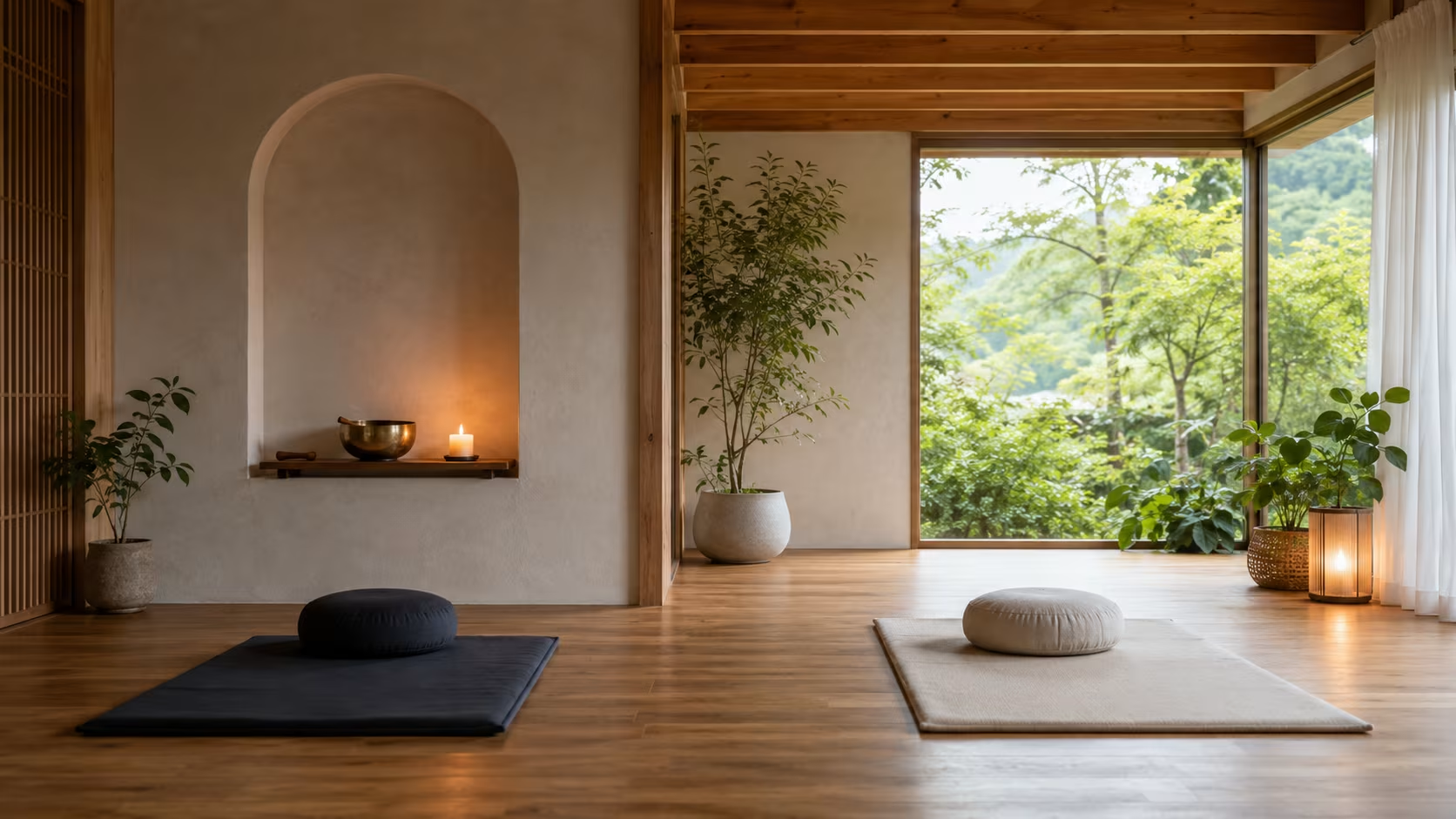
The body scan is a structured awareness practice that systematically moves attention through different parts of the body, observing whatever sensations arise.
The typical structure: lie down or sit comfortably. Begin attention at one end of the body (often the feet) and slowly move it through different regions — feet, lower legs, thighs, pelvis, abdomen, chest, hands, arms, shoulders, neck, face, head. In each region, observe what's present — pressure, temperature, tingling, neutrality — without trying to change anything. The whole scan typically takes 20 to 45 minutes.
The body scan is included in most MBSR programs and is often the first practice taught. It's accessible because it has a clear structure, a obvious object of attention, and produces noticeable physical effects (often deep relaxation, sometimes also surprising contact with held tension or emotion).
What this trains: somatic awareness, the capacity to detect and tolerate physical sensation, and a particular flavor of present-moment attention. It also serves as a meditation that's hard to do badly — the structure carries you through even when your concentration is poor.
For people who find seated meditation difficult, especially those with anxiety or significant physical tension, the body scan is often easier to do consistently. It also has specific applications in chronic pain management, where the gradual cultivation of non-reactive awareness of bodily sensation directly addresses the central nervous system patterns that maintain chronic pain.
Mantra-based practices (TM and others)
Mantra meditation uses repeated mental recitation of a word, phrase, or sound as the object of attention. The most famous version in the West is Transcendental Meditation (TM), founded by Maharishi Mahesh Yogi in the 1950s, but mantra practice is much older and exists in many traditions including Hindu, Buddhist, and Christian contemplative practice.
The basic instruction: sit comfortably, eyes closed. Mentally repeat the chosen mantra, easily and effortlessly. When the mind wanders, gently return to the mantra. Continue for 20 minutes, twice a day in the case of TM.
TM specifically has been studied in cardiovascular outcomes, where it has shown small but reproducible benefits — modest reductions in blood pressure, some evidence of reduced cardiovascular event rates in higher-risk populations. The evidence has critics, and the field's methodological standards have varied, but the basic finding that sustained TM practice produces cardiovascular benefit has held up across multiple meta-analyses.
The mechanism is debated. Some researchers attribute the effects to the specific nature of the practice — the effortless mental orientation it cultivates. Others see it as similar to other quiet sitting practices, with the specific technique being less important than the consistent practice itself.
Mantra-based practices have a few practical advantages. The clear object makes the practice easier to maintain. The non-conceptual nature of the sound (when a meaningless syllable is used) reduces the tendency to get caught up in meaning. The structure allows for short, frequent practice.
For people who find their minds particularly difficult to settle, mantra can be easier than breath-based practice. For people who object to the explicit spiritual framing of TM, similar techniques can be learned from secular teachers using neutral syllables.
Visualization and guided practices
Many of the meditation apps and recordings available today use guided practices — a teacher's voice leading the listener through visualizations, body scans, or structured reflections.
Guided practice has real advantages for beginners. The voice gives the mind something to attend to, the structure carries you through, and you don't have to remember what to do. For people who find self-directed practice impossibly difficult, guided meditation is a reasonable starting point.
The limitation at some point, the goal of meditation is the development of skills that you carry with you, including the skill of practicing without guidance. People who only ever do guided practices tend to plateau at a certain level. The structure that helped initially becomes a crutch that limits depth.
A reasonable progression start with guided practice if you need to. Within a few months, begin including some self-directed sessions. By the end of a year of practice, most sessions should be self-directed, with guided sessions used occasionally for variety or for specific purposes.
Visualization practices are a related category. Specific traditions — Tibetan Buddhist deity practice, certain Christian contemplative practices, modern therapeutic imagery — use detailed visualizations to cultivate specific mental qualities or to work with particular contents. These are advanced practices that benefit from instruction from a qualified teacher; they're not the place to start as a beginner.
What the research shows about each
A brief tour of what's been demonstrated and what hasn't.
Mindfulness-based practices
Strongest evidence base. Moderate benefits for anxiety, depression, chronic pain, sleep, stress in clinical populations. Smaller but reproducible benefits in healthy populations. Some evidence of brain structural changes after extended practice. Effect sizes for clinical conditions are comparable to other established interventions and smaller than medication or full psychotherapy alone, but with favorable side effect profiles.
Loving-kindness practices
Smaller but growing evidence base. Reproducible increases in positive emotion, social connection, and empathy measures. Some evidence of reduced implicit bias and reduced anger reactivity. Effect sizes moderate in well-designed studies.
Focused attention practices
Reproducible improvements in attention regulation and working memory. Less direct evidence on mental health outcomes than mindfulness because it's less commonly studied as a standalone intervention.
Mantra-based practices (especially TM)
Cardiovascular benefits documented. Stress reduction effects similar to other meditation forms. Some methodological controversy in the older studies; more recent work has been more rigorous.
Body scan
Evidence mostly as a component of MBSR rather than standalone. Useful for somatic awareness, sleep, and as an entry into formal practice.
Visualization practices
Less Western research; effects depend heavily on the specific content. Generally not a starting point for evidence-based practice.
The most consistent finding across the literature: dose matters. Effects scale with practice duration over weeks, total practice time per week, and years of cumulative practice. The biggest predictor of benefit isn't which practice you choose but how consistently you do it.
Choosing a practice based on what you want
If your main goal is stress reduction or anxiety management, mindfulness-based practice (MBSR-style) is the default. Start with an 8-week course if accessible; an app-based equivalent is a reasonable second option.
If your main interest is in relationships, empathy, or self-criticism, loving-kindness practice is well-targeted. It can be done alongside or instead of mindfulness.
If you find seated meditation difficult and want an easier entry, start with body scan or guided practices and build toward less-structured practice.
If you have an interest in cardiovascular outcomes specifically and want a structured method with research support, TM is a defensible choice despite its quirks. Less expensive secular mantra options are also available.
If you have a specific religious or contemplative tradition that calls to you, the practices within that tradition will likely be more sustainable than secular alternatives. The tradition provides community, structure, and meaning that abstract practice can lack.
If you're working on chronic pain, MBSR or mindfulness-based pain management (a related protocol) has the most evidence.
If you're interested in the deeper levels of contemplative practice — extended retreats, advanced techniques, the bigger claims about consciousness — work with a teacher in a credible lineage rather than self-directing.
For most beginners, the practical answer is simpler than these distinctions suggest: pick something accessible, do it daily for two months, then evaluate. Most people see benefit from any of the well-established practices done consistently. The variation between practices is real but smaller than the variation between consistent practice and inconsistent practice.
Sources
Lutz, A., Slagter, H. A., Dunne, J. D., & Davidson, R. J. (2008). Attention regulation and monitoring in meditation. Trends in Cognitive Sciences, 12(4), 163–169.
Goyal, M., Singh, S., Sibinga, E. M., Gould, N. F., Rowland-Seymour, A., Sharma, R., Berger, Z., Sleicher, D., Maron, D. D., Shihab, H. M., Ranasinghe, P. D., Linn, S., Saha, S., Bass, E. B., & Haythornthwaite, J. A. (2014). Meditation programs for psychological stress and well-being: A systematic review and meta-analysis. JAMA Internal Medicine, 174(3), 357–368.
Fredrickson, B. L., Cohn, M. A., Coffey, K. A., Pek, J., & Finkel, S. M. (2008). Open hearts build lives: Positive emotions, induced through loving-kindness meditation, build consequential personal resources. Journal of Personality and Social Psychology, 95(5), 1045–1062.
Hölzel, B. K., Carmody, J., Vangel, M., Congleton, C., Yerramsetti, S. M., Gard, T., & Lazar, S. W. (2011). Mindfulness practice leads to increases in regional brain gray matter density. Psychiatry Research: Neuroimaging, 191(1), 36–43.
Brook, R. D., Appel, L. J., Rubenfire, M., Ogedegbe, G., Bisognano, J. D., Elliott, W. J., Fuchs, F. D., Hughes, J. W., Lackland, D. T., Staffileno, B. A., Townsend, R. R., & Rajagopalan, S. (2013). Beyond medications and diet: alternative approaches to lowering blood pressure: a scientific statement from the American Heart Association. Hypertension, 61(6), 1360–1383.
Kabat-Zinn, J. (1990). Full Catastrophe Living: Using the Wisdom of Your Body and Mind to Face Stress, Pain, and Illness. Delacorte.
Salzberg, S. (1995). Lovingkindness: The Revolutionary Art of Happiness. Shambhala.
Frequently Asked Questions
How long until I see results from meditation?
Some effects appear after a single session — small shifts in attention and mood. The trait-level changes that researchers care about — reduced reactivity, improved emotional regulation, structural brain changes — typically appear after 8 weeks of daily practice at 20+ minutes per session.
What's the difference between mindfulness and meditation?
Mindfulness is one specific quality of attention — present-moment awareness without judgment. Meditation is the broader category of formal practices that train various mental skills, of which mindfulness practice is one type. All mindfulness meditation is meditation; not all meditation is mindfulness.
Which type of meditation is best?
Depends entirely on what you're trying to train. For anxiety and emotional regulation, mindfulness practices have the most evidence. For empathy and relationships, loving-kindness. For pure relaxation, body scan or breath-focused. For deep absorption, mantra-based or concentration practices. There's no universal best.
Can I meditate while doing other things, like walking or cooking?
Informal mindfulness practice during daily activities is real and useful. But it's not a complete substitute for formal seated practice. The seated practice builds skills that then transfer to informal awareness. Trying to only practice while doing other things plateaus quickly.





0 Comments
Leave a comment
Your email won't be published. Required fields are marked with *.