


The standard story goes like this: you sit for eight hours, your hip flexors shorten, you develop "tight hips," your lower back compensates, and you end up with the modern office worker's posture and pain. The advice that follows — stretch your hip flexors, do hip openers, foam roll the IT band — has its own genre on YouTube and Instagram. Some of it helps. Some of it works on the wrong mechanism. Most of it is incomplete.
The actual story is more interesting and produces different recommendations. Hip flexors don't measurably shorten over a workday in the way muscles can shorten across years of immobilization. What does happen is more about neurological adaptation, motor pattern degradation, and weakness in the muscles you're not using than tightness in the ones you're holding in flexion. The fix involves stretching as one component, but the other components matter more than stretching alone suggests.
This piece walks through what's actually happening to the hips of people who sit all day, what helps, and which popular interventions are weaker than they look.
What Sitting Actually Does to the Hips
Several things happen to the hips during prolonged sitting:
Hip flexors are in shortened position
The iliopsoas, rectus femoris, and TFL all spend hours in shortened/non-lengthened positions. The muscles aren't actively contracting hard; they're just not at their longer lengths.
Glutes are inactive
The gluteus maximus, the largest muscle in the body, doesn't fire during sitting. Hours of inactivity per day produces measurable adaptations in how the nervous system recruits the muscle. The "amnesic glutes" framing is overstated — the muscle isn't forgetting how to work — but the recruitment patterns do shift.
Hip rotators (deep and superficial) work in limited range
The hip's full available range goes largely unused in sitting. The body conserves what it doesn't use; the available range can decrease over years if not regularly accessed.
Pelvic position shifts
Most chairs and most untrained sitting habits produce posterior pelvic tilt. The pelvis rotates backward, the lumbar spine flattens or rounds, the head comes forward. This pattern, sustained for hours, becomes the default standing pattern too.
Hip extension is essentially zero
The hip never extends past neutral during sitting. Hip extension is a primary function for walking, running, lifting — and it's the position the body practices least if all you do is sit.
What sitting doesn't do, despite the popular language:
It doesn't physically shorten hip flexors in any meaningful structural sense
Muscles can shorten across long periods of immobilization in the same shortened position (months in a cast, for example). Eight hours of daily sitting punctuated by walking, standing, and varied movement doesn't produce that kind of change.
It doesn't cause permanent tightness
The patterns reverse with appropriate intervention. The body's adaptability runs in both directions.
The right framing: sitting produces patterns of disuse, neurological adaptation, and altered recruitment that combine to feel like "tight hips" and produce functional limitations. The intervention has to address those patterns, not just the muscles that feel tight.
The Neurological Adaptation Story
What feels like a tight muscle is often more about neurological tone than tissue length. The nervous system sets a default level of tension in each muscle based on usage patterns, threat perception, and learned habits.
When you stretch a muscle and feel resistance, several things may be happening:
Actual tissue resistance
The connective tissue can't stretch further at the current position. This is what most people assume tightness is. It's often not the primary factor.
Neurological resistance
The muscle's stretch reflex activates, contracting against the stretch. This is what "tight" often actually means — the nervous system pushing back against length the muscle could biomechanically achieve.
Threat-related guarding
Pain history, anxiety, or sympathetic arousal can elevate baseline muscle tone. The muscle feels tight because the nervous system is holding it tighter.
This matters because the intervention differs:
- For actual tissue restriction, prolonged static stretching (60+ seconds, repeated) is appropriate.
- For neurological resistance, the more useful interventions are loaded mobility work that teaches the nervous system new defaults, and contract-relax techniques that reset the stretch reflex.
- For threat-related guarding, addressing the upstream factor (sleep, stress, pain history, breathing) is more useful than more stretching.
Most desk-worker hip "tightness" is neurological resistance more than tissue restriction. Which is why pure static stretching often produces transient relief that doesn't persist — you've momentarily reduced neurological tone, but the underlying adaptation reverts within hours.
Weak Glutes as the Other Side of the Problem
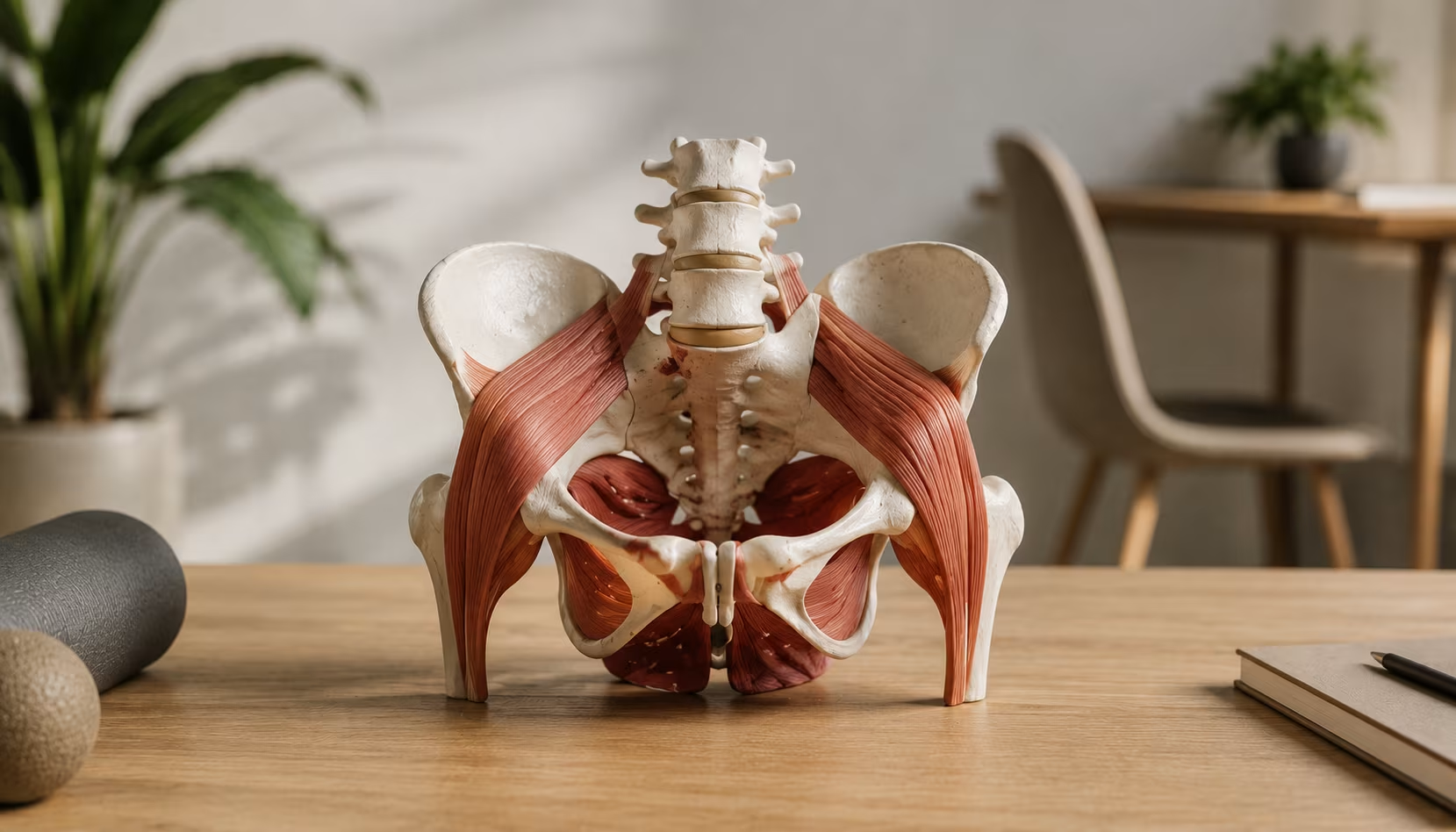
The other half of the equation: the muscles that should oppose hip flexors are typically underused in desk workers. Gluteus maximus, gluteus medius, and the deep hip rotators all atrophy and shift recruitment patterns with chronic sitting.
This matters because hip extension during walking, running, and most loaded movement requires glute activation. When the glutes don't fire properly, other muscles compensate:
- Hamstrings extend the hip instead of glutes (common pattern). Hamstring tightness and recurrent strains follow.
- Lumbar extensors compensate by hyperextending the lumbar spine. Lower back tightness and pain follow.
- The TFL takes over for the glute medius in hip abduction. IT band tightness and lateral knee pain follow.
None of these compensations are fixed by stretching the area that feels tight. The tightness is downstream of the recruitment problem. Strengthening the glutes — and teaching them to fire at the right times during movement — addresses the upstream issue.
What's Worth Stretching
Stretching has a place, just smaller than the popular framing. The targeted stretches that produce the most benefit for desk workers:
Half-kneeling hip flexor stretch. From half-kneeling position (one knee down, other foot flat in front), tuck the pelvis under, squeeze the back glute, gently shift the hips forward. The active glute engagement is part of what makes the stretch work — it inhibits the hip flexor via reciprocal inhibition. Hold 30–60 seconds, repeat each side 2–3 times.
Couch stretch
A more intense version of the above. Back foot elevated on a couch or bench, front leg in lunge. Same active engagement. More demanding on the rectus femoris and TFL. Hold 30–60 seconds.
90/90 hip stretch
Sitting on the floor with one leg bent in front (knee at 90 degrees, lower leg perpendicular to torso) and the other leg bent behind (also 90 degrees). Lean forward over the front leg for stretch. Trains internal rotation of the front hip and external rotation of the back hip. Hold 30–60 seconds each direction.
Pigeon pose (controlled version)
Front leg bent in front of body, back leg extended straight behind. Forward fold over front leg or stay upright. Avoid jamming the front knee; if it hurts, modify with a folded blanket or move to figure-4 supine version.
Figure-4 supine stretch
Lying on back, ankle of one leg crossed over the opposite thigh. Pull the bottom leg toward chest. Stretches glute and external rotators.
Standing hip circles
Active mobility work — large slow circles of the hip in standing position. Not a stretch in the static sense; trains the hip through its full range under control.
Static stretching is most useful as a 5–10 minute daily practice, done warm (after walking, light cardio, or movement). Cold stretching is less effective and slightly riskier. Done at the end of a workday rather than early morning often fits better behaviorally.
What's More Worth Strengthening
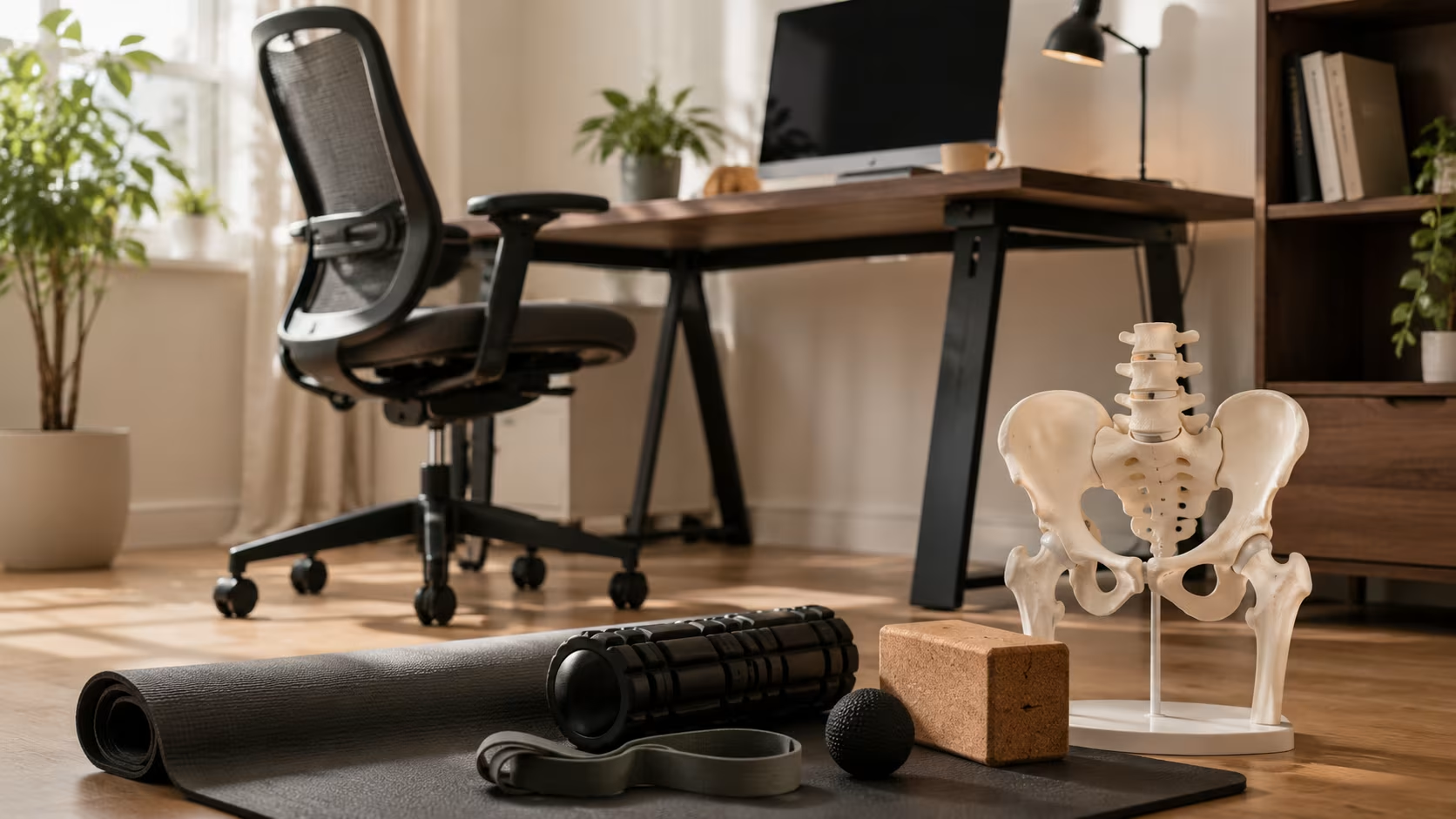
The strengthening side of the equation often produces faster improvement than stretching alone:
Glute bridge progressions
Lying on back, feet flat, lift hips by squeezing glutes. Build to single-leg variations. 3 sets of 10–15 reps, 3–5 times per week.
Hip thrust
Bench-supported version of the glute bridge with weight on the lap (eventually a barbell). The most direct glute exercise available. Train weekly with progressive load.
Banded clamshells and side-lying leg raises
Target glute medius. 3 sets of 12–20 each side.
Lateral band walks
Walking sideways with a resistance band around knees or ankles. Trains gluteus medius dynamically. 3 sets of 10 steps each direction.
Bulgarian split squats
Heavy single-leg work that trains glutes, quadriceps, and stability through full hip range. 3 sets of 8–10 each side.
Romanian deadlifts
Trains hip hinge under load, strengthens glutes and hamstrings through length. 3 sets of 8–12.
Step-ups and reverse lunges
Functional patterns that train hip extension through range.
Two strength sessions per week including some of these exercises does more for desk-worker hip function than five sessions of hip flexor stretching. The strength work also addresses the recruitment patterns that stretching alone doesn't reach.
A Practical Daily Routine
A realistic daily protocol for desk workers, around 15 minutes total:
Morning (5 minutes):
- Cat-cow, 30 seconds
- Hip circles in standing, 30 seconds
- Half-kneeling hip flexor stretch with active glute engagement, 45 seconds each side
- 90/90 hip drill, 30 seconds each side
- Glute bridges, 15 reps
Mid-day (5 minutes, broken into 30-90 second snacks every hour):
- Stand and walk for 2-3 minutes every 30-60 minutes
- Wall-supported hip flexor stretch, 30 seconds each side
- Body weight squats to deep position, 10 reps
- Standing figure-4 stretch, 30 seconds each side
Evening (5 minutes):
- Couch stretch, 60 seconds each side
- Pigeon or supine figure-4, 60 seconds each side
- Foam roll quads and IT band area, 30 seconds each
Weekly strength work (2-3 sessions, 10-15 minutes minimum):
- Hip thrust or glute bridge with weight
- Bulgarian split squat or reverse lunge
- Lateral band walk or banded side-lying abduction
- Romanian deadlift
This isn't elaborate. It addresses the actual problems: limited range usage during the day, weak glutes, neurological adaptation to flexed hip position.
Movement Breaks Through the Workday
Several research findings have converged on the value of brief frequent movement breaks during prolonged sitting:
A 2023 study by Paluch and colleagues found that even short walking breaks (5 minutes every 30 minutes) substantially reduced the cardiovascular and metabolic costs of prolonged sitting compared to sitting uninterrupted. The mechanism likely involves restoring vascular function and signaling pathways that sitting blunts.
Several musculoskeletal benefits also accrue from movement breaks:
- Restored awareness of position before patterns become entrenched
- Brief glute activation through walking that doesn't happen during sitting
- Variability in postural muscle recruitment
- Mental refresh that often improves work output rather than reducing it
Practical implementation:
Pomodoro-style timers
Many productivity apps include timers that prompt breaks. Use them.
Phone calls standing
Phone calls that don't require screen attention can happen during walks or while standing.
Meeting walks
One-on-one meetings can sometimes happen on a walk rather than a conference room.
Standing-only zones
Make your snack and water refill zones standing-required. Each refill becomes a natural break.
Two-minute mobility snacks
A few specific mobility drills done 4-6 times per day total around 10-15 minutes and integrate into transitions rather than feeling like added work.
When Hip Pain Isn't Mobility
A subset of hip pain doesn't respond to mobility work because the underlying issue isn't mobility:
Femoroacetabular impingement (FAI)
Structural bone-shape issues where the femoral head doesn't move freely in the socket. Cam-type, pincer-type, or mixed. Causes characteristic pain patterns and limits range mechanically. Mobility work can help around the structural limit but doesn't change the bone shape. Diagnosis via imaging.
Labral tears
Tear in the cartilaginous rim of the hip socket. Mechanical clicking, deep groin pain, sometimes stuck-feeling positions. Imaging and orthopedic evaluation indicated.
Hip osteoarthritis
Cartilage degeneration. Pain with weight bearing and motion, gradually progressive. Mobility work can help maintain function but doesn't restore cartilage.
Trochanteric bursitis or gluteal tendinopathy
Pain at the lateral hip over the bony prominence. Often confused with "tight hips." Usually requires strengthening (often eccentric loading of gluteus medius) more than stretching, and may need direct treatment.
Pelvic floor referral. Pelvic floor dysfunction can refer pain to the hip and groin. Hip work doesn't address the source.
Lumbar referral
Some hip pain originates in the lumbar spine and refers downward. Spinal sources need spinal evaluation.
If your hip pain has any of these features — sharp catching pain, deep groin pain, mechanical locking, pain that wakes you at night, pain that worsens despite consistent mobility work — get assessment rather than more stretching. A physical therapist or sports medicine physician can sort the categories.
Sources
Page, P. (2012). Current concepts in muscle stretching for exercise and rehabilitation. International Journal of Sports Physical Therapy, 7(1), 109–119.
Paluch, A. E., et al. (2023). Effects of breaks in sitting on cardiometabolic risk and quality of life: a randomised controlled trial. Medicine & Science in Sports & Exercise, 55(8), 1410–1419.
Konrad, A., et al. (2017). The effect of static stretching on body composition: a meta-analysis of randomized controlled trials. Journal of Sports Medicine and Physical Fitness, 57(11), 1462–1472.
Goldenberg, M., et al. (2018). Effects of acute and chronic stretching on pain control. Journal of Pain, 19(8), 882–895.
Behm, D. G., et al. (2016). Acute effects of muscle stretching on physical performance, range of motion, and injury incidence in healthy active individuals: a systematic review. Applied Physiology, Nutrition, and Metabolism, 41(1), 1–11.
Krapf, E. M., et al. (2019). Sitting time and physical activity: associations with type 2 diabetes and cardiovascular disease in adults. European Journal of Applied Physiology, 119(1), 251–262.
Garcia-Hermoso, A., et al. (2020). Muscular strength as a predictor of all-cause mortality in an apparently healthy population: a systematic review and meta-analysis of data from approximately 2 million men and women. Archives of Physical Medicine and Rehabilitation, 101(2), 309–321.
Frequently Asked Questions
Does sitting actually shorten hip flexors?
Not in the way the language implies. The hip flexors don't get shorter from sitting; they spend hours in a flexed position, and the nervous system adapts to that as the default. The 'short' feeling is real but reflects neurological adaptation more than tissue shortening. The implication: stretching alone often doesn't fix what feels like tight hips.
What's the best stretch for tight hips?
The half-kneeling hip flexor stretch (couch stretch variation) and the 90/90 hip rotation drill cover most of what desk workers need. But stretching alone underperforms a routine that combines stretching, strengthening of opposing musculature (glutes especially), and behavioral changes (standing breaks, walking, varied positions). The stretch is one input, not the whole intervention.
How often should I get up from my desk?
Every 30–45 minutes for at least 2–3 minutes is the rough target from sedentary behavior research. The pattern matters more than the duration of any single break. Long uninterrupted sitting is associated with poor metabolic and musculoskeletal outcomes more strongly than total daily sitting time, suggesting frequent interruptions help even if total sitting doesn't change much.
Should I use a standing desk?
Standing all day produces its own problems — venous return issues, foot and leg fatigue, sometimes back pain. The current recommendation is a sit-stand workstation that lets you alternate, with frequent position changes throughout the day. Pure standing isn't the goal; varied posture is.
Why do my hips hurt despite stretching?
Stretching addresses one input. The same hip will hurt for reasons stretching doesn't touch: weak glutes producing compensation, hip impingement (FAI) requiring different work, lumbopelvic instability that needs core training, or pelvic floor dysfunction referring pain to the hip. Persistent hip pain despite stretching warrants assessment rather than more stretching.


0 Comments
Leave a comment
Your email won't be published. Required fields are marked with *.