


Matthew Walker's 2017 book Why We Sleep brought sleep science to broad public attention with a framing that has been both valuable (sleep matters enormously, more than most people realize) and overstated in some specifics (Walker's critics, including neuroscientist Alexey Guzey, have documented significant factual errors in the book's statistics). The core message stands: adequate sleep is one of the most consequential health behaviors, with effects across cognitive performance, immune function, metabolic regulation, and cardiovascular health that are both well-characterized and frequently underestimated.
What gets less attention in the popular sleep discourse is the architecture: the specific structure of a night of sleep and why that structure matters for understanding sleep quality independent of duration. You can sleep eight hours and feel unrested if that time is poorly structured; you can occasionally sleep six hours and wake functional if the sleep architecture was intact. Understanding what your brain is doing at 2 AM is the foundation for understanding how to improve it.
What the evidence shows
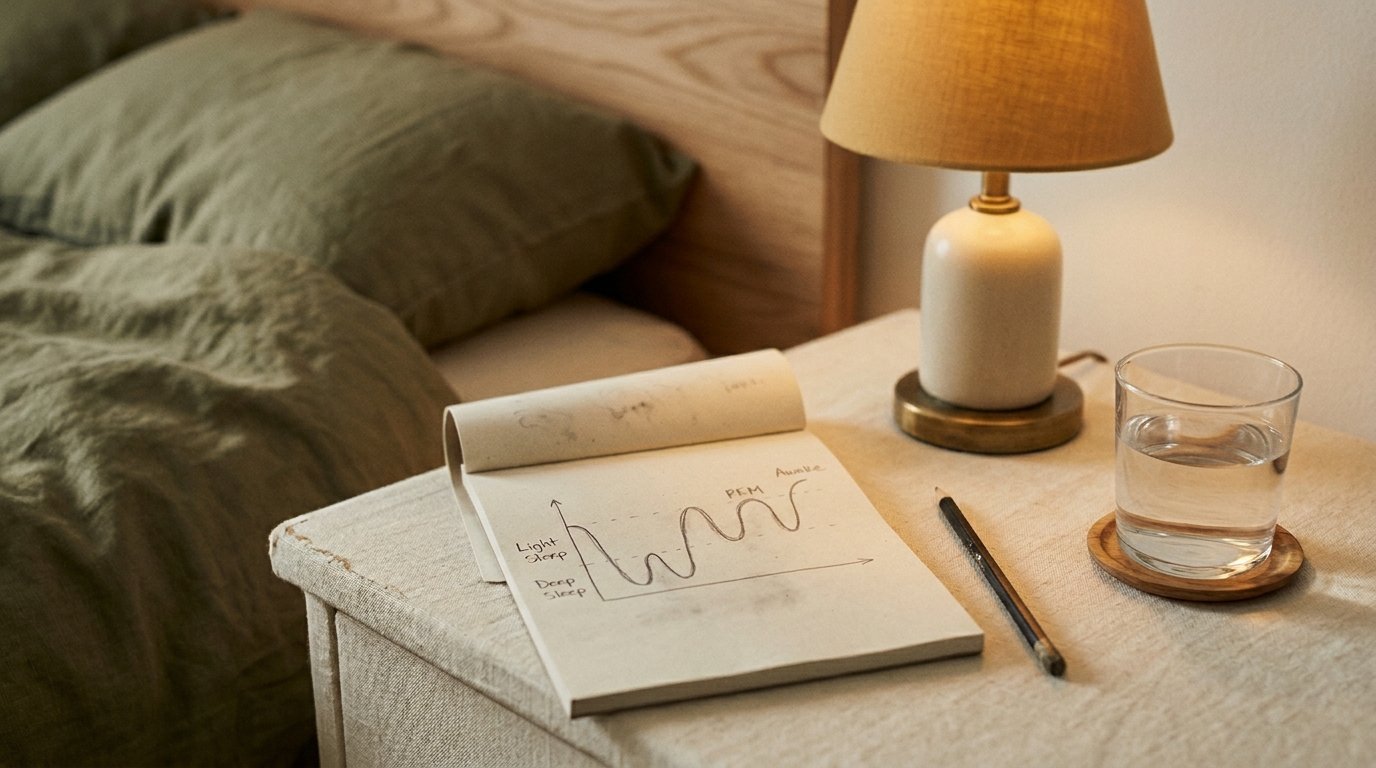
Sleep is organized into approximately 90-minute cycles, typically completing four to six cycles in a full night's sleep. Each cycle contains distinct stages:
NREM Stage 1 (N1)
Light sleep, typically lasting 1–7 minutes at the start of each cycle. Easily disrupted. The hypnic jerk (the sudden sensation of falling just as you fall asleep) occurs here, likely due to transitional muscle relaxation being interpreted as postural change.
NREM Stage 2 (N2)
Deeper sleep, characterized by sleep spindles (brief bursts of neural oscillations between 12–16 Hz) and K-complexes (large slow waves). N2 is where the majority of sleep time is spent, roughly 50% of total sleep time in healthy adults. Sleep spindles are associated with memory consolidation of procedural and declarative memories. N2 also involves body temperature regulation and reduced muscle activity.
NREM Stage 3 (N3): Slow-wave sleep or deep sleep
The deepest sleep stage, characterized by large, slow delta waves (0.5–4 Hz). Accounts for 15–25% of sleep in young adults, declining significantly with age. This is the most physically restorative stage: growth hormone is predominantly secreted during slow-wave sleep (roughly 70–80% of nightly growth hormone release), immune cytokines are elevated, and the glymphatic system (the brain's waste-clearance mechanism) is most active. Sleeping on your side (compared to back or stomach) has been associated in some studies with more efficient glymphatic function, though this is preliminary. N3 is concentrated in the early portion of the night: the first two to three cycles have proportionally more slow-wave sleep.
REM sleep (Rapid Eye Movement)
The final stage of each cycle, characterized by vivid dreaming, paralysis of voluntary muscles (motor atonia), and near-waking levels of brain activity. REM duration increases across cycles: the first cycle may contain only 10 minutes of REM while the fourth or fifth cycle may contain 60+ minutes. This means that cutting sleep short by even 1.5 hours disproportionately reduces total REM sleep, which is concentrated in morning cycles.
REM sleep is critical for emotional memory processing; research from Matthew Walker and others has demonstrated that REM sleep strips the emotional valence from difficult memories, consolidating the memory while reducing the associated distress. REM deprivation is associated with heightened emotional reactivity, increased amygdala activation to emotionally charged stimuli, and reduced prefrontal regulatory control over emotional responses. The phrase "sleep on it" has a documented physiological basis in REM processing.
A note on the glymphatic system (discovered by Maiken Nedergaard's group at the University of Rochester in 2013): during slow-wave sleep, cerebrospinal fluid flows through the brain more rapidly, clearing metabolic waste including amyloid-beta, a protein that accumulates in Alzheimer's disease. Poor sleep quality is associated with higher amyloid-beta accumulation, and this is an active area of dementia prevention research. The mechanistic link is established; the causal evidence for whether improved sleep reduces Alzheimer's risk specifically is ongoing.
The circadian rhythm
Sleep timing is regulated by two processes operating in parallel: Process S (sleep pressure, driven by adenosine accumulation during wakefulness; caffeine works by blocking adenosine receptors) and Process C (the circadian clock, driven by the suprachiasmatic nucleus in the hypothalamus). Optimal sleep occurs when these two systems are aligned: when you're sleepy (high adenosine) at the same time that the circadian system signals nighttime. Social jetlag (the common pattern of sleeping later on weekends and earlier on weekdays) desynchronizes these systems, producing chronically impaired sleep quality even when total duration is maintained.
How to apply it
Step 1: Protect your slow-wave sleep by going to bed earlier, not later
Slow-wave sleep is concentrated in the early portion of the night relative to sleep onset. If you tend to sleep later and wake to an alarm, you're truncating sleep from the beginning of your deepest stage, not from the beginning. You're cutting slow-wave sleep, which is why late sleepers who sleep six hours often feel worse than early risers who also sleep six hours (different points in the slow-wave sleep distribution).
Step 2: Protect your REM sleep by maintaining consistent wake time
REM sleep is concentrated in the later cycles. Maintaining a consistent wake time prevents truncating the REM-heavy later cycles, which is the most common cause of REM deprivation in otherwise adequate sleepers. Wake time is the stronger anchor for circadian rhythm than bedtime; fix the wake time first.
Step 3: Treat your bedroom temperature
Slow-wave sleep and REM sleep onset both require a drop in core body temperature of approximately 1–2°C from waking temperature. Room temperature of 15–19°C (60–67°F) facilitates this cooling. Many people sleep warmer than this, which reduces slow-wave sleep depth.
Step 4: Minimize alcohol before sleep
Alcohol is a sedative that accelerates sleep onset but dramatically disrupts sleep architecture: it suppresses REM sleep in the first half of the night and produces a rebound wakefulness in the second half as it metabolizes. Post-alcohol sleep is less restorative than the sleep duration suggests, particularly for REM-dependent emotional regulation.
Step 5: Manage light exposure
Blue-spectrum light (from screens and LEDs) suppresses melatonin secretion from the pineal gland, delaying circadian phase and sleep onset. The effect is most significant in the 2–3 hours before intended sleep. Morning bright light exposure (10–30 minutes of outdoor light within one hour of waking) reinforces circadian timing, which improves both sleep onset and sleep quality the following night.
Beginner version
Fix your wake time for seven days consecutively, then assess sleep quality. This single change produces measurable improvement in sleep quality for most people within a week by stabilizing circadian timing.
Common mistakes
1. Sleeping in on weekends to "catch up." Social jetlag (shifting sleep timing by 1–2 hours on weekends) disrupts circadian synchrony and is associated with metabolic consequences (higher BMI, insulin resistance) independent of sleep duration. Weekend sleep extension is less effective than maintaining a consistent schedule and sleeping adequate hours nightly.
Using alcohol to fall asleep
Alcohol's sedative effect facilitates onset but reduces total sleep quality: REM suppression and the rebound wakefulness in the second half of the night produce net harm to sleep architecture.
Setting multiple alarms
The fragmented light sleep between snooze intervals is not restorative. The repeated incomplete awakenings produce grogginess (sleep inertia) without the recovery benefit of a single alarm and immediate rising.
Long naps in the late afternoon
A 20-minute nap before 3 PM can improve afternoon alertness without impairing nighttime sleep. Naps longer than 30 minutes or later than 4 PM significantly reduce adenosine accumulation, making it harder to initiate and maintain nighttime sleep.
Tracking sleep obsessively
Consumer sleep trackers (Oura, Apple Watch, Fitbit) measure sleep staging through proxy measures (heart rate and motion) that are substantially less accurate than polysomnography. Orthosomnia (anxiety about sleep tracking data) has been documented as a source of insomnia in previously normal sleepers. Use tracking for general trends, not precise staging data.
When to see a professional
Consult a sleep physician or pulmonologist if: you snore loudly and wake frequently or feel unrefreshed despite adequate sleep duration (possible obstructive sleep apnea, a common and underdiagnosed condition); you have significant difficulty falling or staying asleep that has persisted for more than three months (clinical insomnia); you experience restless legs or limb movements that disrupt your sleep; or you work a rotating shift schedule and are experiencing significant health symptoms related to circadian disruption.
Cognitive Behavioral Therapy for Insomnia (CBT-I) is the first-line treatment for chronic insomnia, more effective and more durable than sleep medication in the clinical evidence, and increasingly available through apps (Sleepio has the most clinical validation) and therapists.
Frequently asked questions
Is eight hours of sleep the right amount for everyone?
Sleep needs are genuinely individual: the evidence most consistently shows risk below 7 hours for most adults. The population distribution is centered around 7–9 hours, but there is meaningful variation, and self-reported need is a reasonably reliable guide. The association between over 9 hours and mortality risk may reflect underlying illness causing long sleep rather than long sleep causing harm. Subjective quality and daytime function at a given duration are the most useful individual indicators.
Do sleep trackers accurately measure sleep stages?
Consumer wearables measure sleep staging through motion and heart rate, rough proxies for the EEG used in clinical polysomnography. Accuracy for distinguishing REM versus NREM is moderate; accuracy for distinguishing specific NREM stages (particularly N2 versus N3) is poor. Use trackers for general trend awareness (consistent wake time, overall duration, sleep timing) rather than as precise staging data. Anxiety about tracker data (orthosomnia) is documented and can itself worsen sleep.
Is a short daytime nap helpful or harmful?
A short nap (10–20 minutes) before 3 PM improves afternoon alertness without significantly reducing nighttime sleep pressure. Naps over 30 minutes enter slow-wave sleep, producing post-nap grogginess and reducing the adenosine sleep drive that facilitates nighttime sleep onset. NASA research on cognitive restoration identified the optimal nap duration as 10–26 minutes. Naps after 4 PM are more likely to delay nighttime sleep onset regardless of duration.
Does exercise improve sleep quality?
Yes, consistently. A 2017 meta-analysis in Sleep Medicine Reviews found regular aerobic exercise significantly improved sleep quality, specifically increasing slow-wave sleep duration and reducing the time to fall asleep. Vigorous exercise close to bedtime (within one hour) may delay sleep onset in some people; morning or late-afternoon exercise is generally preferable. Resistance training also improves sleep quality, though the evidence is somewhat less extensive than for aerobic exercise.




0 Comments
Leave a comment
Your email won't be published. Required fields are marked with *.