

In the classical Hatha tradition, headstand (sirsasana) is called the king of asanas and shoulderstand (sarvangasana) the queen. The honorifics are well over a thousand years old. They reflect a body of practical knowledge accumulated by yogis who experimented on themselves, recorded what they noticed, and passed down techniques that seemed to produce the effects they were after.
The honorifics are also worth examining. Modern medical understanding of the cervical spine, the carotid arteries, and the vertebral arteries is dramatically more detailed than what the early hatha texts had to work with. A practice that may have made sense in a tradition where most practitioners did asana for hours daily under the close supervision of a teacher may be a different proposition for a casual modern student doing a 90-minute class twice a week.
This is a careful look at what the two famous inversions actually do, what risks they carry, who they're appropriate for, and what alternatives exist for the benefits people are after when they reach for these poses.
What inversions are physiologically doing
The traditional claims for inversions are dramatic. They're said to reverse circulation, drain lymphatic fluid, calm the nervous system, balance the endocrine system, and improve mental clarity. Some of this maps onto measurable physiology. Most of it doesn't.
Here's what's actually happening.
When you invert, gravity reverses its effect on the cardiovascular system. Blood pools toward the head instead of the feet. The body responds quickly: the carotid sinus baroreceptors detect the increased pressure at the head, send signals that slow the heart rate and reduce the stroke volume, and within 10 to 30 seconds the system has adjusted to maintain stable cerebral perfusion. This is the same response that happens any time you change posture rapidly, just more pronounced.
The brief increase in blood flow to the head is real. Whether it produces clinical benefit is much less clear. The brain has its own auto-regulation system that maintains relatively stable blood flow under normal conditions, and the brief boost from inverting hasn't been shown to produce sustained cognitive or vascular benefits.
The lymphatic argument has some basis. The lymphatic system has no pump of its own and depends on muscle contraction and gravity to move fluid. Inverting can briefly assist drainage from the lower extremities, which is why people with mild swelling sometimes find legs-up-the-wall poses comforting. But the dramatic claims about "lymphatic flushing" exceed what the limited research can support.
The pressure changes in the chest and abdomen during inversions do affect the autonomic nervous system. The parasympathetic shift that some practitioners report after inversions is consistent with what happens during diving reflex activation and during prolonged exhalation. This is real and probably part of why inversions are reported as calming.
The summary: inversions produce physiological changes, but those changes are smaller and more transient than the marketing suggests. The mental effects — sense of calm, clarity, perspective shift — may be the most reliable benefit, and these come from a combination of physiological response and the focus required to hold the position. The deep tissue and circulatory benefits are mostly hyped.
Headstand: the cervical loading question
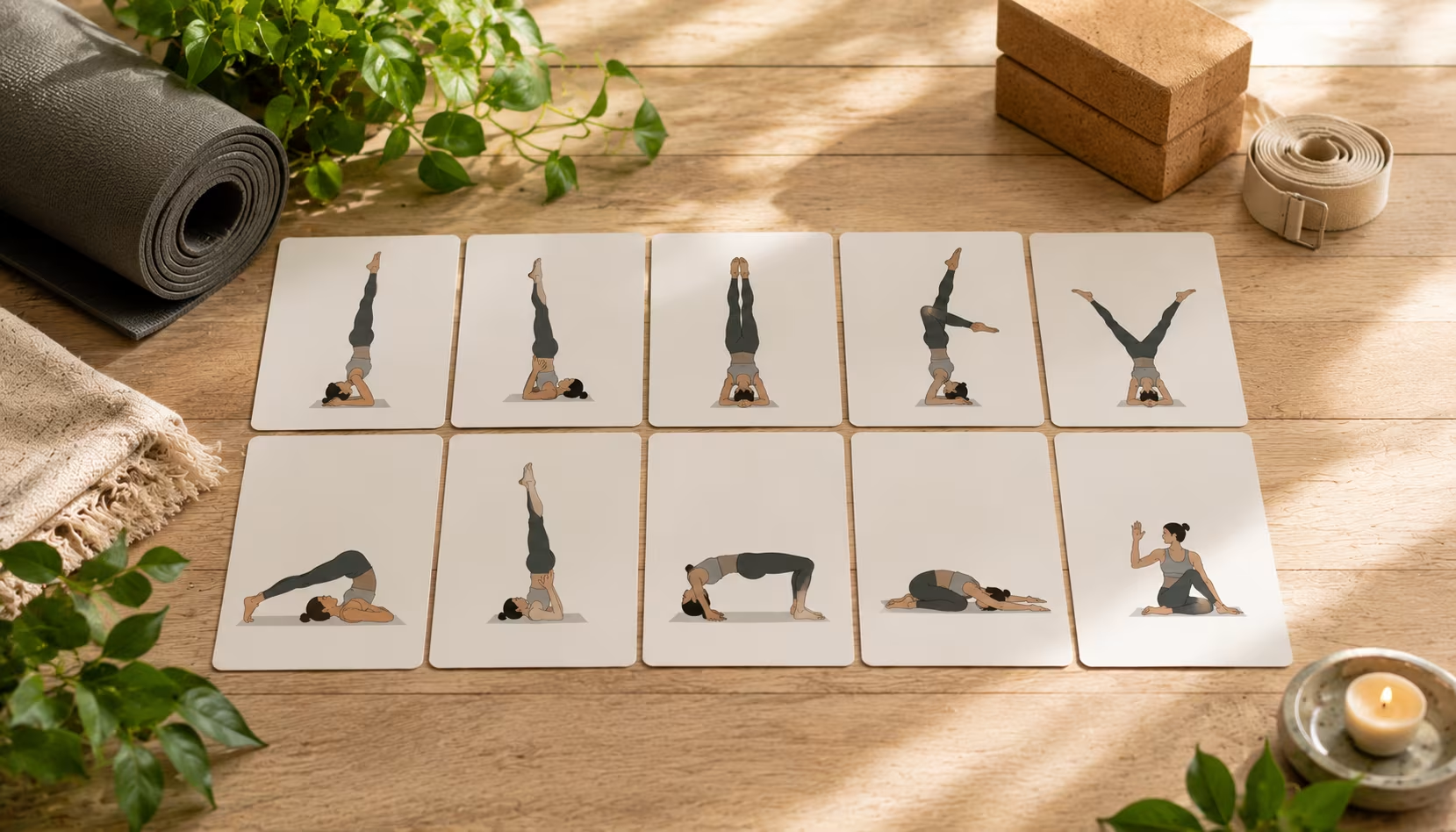
Headstand puts a meaningful percentage of body weight onto the cervical spine. This is the central problem.
The standard variation rests the crown of the head on the floor, with the forearms forming a triangle of support. The classical instruction is that perhaps 30 percent of body weight goes through the head and the rest is supported by the arms. In practice, this distribution depends entirely on technique. Practitioners who haven't built sufficient shoulder and trunk strength to truly support themselves on their arms end up loading more weight through the head — sometimes much more.
The cervical spine is not designed for axial compression bearing significant body weight. Its job is to hold the head up against gravity, allow rotation and flexion, and protect the spinal cord and the vertebral arteries that pass through small canals in the cervical vertebrae. The intervertebral discs in the cervical spine are smaller than those in the lumbar spine, and the muscles are smaller. None of these structures are well-built for the kind of sustained load that headstand applies.
Over time, with regular practice, several patterns of injury have been documented in the medical literature. Cervical disc protrusions and herniations. Cervical spondylosis (degenerative changes in the joints). Cervical stenosis (narrowing of the spinal canal). And, more rarely but most seriously, vertebral artery dissection — a tear in the wall of one of the arteries that supplies the brainstem, which can cause stroke.
The vertebral artery dissection cases are rare enough that they don't show up in any individual practitioner's life, which is why teachers can teach for decades without seeing one. But they are documented enough that case series in neurology journals discuss them as a known complication. The mechanism is the combination of axial load and rotation that can occur in headstand if the head shifts position during the pose.
The honest framing: headstand is not safe in the way most asanas are safe. It is more like rock climbing or contact sports — an activity with real risk that some people choose to do because they value what it gives them more than they fear what could go wrong. The risk is not zero with good technique. The risk is much higher with bad technique.
Shoulderstand: similar problem, different mechanics
Shoulderstand looks safer than headstand because the body weight rests on the upper back and shoulders rather than on the head. This is partly true, but the cervical loading is still significant, and in some ways more concerning.
In a standard shoulderstand, the body is vertical with the shoulders, neck, and back of the head on the floor. The chin is tucked toward the chest, putting the cervical spine in deep flexion. The body weight from the legs, pelvis, and trunk presses down through this flexed cervical spine.
Cervical flexion under load is mechanically problematic for the same reasons headstand is problematic, with a different injury pattern. Disc damage in the lower cervical spine is more common from repeated shoulderstand than from headstand, because the flexion concentrates load at the C5-C7 levels. The neck soft tissue (the ligamentum nuchae and the upper trapezius) can also become irritated.
Many traditional teachers prescribe folded blankets under the shoulders for shoulderstand, raising the body slightly so that the head is below shoulder level and the cervical spine is in less extreme flexion. This is a real improvement and reduces but doesn't eliminate the loading concern.
The risk profile in shoulderstand is somewhat different from headstand. Catastrophic vascular events are less commonly associated with shoulderstand. Chronic disc and joint injuries from repeated shoulderstand are common enough that they have a clinical name: yoga-related cervical pain.
Iyengar and several other modern teachers have explicitly cautioned against shoulderstand for many practitioners and advocated for the propped version with multiple blankets. This is reasonable. But the original unsupported pose is still widely taught, and the cumulative load over years of practice produces problems in many practitioners that they may not connect back to the pose.
The injury data
A systematic review by Cramer and colleagues in 2013 examined published case reports of yoga-related injuries and found inversions to be one of the more represented categories. Cervical injuries from headstand and shoulderstand made up a substantial proportion of the serious yoga-related injury reports.
A 2008 survey of yoga teachers and practitioners found that more than half of teachers had observed cervical injuries during their teaching career, and that the majority of these were associated with inverted postures.
Specific case reports in the medical literature include vertebral artery dissection causing stroke (multiple cases), cervical disc herniation requiring surgical intervention (multiple case series), retinal detachment associated with sustained headstand (rare but documented), and chronic cervical pain attributed to long-term shoulderstand practice (common in case series of yoga practitioners with neck pain).
The total number of injuries is small relative to the millions of people doing yoga. The probability of catastrophic injury for any individual practitioner in any given session is low. But the cumulative risk over years of regular practice is not negligible, and the population of people who do yoga long enough to develop these problems is substantial.
Compared to other physical activities of comparable popularity, yoga is on the safer end of the spectrum overall. The injury rate is lower than running, weightlifting, or most team sports. Within yoga, however, certain poses concentrate the risk, and inversions concentrate it more than most.
Who absolutely should not do these poses
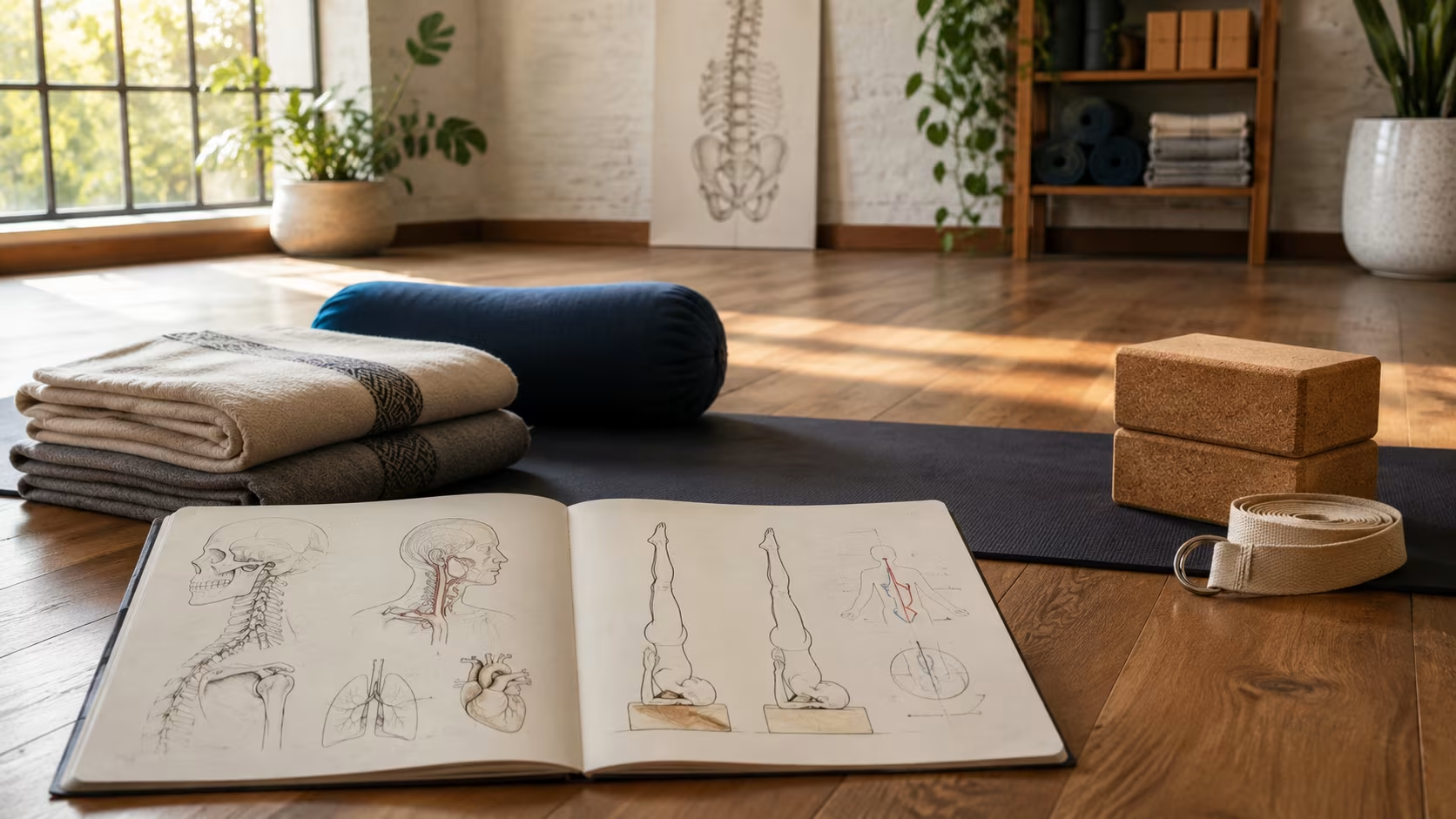
Several conditions are clear contraindications for headstand and shoulderstand, regardless of technique.
Glaucoma
Inversions raise intraocular pressure significantly. This can worsen existing glaucoma and possibly trigger acute angle-closure glaucoma in people with predisposing anatomy. People with diagnosed glaucoma should not do inverted postures.
Uncontrolled hypertension
The pressure changes during inversion can spike blood pressure to dangerous levels in someone with poorly controlled hypertension. People with high blood pressure that's not well-controlled by medication should avoid inversions.
Recent retinal detachment or known retinal problems
Inversions increase pressure on the retina and have been associated with detachment in susceptible individuals.
History of cervical disc problems, cervical surgery, or significant cervical degeneration
Loading an already compromised cervical spine adds risk on top of risk.
Pregnancy after the first trimester
The supine position with weight on the upper body becomes uncomfortable and can compress the inferior vena cava. Inversions are also generally discouraged for the cardiovascular changes they impose.
Menstruation
Some traditional teachings advise against inversions during menstruation. The medical evidence for this is essentially nonexistent, but if a practitioner finds inversions uncomfortable during their period, the discomfort is reason enough to skip them.
Active migraine or recent severe headache
Inversions can worsen vascular headaches.
History of stroke or transient ischemic attack
Vascular events of any kind in the past raise the relative risk of new events during inversion.
Children whose cervical spines are still developing
Though some yoga schools teach headstand to children, the developing cervical spine is a poor candidate for axial loading. Most pediatric yoga programs avoid full inversions.
This list is conservative. Some practitioners with these conditions do inversions safely. But the appropriate default is to avoid them, and only revisit the question with specific medical guidance.
The progression most people skip
If you are determined to do headstand or shoulderstand and don't have a contraindication, the path that produces the lowest injury risk is a slow progression that most casual practitioners skip.
For headstand, the genuine prerequisites: a strong, stable plank that you can hold for 60+ seconds with clean form; a strong, stable forearm plank for 60+ seconds; a comfortable dolphin pose held for 60+ seconds with the heels actively reaching toward the floor; the strength to do dolphin pose with one leg lifted, repeatedly. None of these involve the head touching the ground. They build the shoulder and trunk strength that allow you to actually hold yourself up by your arms when you eventually invert.
The next stage is dolphin pose with the head lightly touching the floor, walking the feet in toward the head, and lifting one leg and then the other off the ground briefly. This trains the inverted balance and the arm-supported weight bearing without yet putting full load on the head.
Only after months of this preparatory work does the full headstand make sense. And even then, the entry should be slow and controlled, the time held should be short (one to three minutes maximum, well below the longer holds some traditions teach), and the exit should be controlled rather than collapsing out.
Most people do not do this progression. They see headstand demonstrated, want to do it, and try to do it before the foundation is built. The result is that the head bears more weight than it should, the neck tenses to compensate, and the foundation for cervical injury gets laid.
For shoulderstand, the equivalent progression involves building shoulder mobility, learning to use blankets correctly to reduce cervical load, and starting with shorter holds. The progression is shorter than for headstand because the balance demands are lower, but the principle is the same: build the prerequisites before doing the full pose.
Safer inversions that give you most of the benefit
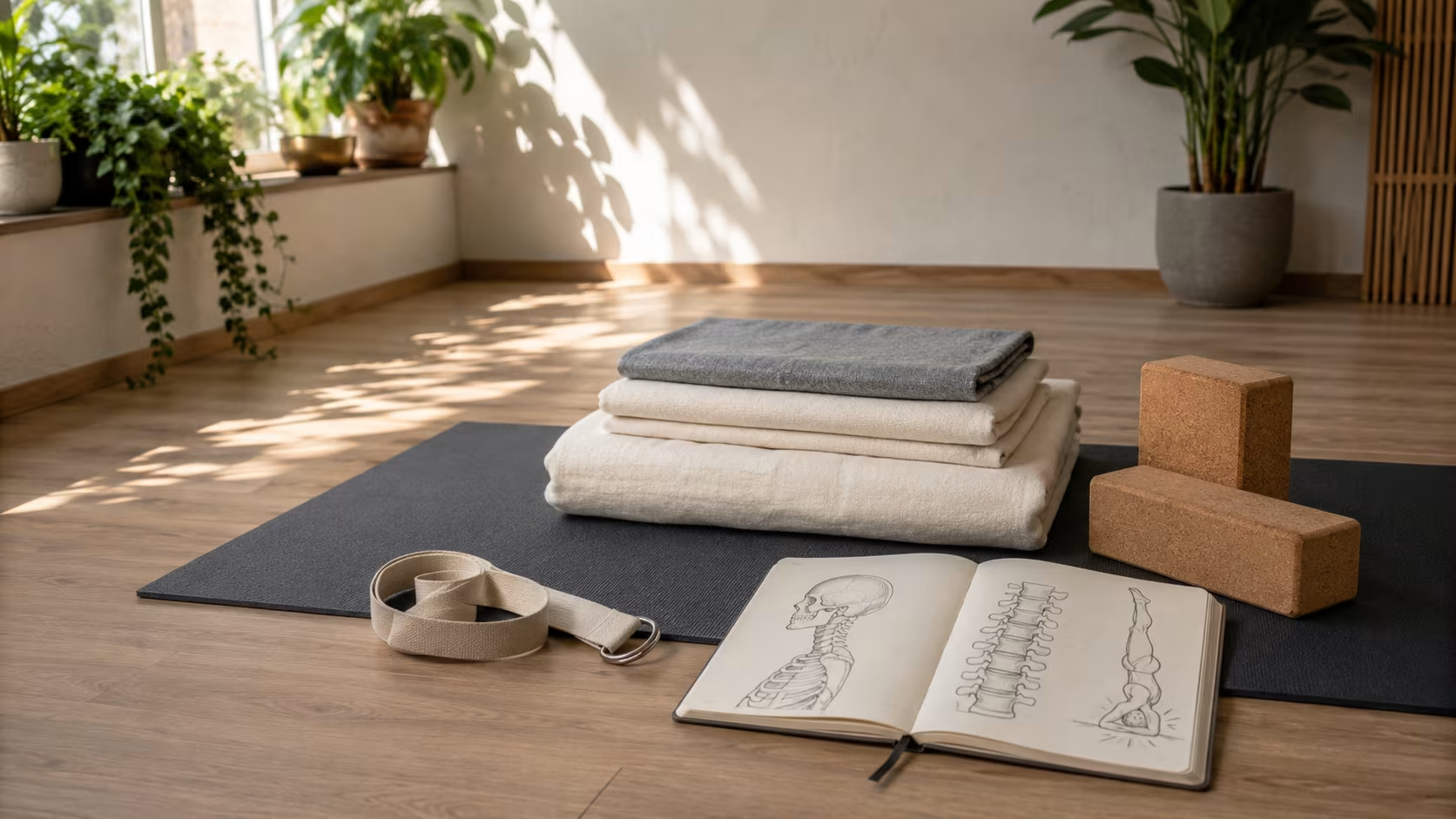
If your interest in inversions is primarily about the experience of being inverted, the calming effects, or the lymphatic and circulatory effects, several safer poses give you most of what headstand and shoulderstand offer.
Legs up the wall (viparita karani)
Lie on your back with your legs resting against a wall. The pelvis can be on the floor or supported by a folded blanket. This is a gentle inversion with no cervical loading whatsoever. The legs-elevated position promotes venous and lymphatic return from the legs and the relaxation effect is real and often more pronounced than from the more demanding inversions. For most people interested in the calming and circulatory benefits, this is the inversion to do. Hold for 5 to 15 minutes.
Supported bridge with a block
Lie on your back with knees bent, lift the hips, and slide a block under the sacrum at its lowest height. This creates a mild inversion of the upper body without inverting the head. Calming, gentle, and without significant cervical load.
Forearm stand (pincha mayurasana)
A more dramatic inversion, balanced on the forearms with the head off the floor. The cervical spine is unloaded. The shoulder demands are higher, which is why this is harder to balance, but it's a much safer fully-inverted pose than headstand for the spine.
Handstand (adho mukha vrksasana)
Balanced on the hands. The cervical spine is unloaded, though the shoulder and wrist demands are high. Safer for the neck than headstand, harder for everything else.
Dolphin pose, held longer
A semi-inversion that gets blood toward the head and stretches the shoulders and hamstrings without any cervical loading. Often overlooked as just a transition pose.
For most yoga practitioners, replacing headstand and shoulderstand with some combination of legs-up-the-wall, supported bridge, and dolphin captures the benefits with a small fraction of the risk. This isn't a dilution of the practice; it's a sensible adaptation given current understanding of cervical biomechanics.
If you're going to do them, do them this way
For practitioners who, after considering the above, choose to include headstand and shoulderstand in their practice, a few principles for reducing risk.
Use a wall for headstand for the first months or years. The wall prevents the kind of falling-forward catastrophe that can produce injury. Even experienced practitioners benefit from a wall when entering and exiting.
Build duration slowly. One minute, then two, then three. The longer holds taught in some traditions (10+ minutes) carry significantly more cumulative cervical load and are appropriate, if at all, only for very experienced practitioners.
Maintain the arm support actively the entire time. The cervical load is determined by how much weight the arms are bearing. The moment your arms tire, the head bears more, and the risk goes up. Get out of the pose before the arms fatigue.
Use blankets for shoulderstand. Multiple folded blankets under the shoulders with the head on the bare floor reduce cervical flexion load substantially. This is not optional; it's standard for any version of shoulderstand worth practicing.
Don't rotate the head while inverted. The combination of axial load and rotation is the position most associated with vertebral artery problems. Keep the head still through the entire pose.
Listen to early warning signs. Pinching in the neck, sharp pain, vision changes, dizziness — all reasons to come down immediately and not return to the pose without consulting someone who knows what they're looking at.
Stop the practice if you develop persistent neck pain. The pose is contributing to it. The pose is more important than the pose.
Sources
Cramer, H., Krucoff, C., & Dobos, G. (2013). Adverse events associated with yoga: A systematic review of published case reports and case series. PLOS ONE, 8(10), e75515.
Caplan, L. R. (2008). Dissections of brain-supplying arteries. Nature Clinical Practice Neurology, 4(1), 34–42.
Russell, K., Gushue, S., Richmond, S., & McFaull, S. (2016). Epidemiology of yoga-related injuries in Canada from 1991 to 2010: a case series study. International Journal of Injury Control and Safety Promotion, 23(3), 284–290.
Hekmat, K., Hasenpusch, K., Bauer, T., & Dorow, P. (2003). Atypical hangman fracture in yoga. European Spine Journal, 12(5), 532–534.
Fishman, L., Saltonstall, E., & Genis, S. (2009). Understanding and preventing yoga injuries. International Journal of Yoga Therapy, 19(1), 47–53.
Iyengar, B. K. S. (1979). Light on Yoga. Schocken Books.
Lee, M., Carroll, T. J., & Carter, A. R. (2014). Stroke after acute neck manipulation: a systematic review of case reports. Journal of Manual & Manipulative Therapy, 22(2), 65–72.
Frequently Asked Questions
Are inversions actually good for circulation?
The dramatic 'reverses circulation' framing is misleading. The body's circulation is driven by the heart and a complex venous return system that works in any orientation. Inversions do briefly increase blood flow to the head and may have minor lymphatic effects, but they don't 'flush' the body in the way some yoga teachings suggest.
Can headstand cause permanent neck damage?
Yes, it can. The cervical spine is not designed to bear body weight in compression. Cases of cervical disc damage, vertebral artery dissection, and chronic neck pain from repeated headstand are well-documented in the medical literature. The risk is not zero even with good technique.
What's the difference between headstand and forearm stand?
Headstand (sirsasana) loads the head and neck. Forearm stand (pincha mayurasana) loads the forearms and shoulders, leaving the head off the floor. Forearm stand is harder to balance but much safer for the cervical spine. If you want an inverted shape and have a healthy shoulder, forearm stand is the better choice.
Should I do shoulderstand before bed for sleep?
There's no specific evidence that shoulderstand improves sleep, despite this being a common claim. If a calming pre-bed practice helps you sleep, the calming is probably doing the work, not the inversion specifically. A few minutes of legs-up-the-wall accomplishes anything shoulderstand might without the cervical risk.





0 Comments
Leave a comment
Your email won't be published. Required fields are marked with *.