


The shoulder is the most mobile joint in the human body, and that mobility comes at a cost. Unlike the hip, which sits deep in a bony socket, the shoulder's ball-and-socket joint is more like a golf ball on a tee — held in place by a thin labrum, a delicate capsule, and a network of small muscles whose only job is to keep the ball centered while the arm moves through enormous arcs.
For overhead athletes — pitchers, swimmers, volleyball players, weightlifters, gymnasts — this design is both the gift and the problem. They need the range to perform. They also need the control to perform safely. The training advice they get usually addresses one and not the other, and often it addresses the wrong one.
Here's what the sports medicine literature actually shows about shoulder mobility in athletes who use their arms overhead, what most popular mobility advice gets backwards, and what a smarter framework looks like.
Mobility versus stability: the wrong dichotomy
You've probably seen the framing: some joints need mobility (ankles, hips, thoracic spine), some need stability (knees, lumbar spine, scapula). The shoulder gets called both, depending on who's writing.
This is too simple, and for the shoulder specifically, it's misleading. The shoulder needs active mobility, which is a different thing from passive flexibility. Active mobility means usable, controlled range — range that the muscles can take you into, hold you in, and bring you back from under load. Passive flexibility means the joint capsule and ligaments allow the bones to be moved into a position by an outside force.
A passively flexible shoulder with no active control is a shoulder waiting to dislocate. A shoulder with great active control but limited passive range is a shoulder that's safe but can't perform overhead sports well. What overhead athletes need is both — and the way to get both isn't to stretch more.
This is the central confusion. The standard mobility cue ("loosen up the shoulder") is usually addressed by passive stretching, which can increase passive range without doing anything for active control. For someone who's already hypermobile — and many overhead athletes are — this makes things worse, not better.
What the overhead position actually requires

To get the arm fully overhead — straight up alongside the head — requires coordinated motion at four different joints. The glenohumeral joint contributes about 120 degrees of flexion. The scapulothoracic articulation (the scapula sliding on the rib cage) contributes another 60 degrees of upward rotation. The sternoclavicular and acromioclavicular joints make smaller contributions. The thoracic spine extends slightly to allow the rib cage to support the position.
If any one of these four contributors is restricted, the others have to compensate. And compensation in the shoulder almost always means the humeral head migrates upward and forward in the socket, which is exactly the position that pinches the rotator cuff against the underside of the acromion. This is where impingement comes from.
So when a thrower or swimmer with shoulder pain gets told to stretch their lats and pec minor, the advice isn't wrong, but it's incomplete. If the thoracic spine is stuck in flexion, no amount of lat stretching will produce a clean overhead position. If the scapula doesn't upwardly rotate properly because the lower trapezius is weak, the problem isn't tightness anywhere — it's a strength problem disguising itself as a mobility problem.
The first question in any shoulder mobility assessment isn't "how far can the arm go?" It's "what's restricting it from going further, and is the restriction in the right place?"
The scapula problem
The scapula is supposed to move. A lot. Through a full overhead reach, it slides up, rotates upward, tilts posteriorly, and slightly retracts — all coordinated by the trapezius, serratus anterior, rhomboids, and levator scapulae working in a specific sequence.
When this sequence breaks, the technical term is scapular dyskinesis. It's been documented in the majority of overhead athletes with shoulder pain. The most common pattern: the scapula tilts anteriorly and the inferior angle wings out, instead of rotating cleanly upward. This is associated with impingement, with rotator cuff injuries, and with a higher rate of shoulder pain in throwing athletes.
The fix is rarely stretching. It's almost always strengthening — specifically the lower trapezius and serratus anterior, which are the two muscles that drive scapular upward rotation and posterior tilt. These are also the two muscles most overhead athletes are weak at, because the popular shoulder exercises (pulldowns, presses, anything that loads the upper trap) don't train them well.
Specific exercises that do prone Y, T, and W lifts (with light weight — under 5 pounds for most people); wall slides with a foam roller; serratus pushups with full protraction at the top; and bear crawls with deliberate scapular control. None of these require equipment most athletes don't have. They do require attention to form that most athletes don't give them.
The honest test if you can do 15 prone Y lifts with a 3-pound dumbbell while keeping your scapula moving cleanly and your neck quiet, your lower trap is reasonably strong. Most athletes can't.
Internal rotation deficit and why it matters
If you're a baseball pitcher, you've probably heard of GIRD — Glenohumeral Internal Rotation Deficit. It's the loss of internal rotation in the throwing shoulder compared to the non-throwing side. The condition has been studied extensively in throwing populations because it's strongly associated with shoulder injuries, especially labral tears and rotator cuff injuries.
Here's how it develops. The throwing motion places extreme repeated stress on the posterior shoulder during deceleration — the moment after the ball leaves the hand, when the rotator cuff and posterior capsule have to slow down a rapidly internally rotating arm. Over thousands of throws, the posterior capsule and the inferior glenohumeral ligament adapt by tightening. This tightness is a protective adaptation, but it changes the resting position of the humeral head and limits internal rotation.
The classical fix used to be the sleeper stretch — lying on the throwing side, pressing the forearm down toward the ground. This is now considered controversial. More recent work suggests that aggressive sleeper stretches can drive the humeral head forward in the socket and worsen anterior instability. The current preference among most sports medicine specialists is the cross-body stretch combined with manual therapy from a qualified provider, not aggressive self-stretching.
The broader lesson: shoulder mobility deficits in throwers are usually adaptations to the demands of the sport, not problems to be fixed by stretching. Some loss of internal rotation is normal in pitchers. The threshold that becomes worth addressing is roughly 20 degrees of difference between sides combined with loss of total rotational range. Below that, you may be looking at a feature, not a bug.
What stretching does and doesn't do for shoulders
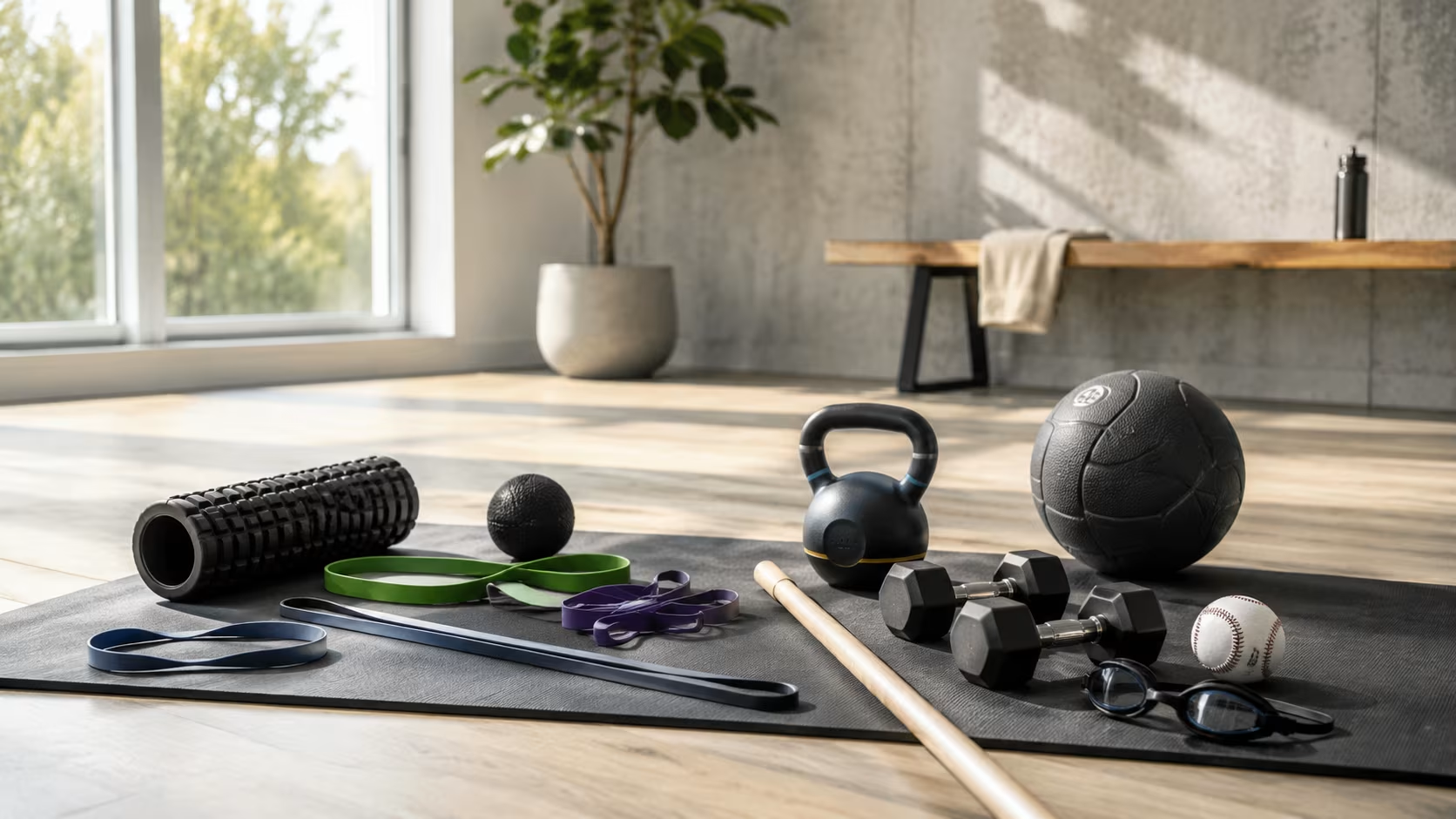
Stretching changes shoulder mobility in two ways: short-term and long-term. The short-term effect is mostly neural — the stretched muscle becomes more tolerant of stretch, the central nervous system reduces protective tension, range increases for an hour or two. The long-term effect, when stretching is done consistently for weeks, includes some actual change in muscle and connective tissue length plus a more permanent shift in stretch tolerance.
For a hypomobile shoulder — say, after a frozen shoulder episode or post-surgery — stretching is part of the program. For an overhead athlete with normal or above-normal range, daily passive stretching of the shoulder probably does more harm than good. It can drive the small protective tightness that comes from hard training out of the system, leaving the shoulder less stable than it was.
What overhead athletes do tend to need: targeted stretching of the latissimus dorsi (which limits overhead position when tight), the pec minor (which holds the scapula in anterior tilt), and the sub-occipital muscles (which restrict thoracic extension when tight). These are usually genuinely tight and benefit from work. Stretching the rotator cuff itself, or doing aggressive end-range stretches of the joint capsule, is more often a problem than a solution.
The shoulder dislocates in only one direction in most athletes — anteriorly. Most popular shoulder stretches put the joint into anterior translation under stretch. You can see why this matters.
A better framework: control, not just range
Borrow this framework from the FRC (Functional Range Conditioning) world, which has been thinking about this carefully for two decades.
For each joint, three categories of work matter: passive range, active range, and end-range strength. Passive range is what you have when something else moves you. Active range is what you can move yourself. End-range strength is what you can produce torque against at your maximum range.
For overhead athletes, the imbalance is usually that passive range is high, active range is somewhat lower, and end-range strength is much lower. The training implication: less work to increase passive range (you don't need it), more work to increase active range to match passive range (you need this), and a lot of work to develop strength at end-range (you need this most).
What end-range strength training looks like: holding the arm in maximum overhead position and doing isometric pulls in different directions; doing slow shoulder rotations at end-range under load; eccentric overhead exercises like single-arm overhead carries with light weight; and the Cossack-style positions in lifting where the shoulder has to produce force in unusual positions.
This isn't yoga. It's not stretching. It's strengthening the small stabilizers in the positions where you're going to actually use them. For overhead athletes, this is almost always more useful than another set of doorway pec stretches.
Sport-specific patterns to know
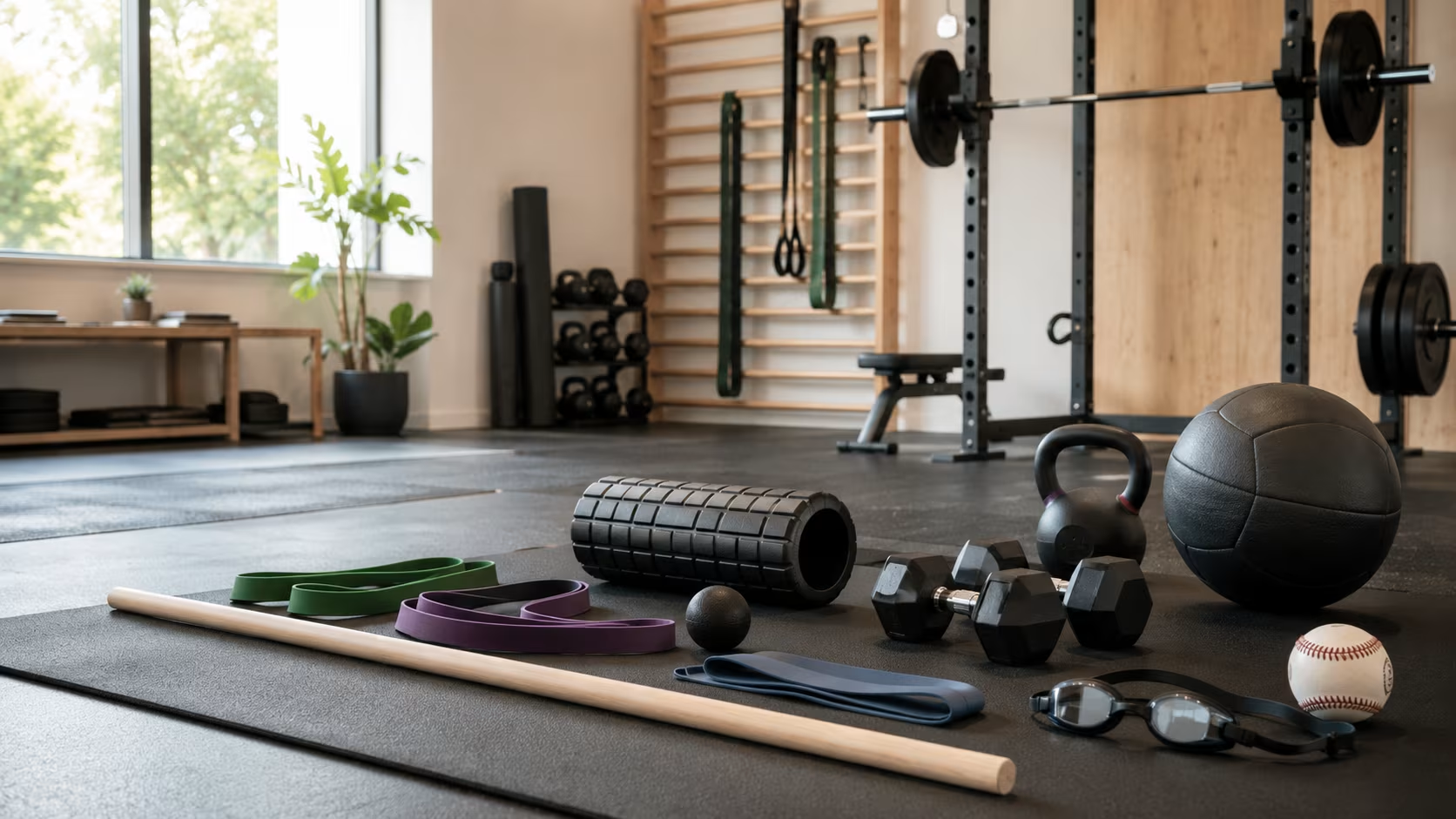
Pitchers
GIRD as discussed above. Also commonly tight in the pec minor and lat on the dominant side, with weakness in the lower trap and serratus. The tradeoff for the throwing arm is real: it will never look or feel like the non-throwing arm, and that's not a problem to solve.
Swimmers
The opposite issue from throwers — extreme repeated overhead work in both directions, often with hypermobile shoulders to start with. Common pattern: anterior shoulder pain on the recovery phase of freestyle, related to scapular control failures and weakness in the deep stabilizers. Stretching is rarely the answer; targeted serratus and lower trap work usually is.
Volleyball players
Similar to pitchers but bilateral. The hitting shoulder and the blocking shoulder both take a beating. Pattern of capsular adaptation similar to throwing but more symmetrical. Watch for impingement during heavy training blocks.
Weightlifters and CrossFitters
A different problem entirely. Heavy overhead loading exposes any restriction in the lats, pec minor, or thoracic spine immediately. Most shoulder issues in this population come from going heavy in positions the athlete doesn't have the range for, with the body finding it through compensations that eventually break. Build the position with light weight first. Then load it.
Gymnasts
Often the most mobile shoulders in any sport, paired with extreme demands for control. Injuries here are usually about chronic overuse rather than acute. Honest scapular control training pays off here as much as in any sport.
When to suspect something is actually wrong
A few patterns that warrant a sports medicine consultation rather than another mobility routine.
Pain at night that wakes you up, especially when sleeping on the affected side. This pattern is more associated with rotator cuff pathology than mechanical impingement.
Loss of strength that comes on rapidly, particularly in external rotation or abduction. This can indicate a tendon problem and shouldn't be trained through.
Feelings of instability — the shoulder slipping, catching, or feeling like it's going to come out. These warrant imaging and a proper assessment, not more mobility work.
Pain combined with numbness or tingling down the arm. This can be a referred pattern from the cervical spine or from compression of one of the brachial plexus structures, neither of which is fixed by shoulder exercises.
Sudden loss of range after an injury, especially if associated with weakness. Could be a tendon tear, a labral injury, or a fracture. Get it looked at.
Mobility work is for shoulders that are functioning normally and need to function better. It's not the right tool for shoulders that are injured or that have lost function suddenly.
Sources
Wilk, K. E., Macrina, L. C., Fleisig, G. S., Porterfield, R., Simpson, C. D., Harker, P., Paparesta, N., & Andrews, J. R. (2011). Correlation of glenohumeral internal rotation deficit and total rotational motion to shoulder injuries in professional baseball pitchers. American Journal of Sports Medicine, 39(2), 329–335.
Kibler, W. B., Sciascia, A., & Wilkes, T. (2012). Scapular dyskinesis and its relation to shoulder injury. Journal of the American Academy of Orthopaedic Surgeons, 20(6), 364–372.
Cools, A. M., Johansson, F. R., Borms, D., & Maenhout, A. (2015). Prevention of shoulder injuries in overhead athletes: A science-based approach. Brazilian Journal of Physical Therapy, 19(5), 331–339.
Reinold, M. M., Wilk, K. E., Macrina, L. C., Sheheane, C., Dun, S., Fleisig, G. S., Crenshaw, K., & Andrews, J. R. (2008). Changes in shoulder and elbow passive range of motion after pitching in professional baseball players. American Journal of Sports Medicine, 36(3), 523–527.
Borstad, J. D., & Ludewig, P. M. (2005). The effect of long versus short pectoralis minor resting length on scapular kinematics in healthy individuals. Journal of Orthopaedic & Sports Physical Therapy, 35(4), 227–238.
Ekstrom, R. A., Donatelli, R. A., & Soderberg, G. L. (2003). Surface electromyographic analysis of exercises for the trapezius and serratus anterior muscles. Journal of Orthopaedic & Sports Physical Therapy, 33(5), 247–258.
McMullen, J., & Uhl, T. L. (2000). A kinetic chain approach for shoulder rehabilitation. Journal of Athletic Training, 35(3), 329–337.
Frequently Asked Questions
I can touch my hands behind my back. Doesn't that mean my shoulder mobility is fine?
It means your shoulder has the gross range. It says nothing about whether you have control of that range, whether the scapula moves correctly, or whether the small stabilizers fire in the right order. People with the most mobile shoulders are often the ones who get hurt first because the tissue is stretchy but undertrained.
Should I stretch my shoulders every day?
If you're an overhead athlete, probably not the way most stretching guides suggest. Daily passive end-range stretching of an already mobile shoulder can drive instability over time. What you probably want daily is light controlled articular rotations, not held stretches.
Why does my shoulder click when I lift my arm overhead?
Most painless clicking is benign — it's usually a tendon sliding over a structure or a small adhesion releasing. Painful clicking, clicking with weakness, or new clicking after an injury deserves a look. The rule of thumb: if it doesn't hurt and your strength is normal, it's probably nothing.
Does sleeping on my side ruin my shoulder mobility?
Side sleeping doesn't ruin mobility, but consistently sleeping on the same side for years can produce mild capsular tightness on that shoulder, especially if you sleep with the arm overhead. If you notice an asymmetry, alternating sides or sleeping with a small pillow under the down-side arm helps.





0 Comments
Leave a comment
Your email won't be published. Required fields are marked with *.