

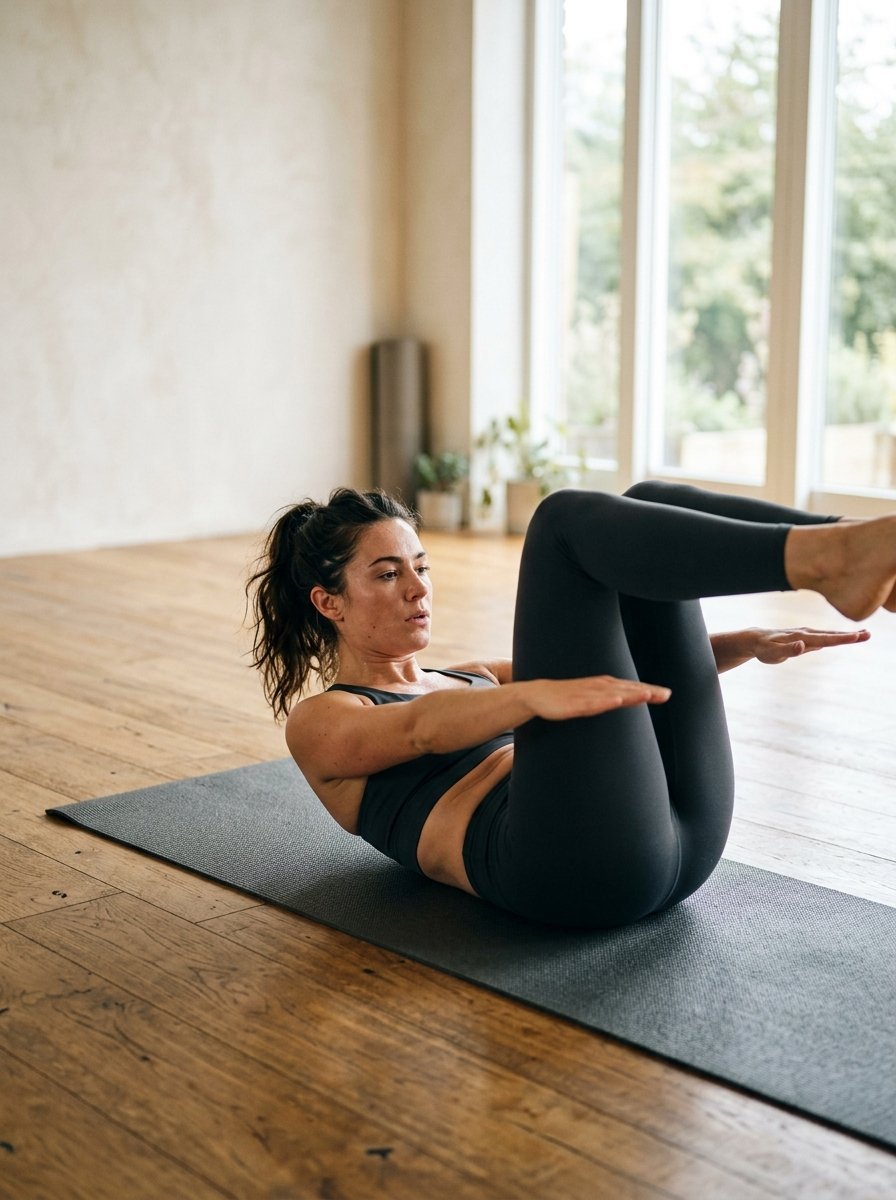
Joseph Pilates developed his system of exercises (originally called Contrology) in the early 20th century as a rehabilitation method, drawing on principles from gymnastics, boxing, and yoga. The contemporary practice has diverged significantly from his original 34 mat exercises, particularly with the introduction of the Reformer and other apparatus, and the evidence base has grown in specific ways that make it easier to know what Pilates is actually good for versus where the claims have outrun the research.
What the evidence supports: Pilates is effective for reducing non-specific chronic lower back pain, improving lumbar-pelvic control, strengthening deep core musculature (particularly the transversus abdominis and multifidus), and improving balance and functional movement patterns in older adults. A 2016 systematic review in the Journal of Orthopaedic & Sports Physical Therapy found Pilates more effective than minimal intervention for chronic low back pain, with effect sizes comparable to general exercise in most studies. A 2015 Cochrane-adjacent systematic review of Pilates for chronic low back pain concluded that Pilates reduced pain and disability compared to no treatment, with effects maintained at follow-up.
What it's less clearly supported for: the claims of producing "long and lean" muscles are not mechanistically credible: Pilates does not produce muscle elongation, which is anatomically fixed, though it can improve postural alignment in ways that change appearance. The evidence for Pilates-specific benefits over well-designed general exercise for most outcomes (other than lumbar-pelvic control) is limited, largely because there are fewer high-quality trials.
For most beginners (particularly those with desk-based lives, lower back pain, or postpartum recovery needs), Pilates provides a valuable entry point to movement with strong attention to body mechanics, pelvic alignment, and breath integration.
What the evidence shows
The specific mechanisms through which Pilates produces its documented benefits:
Transversus abdominis (TrA) activation
The TrA is the deepest abdominal muscle, running horizontally like a corset around the trunk. It's the primary deep stabilizer of the lumbar spine and pelvis. Research from Paul Hodges' laboratory at the University of Queensland has extensively documented that people with chronic lower back pain show delayed TrA activation patterns: the muscle activates after rather than before limb movement, reducing spinal stability at precisely the moment it's needed. Pilates' emphasis on breath coordination and deliberate core activation is well-suited to retraining this pattern.
Multifidus function
The multifidus is a deep spinal muscle running along the lumbar spine, and like the TrA, it shows atrophy and activation delay in chronic lower back pain populations. Exercises performed in Pilates (including bridging, single-leg stretches, and supine series) are known to activate the multifidus at meaningful levels and with appropriate spinal neutral positioning.
Breath and movement integration
The Pilates system emphasizes exhaling during exertion and specifically coordinates breathing with movement, a feature that both supports intra-abdominal pressure management and introduces a mindful attention to movement that is absent from most gym training. This breath-movement integration has value for pelvic floor function (relevant for postnatal populations) and for movement quality generally.
Balance and fall risk in older adults
A 2017 meta-analysis in Gait & Posture found that Pilates training significantly improved static and dynamic balance measures in older adults, an outcome with direct relevance to fall prevention, a leading cause of injury-related mortality in this population.
How to apply it
Eight-week beginner Pilates framework
Weeks 1–2: Foundation, learning to find neutral spine and deep core activation
- Daily practice: 15 minutes
- Key exercises: supine breathing with TrA engagement (feel the lower belly draw in during exhale, not suck in), pelvic tilts, imprinting (finding the difference between posterior tilt, neutral, and anterior tilt), basic bridge
- Goal: proprioceptive awareness of pelvic position and breath-core coordination
- Beginner cue: Place one hand on your lower belly. On the exhale, the belly should gently draw in toward the spine. Practice this 10× in succession before any Pilates exercise.
Weeks 3–4: Building supine series
- Frequency: 4× per week
- Duration: 20–25 minutes
- Add: hundred (legs in tabletop, begin pumping arms), single-leg stretch (both hands on shin, one leg extended), double-leg stretch, supine spinal rotation
- Focus: maintaining neutral spine or appropriate lumbar imprint while the limbs move
- Progression trigger: you can complete the movements without the lower back losing contact with the mat or arching excessively
Weeks 5–6: Introducing prone and side series
- Frequency: 4× per week
- Duration: 25–30 minutes
- Add: swan dive prep (prone spinal extension, elbows under shoulders), single-leg kick (prone, alternating heel kicks), side-lying series (side leg lifts, inner thigh lifts, clams)
- Focus: spinal extension capacity and hip external rotation strength
- Note: the prone extensions require appropriate lumbar mobility and are the exercises most likely to need modification for people with lumbar disc pathology; listen to your body and use a folded towel under the abdomen if needed
Weeks 7–8: Full mat integration
- Frequency: 5× per week
- Duration: 30–35 minutes
- Add: rolling like a ball, spine stretch forward, open-leg rocker prep, corkscrew prep, saw
- Focus: articulating the spine with control rather than momentum, integrating breath with all movements
- Evaluation: Can you perform a single-leg circle without the pelvis rocking? Can you maintain neutral spine in the hundred for 50 counts? These are intermediate competency markers.
Reformer Pilates
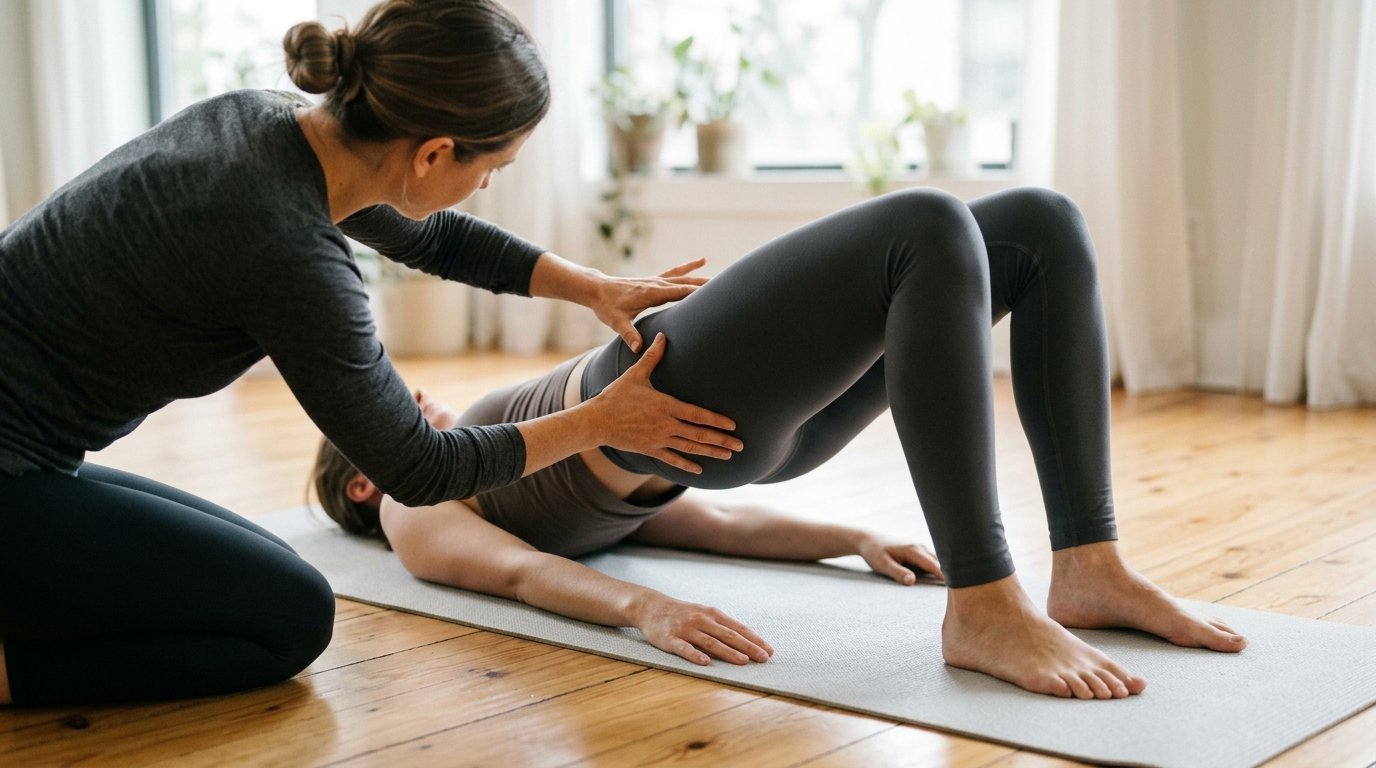
If you have access to a studio, adding Reformer sessions in weeks 5–8 accelerates progression. The Reformer's spring resistance provides both assistance (for learning movement patterns) and resistance (for loading). A qualified Pilates instructor's cueing in the first six weeks significantly reduces the risk of compensations that become habitual.
Common mistakes
Substituting global core bracing for deep muscle activation
Many beginners hold their breath and brace hard, recruiting the rectus abdominis and obliques rather than the TrA. Real Pilates core work is subtle: a gentle drawing-in on the exhale, not a maximal brace. The breath should remain free throughout the exercise.
Moving through pain
Pilates is a rehabilitative system and should not produce pain. Discomfort from unfamiliar muscle activation is expected; joint pain, groin pain, or lumbar pain during exercises is a reason to stop and modify.
Advancing too quickly
The exercises look accessible: lying on your back moving your legs. The actual difficulty lies in maintaining spinal position and breath coordination while moving limbs, which is genuinely challenging. Advancing before the foundation is solid means you're using global muscles to compensate, which defeats the purpose.
Confusing Pilates with HIIT
Pilates at beginner and intermediate levels is not a significant cardiovascular workout. It is a neuromuscular re-education and stability-building practice. Expecting it to replace your cardiovascular exercise is a category error.
Skipping instructor-led classes entirely
Pilates movements are technically specific, particularly spinal articulation and breath coordination. Self-teaching from YouTube is possible but carries a risk of ingraining compensation patterns. At minimum, a few sessions with a qualified instructor in the first four weeks provides corrective feedback worth paying for.
When to see a professional
Consult a physical therapist or Pilates instructor trained in clinical Pilates before beginning if: you have a known disc herniation, spondylolisthesis, or osteoporosis (some Pilates movements, specifically spinal flexion exercises, are contraindicated or require significant modification for these conditions); you are in the early postpartum period (within 6 weeks), where pelvic floor assessment should precede any loaded exercise; or you have hip impingement or labral pathology, which may be aggravated by some hip rotation exercises.
Frequently asked questions
Do I need a Reformer to do Pilates?
No. Mat Pilates is entirely sufficient for most beginners and produces the core stability and spinal control outcomes with the strongest evidence base. Reformer work adds spring-assisted and spring-resisted movement that offers greater exercise variety and rehabilitation precision, and is particularly valuable in clinical settings. If you have access to a studio, incorporating Reformer sessions in weeks 5–8 accelerates progression, but mat Pilates alone produces meaningful results.
Can Pilates help with postpartum recovery?
Yes, with appropriate modifications. Pilates is among the most evidence-supported approaches to postnatal core restoration, specifically for diastasis recti (abdominal muscle separation) and pelvic floor rehabilitation. The foundational breathing and transversus abdominis work in weeks 1–2 of this framework is appropriate from relatively early in postnatal recovery. Consult a women's health physical therapist to assess pelvic floor status before beginning any loaded core work postpartum.
How does Pilates compare to yoga for core strength?
Both develop core stability through sustained low-load positions, but with different emphases. Pilates is more systematically focused on lumbar-pelvic control, deep stabilizer activation, and spinal articulation. Yoga emphasizes flexibility, balance, and breath integration across a broader range of postures. For chronic lower back pain specifically, Pilates has more targeted clinical evidence. They are complementary practices; many people benefit from both.
How many sessions per week are needed to see results?
Clinical trials for lower back pain typically use two to three sessions per week as the intervention dose. For general core development and postural awareness, three to four sessions of 25–35 minutes per week produces noticeable improvement within four to six weeks in most people. Daily practice at shorter duration (15 minutes) may produce faster neuromuscular adaptation through frequency of stimulus. Consistency matters more than occasional longer sessions.


0 Comments
Leave a comment
Your email won't be published. Required fields are marked with *.