


The Pilates studio scene in most cities has split into two parallel tracks. Reformer studios — equipment-heavy, smaller classes, premium pricing — cater to one audience. Mat classes — larger, equipment-light, often at standard gyms — cater to another. Both call what they do Pilates. Joseph Pilates would likely have been confused by the marketing distinction. He developed the system as integrated whole, not as two product lines.
What's actually different about the two formats matters more than the cultural framing of one as serious work and the other as filler. The reformer provides specific affordances — spring resistance, support during difficult positions, the ability to add load to bodyweight movement — that the mat doesn't. The mat requires more direct strength and body control for the same movements. Different bodies, different goals, different starting points benefit from different formats.
This piece walks through what each format actually offers, who benefits more from which, and how to think about Pilates if you're new to it.
What the Reformer Actually Does
The reformer is a sliding carriage on a frame, with adjustable springs providing resistance, plus straps, foot bars, and shoulder rests for various exercises. Joseph Pilates designed it in the 1920s while interned during World War I — he reportedly attached bedsprings to hospital beds to allow injured patients to rehabilitate. The modern reformer is the descendant of that improvisation.
Several things the reformer adds:
Spring resistance that's directionally adjustable
Stronger springs make some movements harder (pushing the carriage away from your body) and other movements easier (pulling the carriage back). The same exercise can be made harder or easier by changing spring tension or the orientation of the work.
Support through hard positions
Beginners working on hip mobility, hamstring length, or shoulder stability often can't hold certain positions on the mat. The reformer's straps and supports allow approximate access to the position with assistance, making early practice possible.
Resistance through full range of motion
Bodyweight provides decreasing resistance through a movement as leverage changes. Springs provide more consistent resistance — sometimes increasing through the range, depending on configuration.
Specific exercise vocabulary
Many Pilates exercises are reformer-specific. The footwork series, the long stretches, the short box series, the pulling straps — these are the bread and butter of reformer work and don't transfer directly to the mat.
Eccentric loading
The spring resistance during the return phase loads the muscle in lengthened positions, which has hypertrophy and mobility benefits that pure bodyweight work doesn't replicate as cleanly.
For people newer to movement, post-rehab populations, or anyone wanting more specific muscular targeting, the reformer offers tools the mat doesn't.
What the Mat Demands
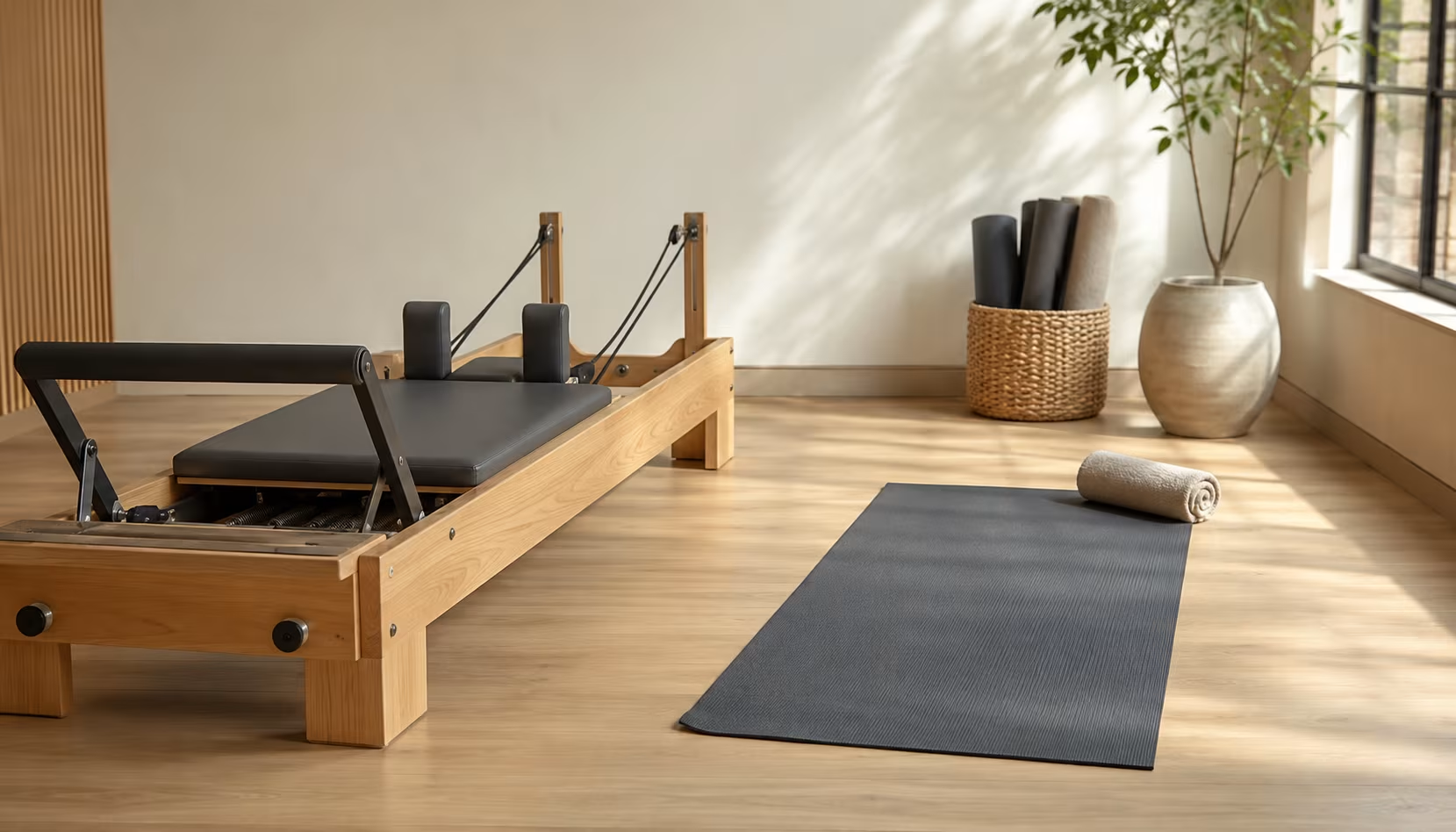
Mat Pilates uses bodyweight and gravity. Joseph Pilates developed the original 34 mat exercises (later expanded by his students), and these remain the core of mat work.
What the mat provides:
Direct demand on stabilizers
Without spring support, the body has to provide its own stability. Exercises like the teaser, the roll-up, and the hundred require coordinated trunk, hip, and shoulder stability with no external assistance.
Honesty
The mat doesn't lie. If you don't have the strength or mobility for a movement, the reformer might let you get into a position you couldn't otherwise reach; the mat usually doesn't. Some practitioners prefer this — you work with what your body can actually do rather than borrowing capacity from the equipment.
Portability
A mat goes anywhere. Pilates studios are concentrated in cities and major suburbs; mat Pilates can happen in a hotel room, a backyard, or a small apartment.
Lower cost
Mat classes at standard gyms are usually included with membership. Independent mat studios charge less than reformer studios. Home practice with online classes can be near-free.
Larger class sizes
Mat classes typically run 15–25 students. The instructor gets less time per person. This is a meaningful limit for beginners with form questions.
For people with reasonable baseline fitness who want core and trunk work without major joint demand, mat Pilates is efficient. The intensity isn't lower than reformer work necessarily — well-taught mat classes can be brutal — but the work is structured differently.
Choosing Based on Your Starting Point
A few rough guidelines for which format fits where:
Total beginner with sedentary background
Reformer is often better. The equipment supports early work and helps you find positions you can't achieve on the mat. The smaller class size means more instructor attention. Worth the higher cost if you can manage it.
Active person, decent fitness baseline
Either works. Mat is more efficient if you'll do it consistently. Reformer adds variety and provides more specific resistance work.
Post-rehab or current injury
Reformer, ideally with an instructor experienced in post-rehab work. The supported environment matters for safe progression.
Strong lifter looking to add mobility and core work
Mat often. You don't need the reformer's load assistance; you do need the direct trunk stability demand.
Pregnant or recently postpartum
Reformer studios with appropriate prenatal/postpartum training. The reformer's adjustability accommodates a changing body better than a typical mat class.
Older adults or mobility-limited
Reformer. The supported positions reduce risk during early stages, and the variable resistance allows true beginning loads.
Athletes adding Pilates as supplementary work
Mat often. You don't need the studio investment; you need targeted core and mobility work that supplements existing training.
Budget-conscious starter
Mat at a standard gym, supplemented with home practice. The reformer premium isn't required to get benefits.
The Evidence on Pilates
Pilates research has accumulated steadily, particularly over the past 15 years. The picture:
Low back pain
Several meta-analyses have shown Pilates reduces pain and disability in chronic non-specific low back pain, with effects similar to general exercise. The Yamato et al. (2015) Cochrane review found low-to-moderate quality evidence for Pilates being more effective than minimal intervention for back pain.
Postural improvements
Studies have documented measurable improvements in postural alignment, scapular position, and pelvic position with sustained Pilates practice. The effect sizes vary by population and protocol.
Core strength and stability
Pilates produces measurable improvements in core endurance tests (plank holds, sit-up tests, deep abdominal activation patterns) in randomized trials.
Flexibility
Modest improvements in sit-and-reach scores and trunk flexibility measures, comparable to other flexibility interventions.
Balance in older adults
Several trials in older populations show Pilates improves balance measures and reduces fall risk indicators.
Quality of life and mental health. Pilates programs show effects on perceived quality of life, depression scores, and anxiety in some populations — though similar effects show up for most exercise interventions.
What the evidence doesn't strongly support:
- Significant weight loss (Pilates burns relatively few calories per session)
- Substantial muscle hypertrophy comparable to traditional strength training (the loads are usually too light)
- Pilates as a unique standalone treatment for any specific condition (it's one of several useful approaches)
The honest summary: Pilates works for what it's designed to do — core strength, mobility, postural awareness, supportive rehabilitation. It's not a magic bullet, and the marketing that frames it as uniquely transformative outruns the evidence.
What Pilates Doesn't Replace
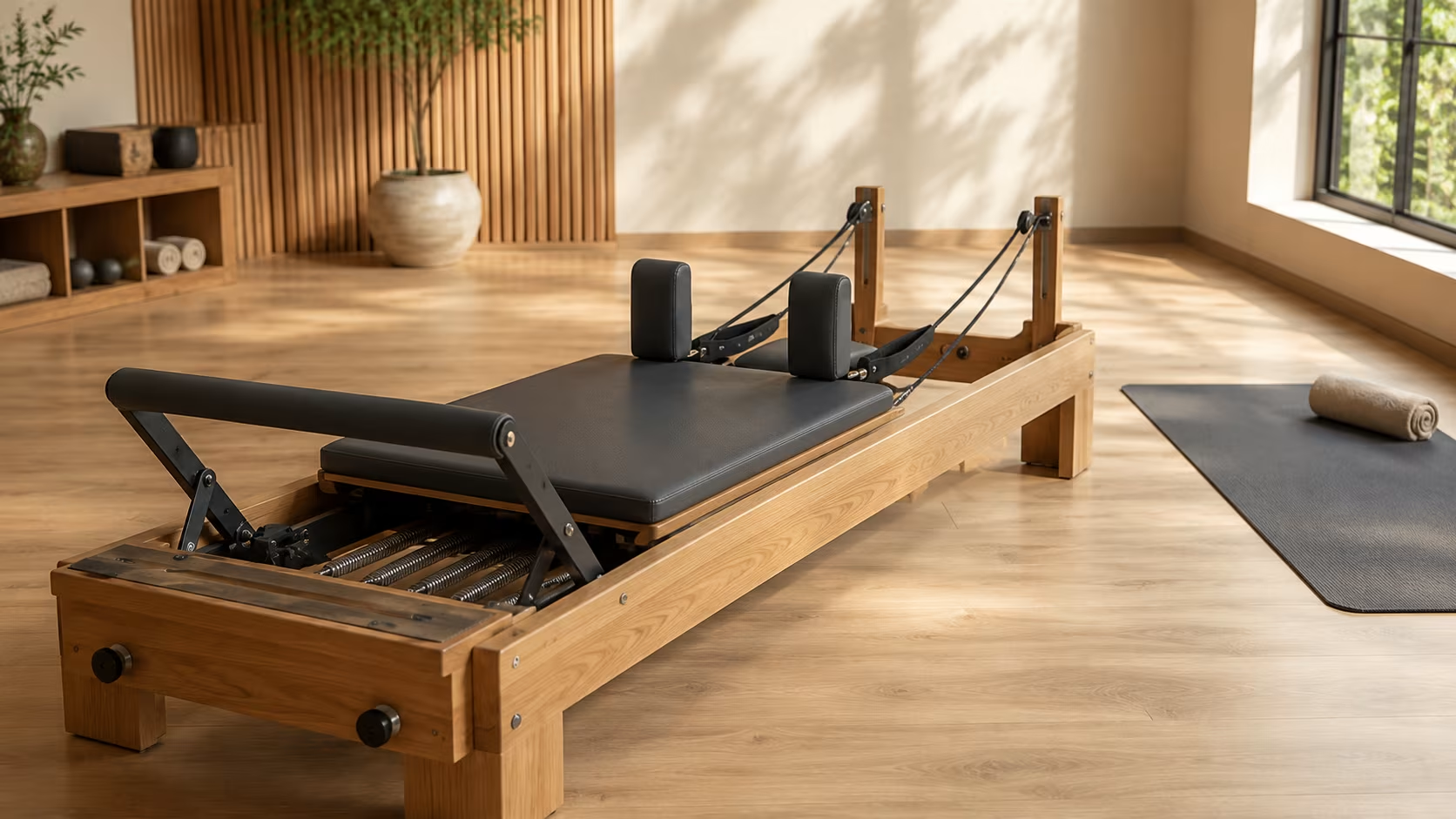
A few areas where Pilates is supplementary rather than primary:
Cardiovascular fitness
Pilates is low-cardiovascular-demand for most practitioners. It doesn't replace running, cycling, swimming, or other aerobic work for heart and lung development.
Significant strength gains
The loads in Pilates are typically light. People wanting to gain measurable muscle mass need progressive resistance training with heavier loads.
Bone density preservation
Pilates may help slightly via balance and postural awareness, but the loading isn't usually high enough to stimulate substantial bone adaptation. Weight-bearing exercise and resistance training do more here.
Pure flexibility (passive range of motion)
Pilates emphasizes active control through range, not passive flexibility. Yoga and static stretching produce different (often greater) passive flexibility gains.
The right framing: Pilates is one component of a varied movement practice. People who do only Pilates are missing some training stimuli. People who do no Pilates are missing others. The combination of strength, cardiovascular work, and Pilates-style mobility/stability work covers more ground than any single discipline alone.
The Cost and Time Calculation
A rough comparison in major US cities in 2026:
Reformer studio
- Single class: $35–60
- 10-pack: $300–500
- Monthly unlimited: $200–350
- Private session: $90–150 per hour
Mat class at gym:
- Included with gym membership ($30–100/month for the gym)
- Or independent studio at $20–35 per class
Home practice
- Online subscription (Pilates Anytime, Glo, others): $15–25/month
- Free YouTube channels with quality instruction available
- Mat: $25–50 one-time
For consistent practice (3 sessions per week), the math:
- Reformer at single class price: $400–700/month
- Reformer with unlimited pack: $200–350/month
- Studio mat: $240–420/month
- Gym mat with included classes: $30–100/month
- Home practice: $15–25/month
The reformer premium is substantial. For some people, it's worth it. For others, gym-based mat practice supplemented with occasional reformer sessions provides most of the benefit at a fraction of the cost.
Home Practice Considerations
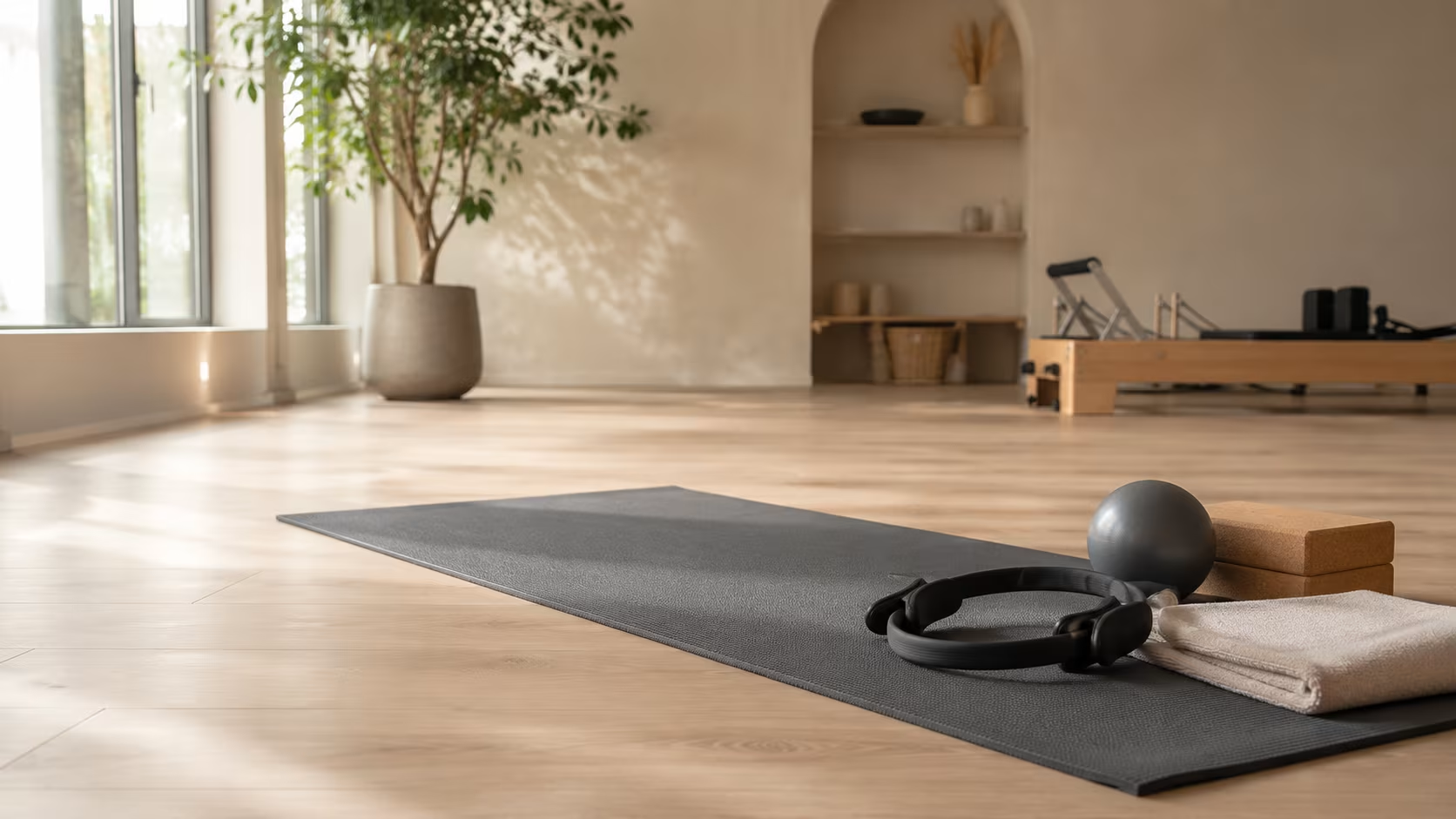
Home Pilates is increasingly viable. Some considerations:
Start with instruction
A few in-person classes — at a studio or with a private instructor — establish baseline form. Pure self-taught Pilates often reinforces compensations that limit benefit and risk injury.
Choose instructors carefully online
YouTube has both excellent and poor Pilates content. Look for instructors with comprehensive Pilates training (BASI, Stott, Romana's Pilates, Polestar are reputable certification bodies). Some popular wellness influencers teach modified versions that share little with classical Pilates.
Build incrementally
A daily 20-minute home practice often beats a weekly 60-minute class for total benefit. Short, frequent sessions reinforce neural patterns and build strength gradually.
Use a real mat
A yoga mat works but is generally thinner than ideal for Pilates. Dedicated Pilates mats provide more padding for spine work. Worth the small investment if you'll practice regularly.
Consider a reformer eventually
Home reformers exist for $1,500–4,000. Worth considering for serious practitioners who'd otherwise spend that much on studio classes within 6–12 months.
What to Expect From Class to Class
A first few weeks of Pilates often produces specific experiences:
Soreness in unexpected places
Pilates targets muscles that other training often misses — deep abdominals, glute medius, serratus anterior, posterior shoulder. New practitioners often report soreness in muscles they didn't know they had.
Confusion at terminology
Classical Pilates uses specific terminology — "scoop the abs," "navel to spine," "lengthen through the crown of the head" — that doesn't always translate to body awareness immediately. The vocabulary becomes more meaningful with practice.
Pelvic floor awareness
Many Pilates exercises engage the pelvic floor consciously. For people who've never thought about this musculature, the awareness itself is novel.
Slow visible progress, fast subjective changes
People often report feeling different (more aware, more upright, easier breathing) before they look or measure differently. The subjective shift comes first; measurable strength and mobility changes follow over 8–12 weeks.
Plateau around month 3
A common pattern: rapid initial gains, then a plateau. This is normal and usually resolves with class variation, instructor changes, or moving to slightly more advanced practice.
Sources
Yamato, T. P., et al. (2015). Pilates for low back pain. Cochrane Database of Systematic Reviews, (7), CD010265.
Wells, C., Kolt, G. S., & Bialocerkowski, A. (2012). Defining Pilates exercise: a systematic review. Complementary Therapies in Medicine, 20(4), 253–262.
Bullo, V., et al. (2015). The effects of Pilates exercise training on physical fitness and wellbeing in the elderly: a systematic review for future exercise prescription. Preventive Medicine, 75, 1–11.
Cruz-Ferreira, A., et al. (2011). A systematic review of the effects of Pilates method of exercise in healthy people. Archives of Physical Medicine and Rehabilitation, 92(12), 2071–2081.
Lim, E. C. W., & Poh, R. L. C. (2022). Pilates-based exercises for non-specific chronic low back pain: a systematic review with meta-analysis of randomized controlled trials. Disability and Rehabilitation, 44(20), 5805–5817.
Latey, P. (2001). The Pilates method: history and philosophy. Journal of Bodywork and Movement Therapies, 5(4), 275–282.
Frequently Asked Questions
Is reformer Pilates better than mat?
Different, not strictly better. The reformer provides spring-resistance that can assist beginners through difficult positions and add resistance to make stronger work harder. Mat Pilates uses bodyweight and gravity exclusively, which can be more demanding for some movements and easier for others. The right starting point depends on your fitness baseline and goals.
Why is reformer so expensive?
Reformer studios run small group classes (3–10 people) with expensive equipment requiring qualified instructors. A reformer machine costs $3,000–8,000 retail. The per-class price (often $35–60 in major cities) reflects equipment depreciation, instructor wages, and limited class capacity. Mat classes scale to larger groups and don't require equipment, hence the lower price.
Can I do Pilates at home without equipment?
Yes, with caveats. Mat Pilates done at home — following videos or online classes — provides much of the core strength and mobility benefit. The technical precision matters; without an instructor watching, form errors can persist. A few in-person sessions to learn the basics, then home practice, is a common approach.
How long until I see results from Pilates?
Studio convention says '10 sessions to feel it, 20 to see it, 30 to have a new body.' The 30-session number tracks with what the research suggests for measurable strength and mobility changes — roughly 10–12 weeks of 2–3 sessions per week. People often report feeling better immediately (postural awareness, body awareness) before visible changes show up.
Is Pilates good for back pain?
Modest evidence, yes — particularly for chronic non-specific low back pain. Several meta-analyses have shown Pilates reduces pain and disability scores compared to no treatment, with effects similar to general exercise. The improvement is real but not magical; Pilates is one of many exercise modalities that helps.


0 Comments
Leave a comment
Your email won't be published. Required fields are marked with *.