


Walk into a high-end Pilates studio in any running town — Boulder, Boston, Eugene — and you'll find half the schedule labeled "Pilates for Runners." The pitch is consistent: stronger core, better hip stability, fewer injuries, faster times. The pitch is not entirely wrong. It is also not entirely right.
Here's what the evidence actually shows, what it doesn't, and how to think about adding Pilates to a running practice without overcommitting to claims it can't keep.
What Pilates can plausibly do for a runner
Three things, with reasonable evidence behind them.
It can improve running economy by a small but real margin. Several controlled studies have found that 6 to 12 weeks of regular Pilates training reduces the oxygen cost of running at a given submaximal pace, on the order of 1 to 3 percent. That doesn't sound like much. In a marathon, it can be the difference between holding goal pace at mile 22 and not.
It can improve trunk endurance and lateral hip strength, which together affect running form under fatigue. The cross-pelvic drop — the way the unsupported hip drops when the foot is in the air — gets worse as the gluteus medius and trunk fatigue. Pilates directly trains both. Studies measuring kinematics before and after Pilates blocks have shown reduced contralateral pelvic drop and reduced trunk lean.
It can give you a better proprioceptive map of your own body. This is harder to quantify and easier to feel. Six weeks into regular practice, most runners report knowing where their pelvis is, what their feet are doing, and how their breath relates to their stride in a way they didn't before. That awareness pays off in the small mid-run adjustments that prevent overuse patterns from compounding.
That's three honest claims, with studies behind them. Anything beyond that gets speculative.
What it probably can't do
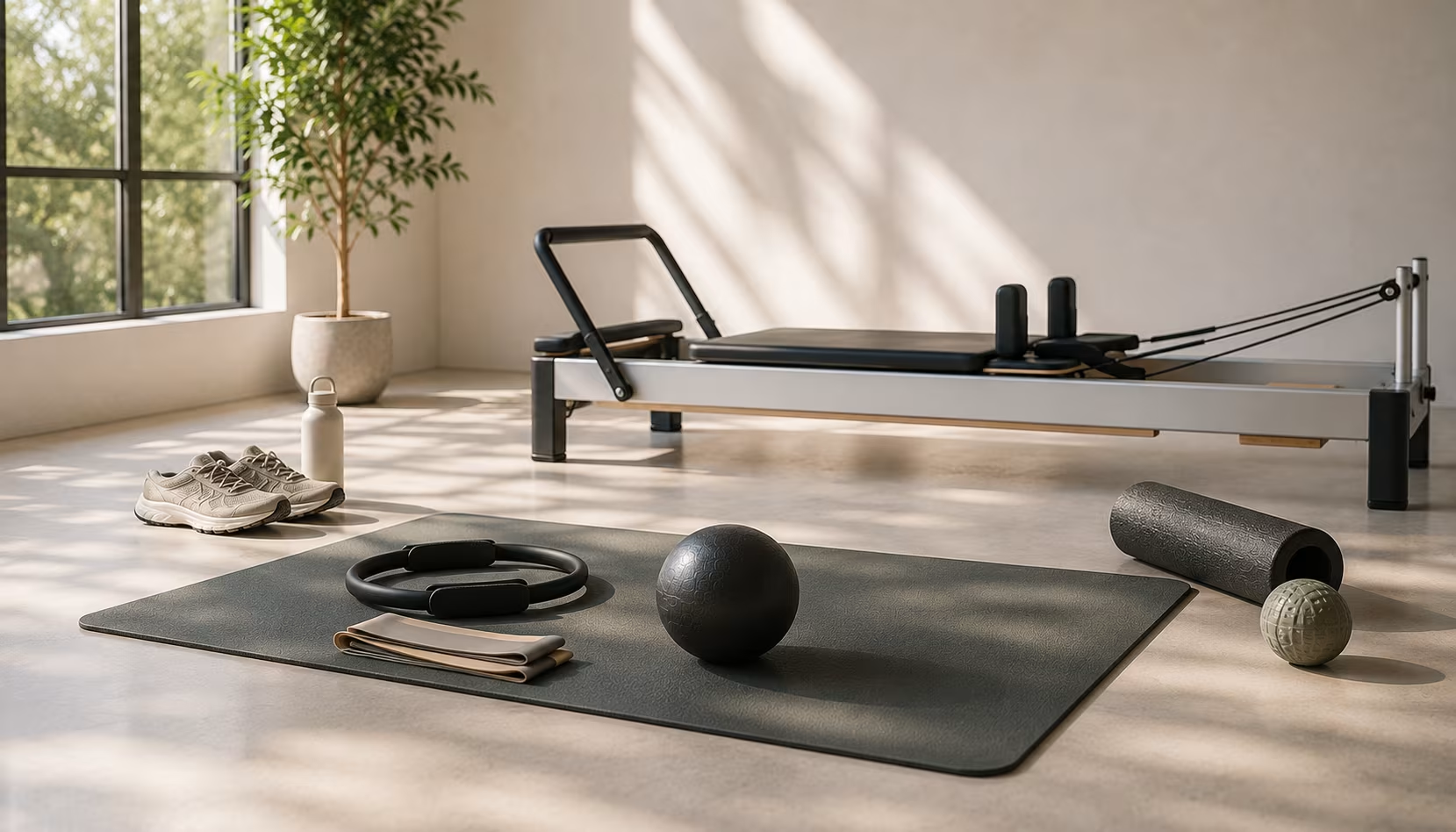
It can't replace strength training. The forces in running peak at 2 to 3 times bodyweight per stride, and the tissues that handle those forces — tendons, the connective tissue around the joint capsules, the muscle-tendon junctions — adapt to load. Pilates loads the system in interesting ways but rarely loads it heavy. If your hamstrings or your patellar tendon need more resilience, heavy slow resistance work does that better than any number of footwork series on the reformer.
It probably can't prevent the most common running injuries on its own. The injury data here is mixed. A few studies have shown reduced injury rates in groups doing Pilates alongside running, but the same data shows reduced injury rates in groups doing almost any well-programmed adjunct training. Strength work, plyometrics, even a structured walking program have shown similar effects. The active ingredient may be "doing something other than running" rather than Pilates specifically.
It can't undo the consequences of bad mileage decisions. If you're running too much, too fast, on inadequate sleep, no amount of Pilates is going to keep your tibia healthy. Most running injuries are loading errors, and loading errors get fixed by changing the load.
The running economy question
Running economy is one of the few performance variables in distance running that adult athletes can still meaningfully change. VO2 max is somewhat trainable but largely fixed in your twenties. Lactate threshold moves with smart training but plateaus. Economy — how much oxygen you burn at a given pace — keeps improving for years, and the improvements come from a handful of sources: gait mechanics, neuromuscular efficiency, tendon stiffness, trunk stability, and breathing patterns.
Pilates touches several of these. The trunk stability work reduces wasted lateral movement at the pelvis, which means less energy spent stabilizing and more available for forward propulsion. The breath work, particularly the lateral rib expansion that Pilates emphasizes, helps with the breathing patterns that hold up under fatigue.
A 2017 study by Finatto and colleagues followed recreational male runners through 12 weeks of twice-weekly Pilates added to their normal training. Compared to a control group that just kept running, the Pilates group showed improved running economy at lactate threshold pace and improved 5K times. The economy improvement was about 5 percent at the higher pace, which is on the larger end of what anyone has measured.
A 2020 systematic review (Laws et al.) pooled the running-and-Pilates studies and concluded that the effect is real but modest, with the strongest evidence for trunk stability, hip strength, and small running economy gains. The reviewers noted what every reviewer notes: the studies are small, the protocols vary, and the placebo of "doing focused training and feeling fitter" is hard to control for.
The honest summary: if you add Pilates twice a week for three months and don't change anything else, you'll probably get a little faster and feel a little better. If you don't, you haven't done it consistently enough, or your running training isn't where the bottleneck is.
Hip stability and the cross-pelvic drop
Watch a tired runner from behind in the last miles of a marathon. The unsupported hip drops a little with each step on the opposite leg. This is the cross-pelvic drop, also called the contralateral pelvic drop, and it's one of the most studied gait variables in running biomechanics.
It matters for two reasons. Excessive drop is associated with a higher risk of iliotibial band syndrome, patellofemoral pain, and gluteal tendinopathy. And it leaks energy — every degree the pelvis drops is a small spring loaded that doesn't return as forward motion.
The drop is mostly controlled by the gluteus medius on the stance leg, with help from the deep abdominals and the quadratus lumborum. Pilates trains all three, often simultaneously. Side-lying leg work, standing single-leg work on the reformer, kneeling side bends — these target the lateral chain in ways that more general strength work often skips. The glute med specifically responds well to the slow, controlled, end-range work that Pilates emphasizes.
If you're going to focus your Pilates time on one thing as a runner, this is a defensible choice. Even one good side-lying series done well, two to three times a week, will change how your hips feel after a long run within a few weeks.
The trunk: rotation, not just bracing
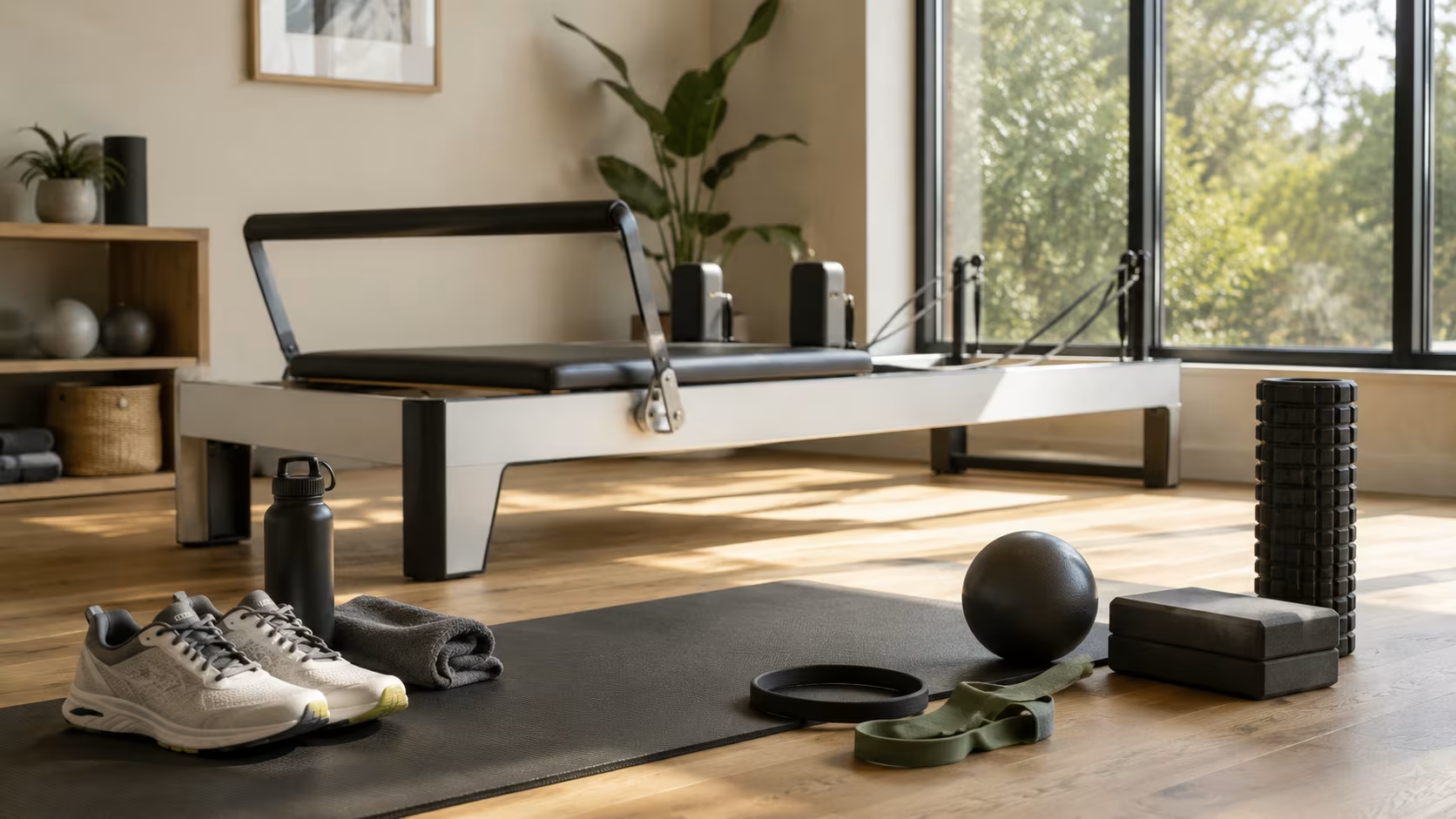
The trunk advice runners hear most often — "engage your core" — is basically wrong, or at least incomplete. Running is a rotational activity. The arms swing, the trunk counter-rotates, and the energy transfers diagonally across the body from shoulder to opposite hip. A trunk that's locked into bracing patterns can't do this efficiently.
Good Pilates work for runners includes rotational and counter-rotational exercises specifically. Spine twist, saw, criss-cross, side bend with rotation — these train the obliques and the deeper trunk rotators in the patterns that running actually uses. The classical mat sequence is rich in this work. The reformer adds load to it.
This is also why bracing-style core training (planks, dead bugs, hollow holds done as the only ab work) often disappoints runners who try it. The trunk gets stiffer, but stiffness isn't what running needs. Running needs controlled, repeatable rotation through fatigue. That's a different training target.
What a runner-friendly session actually looks like
If you're going to spend 50 minutes on Pilates twice a week as a runner, here's a defensible structure. Mat or reformer, both work.
Open with breath and trunk awareness. Five minutes. The breath pattern here is more important than the duration. Lateral rib expansion, full exhale to engage the deep abdominals, light pelvic floor coactivation. This is the warm-up for the trunk that runners almost never do otherwise.
Move into a deep abdominal sequence. Ten to fifteen minutes. Hundred (modified or full), single leg stretch, double leg stretch, criss-cross. The point is the breath-trunk coordination, not the burn. If your form deteriorates, stop.
Add a hip series. Fifteen minutes. Side-lying clams and leg lifts done slowly with the spine long, kneeling side bends, single-leg standing work if you have a reformer. This is where you get the gluteus medius work that prevents the cross-pelvic drop. Don't rush.
Finish with rotation and length. Ten to fifteen minutes. Spine twist, saw, mermaid, a long supine hamstring and hip flexor sequence. Runners need length in the hip flexors and hamstrings; this is the place to address that without overstretching.
Skip anything that feels like a yoga class trying to look like Pilates — long held stretches, deep flexion, anything that puts your spine in a position that running already overworks. The point is to complement running, not to add another stress to the same tissues.
Programming around hard running days
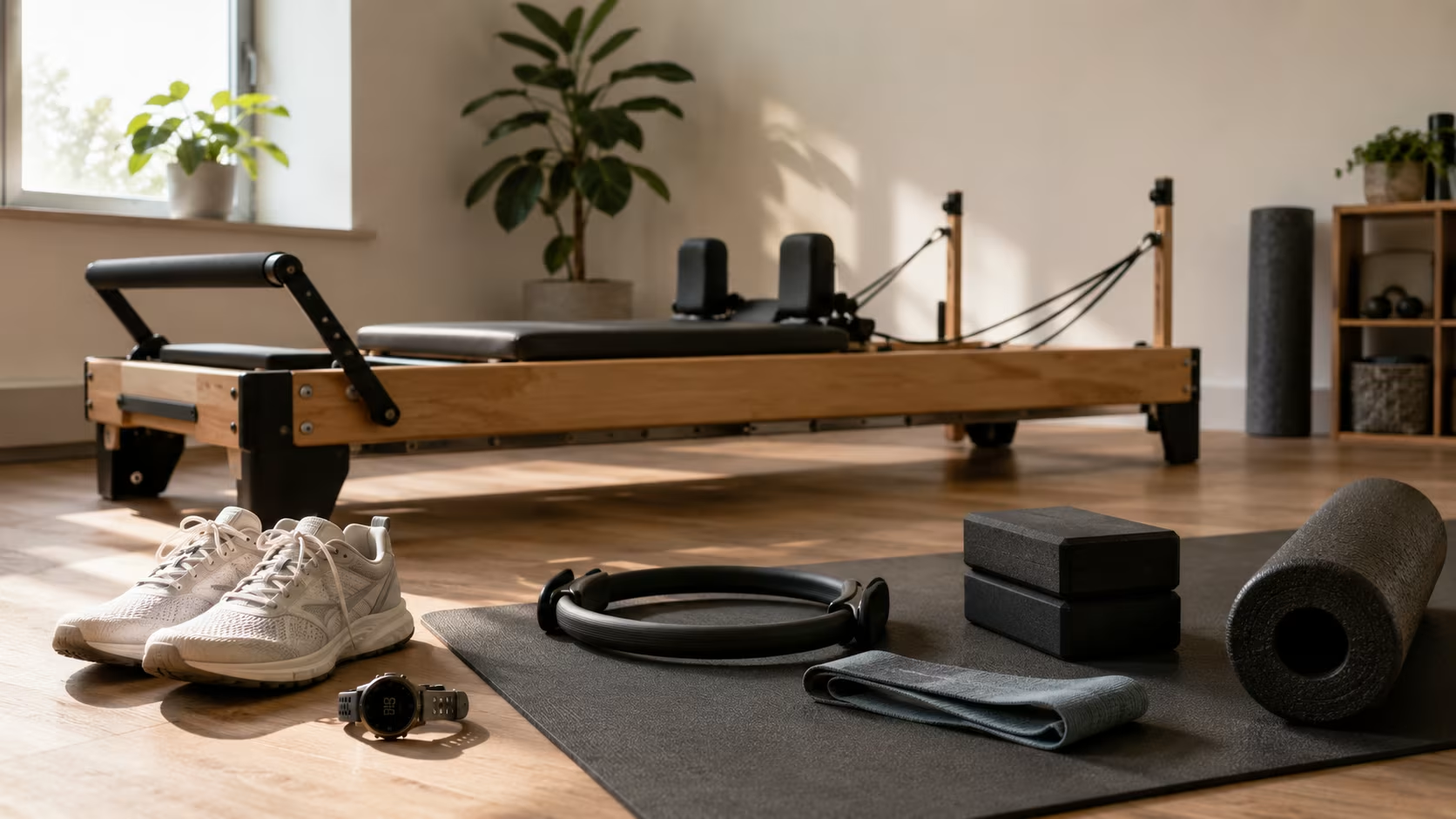
The when matters as much as the what.
Day before a quality session (intervals, tempo, long run): light Pilates only. Breath work, gentle mat sequence, no heavy single-leg loading. You want to feel mobile, not sore.
Day of a quality session, after the run: this is the sweet spot for harder Pilates work. The legs are warm, the trunk is online, and the next 24 hours are recovery anyway. A full session here is well-placed.
Easy run day Pilates can stand on its own. A full session in the morning, easy run in the afternoon, or vice versa. They don't interfere with each other much.
Race week light, familiar work only. This is not the week to try a new reformer class. Stick to a short version of your usual mat sequence, mostly breath and gentle hip work. Anything that produces unfamiliar soreness is a problem.
Off-season this is when you can build the most. Three sessions a week for 8 to 12 weeks during a base-building phase will produce the kind of changes that show up next season.
When Pilates is the wrong answer
A few situations where the time would be better spent elsewhere.
You're nursing an acute injury and looking for a fix. Pilates is not rehab unless it's prescribed by someone who knows your injury. A studio instructor, however good, isn't a sports physiotherapist. Get the right diagnosis first.
You're already strong but slow. If your strength training is solid, your trunk is well-trained, and your VO2 max is your limiter, more Pilates isn't going to move the needle. More running probably will.
You hate it. Adherence is the only training variable that matters in the long run. If you've tried Pilates for two months and you dread every session, the marginal economy improvements aren't worth the dread. Try yoga, try targeted strength work, try anything you'll actually do. The best supplementary training is the one you'll keep doing in February.
You're in the middle of a peak training block. Adding new training stress during a peak is a bad idea regardless of what the new stress is. Build Pilates in during base, not during sharpening.
Sources
Finatto, P., Silva, E. S. D., Okamura, A. B., Almada, B. P., Oliveira, H. B. D., & Peyré-Tartaruga, L. A. (2018). Pilates training improves 5-km run performance by changing metabolic cost and muscle activity in trained runners. PLOS ONE, 13(3), e0194057.
Laws, A., Williams, S., & Wilson, C. (2017). The effect of clinical Pilates on functional movement in recreational runners. International Journal of Sports Medicine, 38(10), 776–780.
Bredeweg, S. W., Kluitenberg, B., Bessem, B., & Buist, I. (2013). Differences in kinetic variables between injured and noninjured novice runners: A prospective cohort study. Journal of Science and Medicine in Sport, 16(3), 205–210.
Noehren, B., Pohl, M. B., Sanchez, Z., Cunningham, T., & Lattermann, C. (2012). Proximal and distal kinematics in female runners with patellofemoral pain. Clinical Biomechanics, 27(4), 366–371.
Snyder, K. R., Earl, J. E., O'Connor, K. M., & Ebersole, K. T. (2009). Resistance training is accompanied by increases in hip strength and changes in lower extremity biomechanics during running. Clinical Biomechanics, 24(1), 26–34.
Cruz-Ferreira, A., Fernandes, J., Laranjo, L., Bernardo, L. M., & Silva, A. (2011). A systematic review of the effects of Pilates method of exercise in healthy people. Archives of Physical Medicine and Rehabilitation, 92(12), 2071–2081.
Frequently Asked Questions
How often do runners need to do Pilates to see a benefit?
The studies showing performance benefits used two sessions per week of about 50 minutes each, sustained over 6 to 12 weeks. One session a week probably maintains what you have. Less than that is more about feeling good than measurable change.
Will Pilates make me a faster runner?
By itself, no. It can improve running economy slightly, which means you use a bit less oxygen at a given pace. That's a real effect, on the order of 1 to 3 percent in trained runners over a few months. The faster runners in your race aren't faster mainly because they do Pilates.
Reformer or mat Pilates for runners?
Reformer adds adjustable resistance and lets the legs work in spring-loaded extension, which mimics the running stride well. Mat costs nothing and trains the trunk in body weight positions. Most runners get more out of reformer if it's accessible. Mat is fine if it isn't.
Should I do Pilates the day before a long run?
A short, low-load session is fine. A heavy or unfamiliar session isn't, especially anything with a lot of single-leg loading or eccentric work — your hips will be sore in places you don't want them sore at mile 12.


0 Comments
Leave a comment
Your email won't be published. Required fields are marked with *.