


The body scan is one of the simplest meditation practices to describe and one of the most overlooked in popular meditation discussions. It's the practice that gets covered in week one of MBSR and then often dismissed by students as something to graduate from once they're "ready" for real meditation. This is exactly backwards. The body scan is a complete meditation practice that does specific work no other practice quite replicates.
Here's what the body scan is, how to do it well, what it's training, and why it might be the most useful contemplative practice for many beginners and many long-term practitioners alike.
What the body scan actually is
The body scan is a structured meditation in which attention is moved systematically through different regions of the body, with the practitioner observing whatever sensation is present in each region without trying to change anything.
Lie down or sit comfortably. Close the eyes if comfortable. Bring attention to one end of the body — the feet are most common, though some traditions start at the head. Notice whatever sensations are present at that location: pressure, temperature, tingling, movement, neutrality, the sense that nothing is there. Stay with that region for some period — perhaps 30 seconds for a shorter practice, several minutes for a longer one — then move attention to the next region. Continue until you've moved through the entire body.
That's the basic instruction. Everything else is variation, refinement, and recovery from common patterns of difficulty.
What distinguishes the body scan from related practices: the systematic structure (you move through the body in order, not jumping around), the sustained attention to specific regions (you stay long enough for sensation to emerge), the explicit non-doing orientation (you observe without trying to change), and the distribution of attention to areas typically ignored in daily life.
The practice came into Western secular meditation primarily through Jon Kabat-Zinn's MBSR program, where it appears in week one and continues throughout the eight weeks. Kabat-Zinn drew on Burmese vipassana tradition for the specific technique. The practice has analogues in other contemplative traditions but the systematic version popularized by MBSR is somewhat distinctive.
The physiology of why it works

Several mechanisms appear to contribute to what the body scan does.
Interoceptive awareness training
Interoception is the perception of internal bodily states — heart rate, breathing, hunger, temperature, muscle tension. Most adults have moderate to poor interoceptive awareness, which is associated with various psychological difficulties including alexithymia (difficulty identifying emotions), anxiety amplification, and reduced emotional regulation. Direct training of interoceptive attention, like the body scan provides, improves this capacity over time.
Parasympathetic activation
The slow, sustained, non-demanding attention of the body scan tends to produce a parasympathetic shift — slowed heart rate, increased heart rate variability, reduced cortisol. This isn't quite the same mechanism as breath-focused practice; the body scan includes breath awareness as a component but isn't centered on it.
Default mode network shifts
The default mode network is a set of brain regions active during self-referential thinking, mind-wandering, and rumination. Sustained attention practices including the body scan reduce activity in these regions and reduce the rumination that contributes to anxiety and depression.
Pain reprocessing
For people with chronic pain, the body scan provides repeated, structured exposure to bodily sensations including unpleasant ones, in a context of non-reactivity. Over time, this changes how the nervous system processes pain signals, often reducing pain intensity and the suffering associated with pain.
Tension dissolution
Bringing attention to areas of held muscular tension, without trying to release the tension, often produces release anyway. This is a paradoxical feature of attention — that which is held in awareness without resistance often softens of its own accord.
Embodiment
Modern adults spend much of their time disconnected from the body, attention captured by screens, abstractions, and verbal thinking. The body scan reverses this, providing extended structured time with attention firmly located in physical sensation. The cumulative effect of this reorientation is real and matters for mental and physical wellbeing in ways that are hard to measure but easy to notice.
The classic MBSR sequence
The standard MBSR body scan, which has been recorded in many slightly different versions but follows a consistent pattern.
Begin lying down on your back, arms at your sides with palms up, legs extended, eyes closed. Take a few minutes to settle into the position, allow the body to relax into the support beneath you, and notice the breath without trying to change it.
Bring attention to the toes of the left foot. Notice whatever sensation is present in the toes. Move slowly, not analyzing, just observing. After 30 seconds to a minute, expand attention to include the rest of the foot — the sole, the top, the heel, the ankle. Notice all the sensations.
Move attention up the lower leg — the calf, the shin. Note the sensations of contact with the floor, the temperature, any tingling or pulsing.
Continue to the knee, the upper leg, the hip. Take your time. Each region gets sustained attention, not just a flicker.
Move to the right foot and repeat the sequence: toes, foot, lower leg, knee, upper leg, hip.
Bring attention to the pelvis, the lower abdomen, the lower back. Notice the breath as it moves the abdomen. Notice the sensations of the pelvis against the floor.
Move up through the abdomen, the chest, the upper back. Notice the breath, the heartbeat if you can detect it, any other sensations.
Move attention to the fingers of one hand, then the whole hand, then up the arm — wrist, forearm, elbow, upper arm, shoulder. Repeat for the other arm.
Move to the neck, the throat, the jaw. Notice tension that may be held here.
Continue to the face — the lips, the cheeks, the eyes, the forehead, the scalp.
Finally, bring attention to the entire body as a whole. Sense the body as a single unified field of sensation. Rest in this awareness for a few minutes.
End by gently moving the fingers and toes, opening the eyes, and slowly returning to ordinary awareness.
The whole sequence takes 30 to 45 minutes when done at the typical MBSR pace. Shorter versions can compress the sequence; longer versions can spend more time in each region.
Common errors and how to fix them
Several patterns interfere with the body scan in predictable ways.
Going too fast
The most common error. Beginners often speed through the sequence, spending five seconds per region instead of 30 to 60. This skips past the actual work of the practice — the time required for sensation to emerge into awareness, for the attention to stabilize, for any tension to begin softening. If the whole scan takes less than 15 minutes, you're moving too fast.
Trying to feel something
When attention reaches an area and there's no immediate strong sensation, the temptation is to manufacture one — to imagine warmth, to flex the muscles, to invent feeling. The instruction is the opposite: notice what's actually there, including the absence of clear sensation. "I don't feel much in this area" is itself the experience of that area in this moment.
Trying to relax
The body scan is often taught alongside or as a relaxation technique, which can produce confusion about the goal. Relaxation is often a side effect of the scan, but it's not the goal. The goal is non-reactive awareness. Trying to relax introduces effort and frustration when relaxation doesn't happen.
Falling asleep
Common, especially when done lying down at the end of the day. If sleep is the goal, this is fine. If meditation training is the goal, sleep undermines the practice. Solutions: do the scan sitting up rather than lying down, do it at a more alert time of day, keep eyes slightly open, or accept the practice as a sleep aid and do separate sitting meditation for skill development.
Avoiding difficult sensations
When attention reaches an area of pain, tension, or unpleasantness, the natural pull is to skip it or to leave quickly. The practice asks for sustained attention even with unpleasant sensation, observing without resistance. This is hard. It's also where significant work happens for chronic pain and tension patterns.
Rumination disguised as practice
"I notice my back hurts. I should really do something about that. Maybe I need a new mattress. The mattress is expensive though, and..." This is thinking about the body, not attending to it. The practice is wordless attention to direct sensation. When you notice you're in narrative mode, return to direct sensing.
Going through the motions
After many sessions, the structure can become automatic and the attention habitual rather than fresh. Each scan should be approached as a new experience of the body, not a repetition of past scans. The body changes from session to session and day to day.
Variations: shorter, sitting, walking
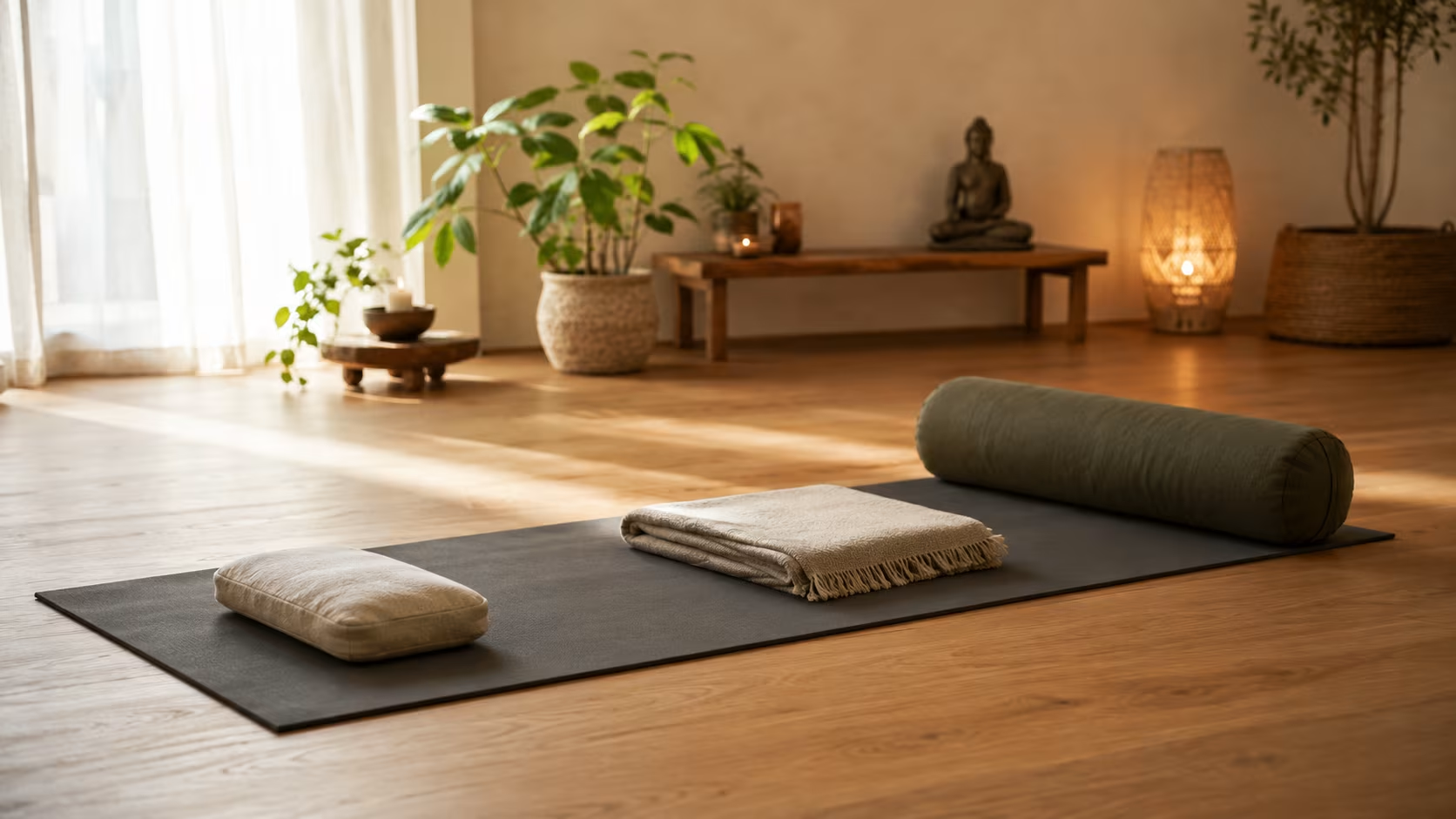
The classic 45-minute lying-down body scan is one form. Several variations are useful in different contexts.
Short body scan (10 to 15 minutes)
Move through the body more quickly, with less time per region. Useful as a daily practice when time is limited. The attention quality may be slightly less developed than in longer sessions, but consistency over time matters more than session length.
Seated body scan
Done sitting upright in a chair or on a cushion. Similar sequence but with adjustments for the seated position. Avoids the sleep tendency. Useful at any time of day.
Standing body scan
Done standing in a balanced posture. The work changes somewhat — the body is actively engaged rather than supported, so awareness includes the small adjustments of balance. Useful for transitional moments during the day.
Walking body scan
Done while walking slowly, with attention moving through the body during the walk. A form of walking meditation. The attention is somewhat split between the walking and the scanning, which makes it more cognitively demanding.
Brief informal scans
A 60-second mini-scan during the day — sitting at your desk, in line at a store, before a difficult conversation. Quickly move attention from feet to head, noting overall body state. Useful for interrupting tension patterns and checking in with the body during busy days.
Targeted scans
Focusing on a specific region — usually one with chronic pain, tension, or some particular interest. Spend 20 minutes attending in detail to the shoulders, or the lower back, or the abdomen. Useful for working with specific issues.
The standard 30-to-45-minute version is the one with the most research support, but the variations have their place. A daily practice that includes a long version a few times a week and shorter versions on busier days is sustainable and effective.
What to expect over weeks of practice
The body scan reveals itself gradually over weeks and months of practice.
Weeks 1 to 2
The basic mechanics. Most attention goes to maintaining the structure and trying not to fall asleep. Awareness of the body is somewhat surface-level. The mind wanders frequently, often into planning or worry. This is normal.
Weeks 2 to 4
Awareness of body becomes more textured. You start to notice areas of held tension that you didn't know were there. Some sessions feel deeper than others. The capacity to sustain attention through unpleasant sensations begins to develop.
Weeks 4 to 6
The shift from "doing" the scan to "being with" the body. Less effort, more simple presence. Areas that consistently held tension may begin to soften without effort. Subtle sensations become available — the pulse in different areas, the breath moving distant body parts, the changing quality of attention itself.
Weeks 6 to 8
The practice begins to extend into daily life. Attention to the body becomes more available outside of formal practice. Tension patterns get noticed earlier and addressed more easily. Sleep often improves.
Beyond two months
The body scan becomes a deep familiar practice that reveals new things each session. Months and years of regular practice continue to deepen the awareness of subtle aspects of bodily experience. The gap between the body of formal practice and the body of daily life narrows.
The depth available in this practice is much greater than the simple instructions suggest. Twenty-year practitioners still describe surprising new experiences in body scans. This is not because the practice gets fancier — it doesn't — but because the awareness gets more refined, allowing more subtle aspects of experience to come into view.
The body scan for specific situations

Several situations where the body scan is particularly useful.
Sleep difficulty
A body scan in bed before sleep, especially the longer version, can dramatically improve sleep onset for many people. The downward shift in arousal that the practice produces, combined with the structured attention that interrupts pre-sleep rumination, is well-suited to the difficulty falling asleep. The practice has been included in cognitive behavioral therapy for insomnia for this reason.
Chronic pain
The body scan is a core component of Mindfulness-Based Pain Management programs. The repeated, structured exposure to bodily sensation including unpleasant sensation, in a context of non-reactivity, changes the nervous system's relationship with pain over time. This is well-supported in the chronic pain research.
Anxiety
The body component of anxiety — the held tension, the racing heart, the shallow breathing — is directly addressed by the body scan. Some anxiety responds particularly well to body-focused practices because the cognitive-only approaches don't reach the somatic component.
Trauma recovery
With caveats. The body scan can be helpful in trauma recovery because trauma is stored in part as bodily patterns. The same feature can make standard body scans difficult for trauma survivors, as somatic memories may surface that need support to process. Trauma-sensitive variations exist and are the appropriate framework for this work.
Recovery from illness
The body scan can help re-establish embodied connection during recovery from illness, surgery, or extended physical difficulty. The non-demanding nature of the practice fits the limited capacity of recovery; the gradual reconnection with the body supports the larger recovery process.
Periods of dissociation or numbness
Some people experience extended periods of disconnection from the body — common in stress, depression, and after trauma. The body scan provides a structured way to gradually reestablish embodied awareness without overwhelming the system.
How it differs from progressive muscle relaxation
The body scan is sometimes confused with progressive muscle relaxation (PMR), an older relaxation technique developed by Edmund Jacobson in the 1920s. They share some features but differ in important ways.
PMR involves systematically tensing and then releasing different muscle groups. Tense the muscles in the foot for 5 seconds, then release. Move to the calf, tense and release. Continue through the body. The tensing-releasing cycle teaches the contrast between tension and relaxation, helping people recognize tension and learn to release it.
The body scan involves no tensing. Attention is brought to each region without changing anything. The intervention is purely attentional, not muscular.
Both can produce relaxation effects. The mechanisms are different. PMR works partly through the muscular cycle and partly through attention; the body scan works through attention alone.
For pure relaxation, both are effective. For developing the broader capacities of meditation — sustained attention, non-reactivity, embodied awareness — the body scan does more, because PMR's manipulation of muscles takes attention away from the work of pure observation.
For people new to body practices, PMR is sometimes easier as a first step because the tensing-releasing cycle is more obviously "doing something." The body scan's pure observation can feel like nothing at first, until the practice deepens and the work of observation reveals itself.
A reasonable progression: start with PMR if pure observation feels too abstract. After a few weeks, introduce the body scan. Over time, the body scan typically becomes the primary practice as its depth becomes apparent.
Sources
Kabat-Zinn, J. (1990). Full Catastrophe Living: Using the Wisdom of Your Body and Mind to Face Stress, Pain, and Illness. Delacorte.
Mehling, W. E., Wrubel, J., Daubenmier, J. J., Price, C. J., Kerr, C. E., Silow, T., Gopisetty, V., & Stewart, A. L. (2011). Body Awareness: a phenomenological inquiry into the common ground of mind-body therapies. Philosophy, Ethics, and Humanities in Medicine, 6(1), 6.
Farb, N., Daubenmier, J., Price, C. J., Gard, T., Kerr, C., Dunn, B. D., Klein, A. C., Paulus, M. P., & Mehling, W. E. (2015). Interoception, contemplative practice, and health. Frontiers in Psychology, 6, 763.
Cebolla, A., Galiana, L., Campos, D., Oliver, A., Soler, J., Demarzo, M., Baños, R. M., Feliu-Soler, A., & García-Campayo, J. (2018). How does mindfulness work? Exploring a theoretical model using samples of meditators and non-meditators. Mindfulness, 9(3), 860–870.
Schmalzl, L., Crane-Godreau, M. A., & Payne, P. (2014). Movement-based embodied contemplative practices: definitions and paradigms. Frontiers in Human Neuroscience, 8, 205.
Cherkin, D. C., Sherman, K. J., Balderson, B. H., Cook, A. J., Anderson, M. L., Hawkes, R. J., Hansen, K. E., & Turner, J. A. (2016). Effect of mindfulness-based stress reduction vs cognitive behavioral therapy or usual care on back pain and functional limitations in adults with chronic low back pain: a randomized clinical trial. JAMA, 315(12), 1240–1249.
Ong, J. C., Manber, R., Segal, Z., Xia, Y., Shapiro, S., & Wyatt, J. K. (2014). A randomized controlled trial of mindfulness meditation for chronic insomnia. Sleep, 37(9), 1553–1563.
Frequently Asked Questions
How long should a body scan take?
Standard MBSR body scans run 30 to 45 minutes. Shorter versions of 10 to 20 minutes work as a daily practice. Anything under 10 minutes is too rushed to do the actual scanning work; you can't move attention through the body carefully in that time. Longer than 45 minutes is fine but produces diminishing returns.
Is it okay to fall asleep during a body scan?
Falling asleep means the practice has worked as a relaxation technique but failed as a meditation practice. The body scan is supposed to train sustained relaxed awareness, not sleep. If you consistently fall asleep, do it sitting up rather than lying down, do it earlier in the day, or treat it as a sleep practice rather than a meditation practice.
What if I don't feel anything in some parts of my body?
Common and not a problem. Areas with less proprioceptive density (the back, the abdomen) often feel less detailed than areas with more (the hands, the face). Just acknowledge the absence of sensation as the experience of that area in this moment. Trying to manufacture sensation defeats the practice.
Can the body scan help with chronic pain?
Yes, with caveats. The body scan is part of MBSR and Mindfulness-Based Pain Management programs that have evidence for chronic pain. The practice trains a non-reactive awareness of bodily sensation that can change how the nervous system processes pain over time. It's not the same as making the pain go away — it's about changing your relationship with it.





0 Comments
Leave a comment
Your email won't be published. Required fields are marked with *.