

If you walked into a restorative yoga class and a yin yoga class without being told which was which, you'd see similar things from the door. Lights low. Mats spread out. Bodies arranged in unusual positions, supported by various combinations of bolsters, blocks, and blankets. Soft music. People holding poses for what seems like much longer than is reasonable.
The visual similarity has caused decades of confusion in the yoga community. The two styles get used interchangeably in studio marketing, taught with overlapping techniques by teachers who haven't separated them, and often confused by students who can't tell what they're supposed to be feeling.
Underneath the surface, they're after fundamentally different things. The differences matter because they determine what each style can deliver, who they're appropriate for, and how to use them in a complete practice.
Different goals, different mechanisms
The fundamental difference is what each style is trying to affect.
Restorative yoga targets the nervous system. The supported, comfortable positions and long holds are designed to allow the body to drop deeply into parasympathetic activation — the recovery state. The poses are not stretches. The point is not to feel anything physical. The point is to give the nervous system the experience of total physical safety and absence of demand for an extended period, and let the recovery effects unfold.
Yin yoga targets connective tissue. The long, mostly passive holds are designed to apply sustained light tension to the fascia, ligaments, and joint capsules — the connective tissues that don't respond well to brief stretching but do respond to extended low-load loading. The poses look like restorative poses but they're not supposed to be comfortable. There should be a clear sensation of stretch in the targeted area, sustained over minutes, gradually working into the connective tissue around the joint.
The practical implication: if you're in a "yin" class and the teacher props you up so comfortably that you feel nothing, you're actually doing restorative yoga. If you're in a "restorative" class and you're feeling significant stretch sensations, you're actually doing a slow stretching class. Both have value but they're different practices with different effects.
What restorative yoga is doing
Restorative yoga was developed in the West, primarily by B.K.S. Iyengar's student Judith Lasater, who began teaching the style in the 1970s. The practice draws on Iyengar's prop-heavy approach to asana but reorients the work entirely toward parasympathetic recovery.
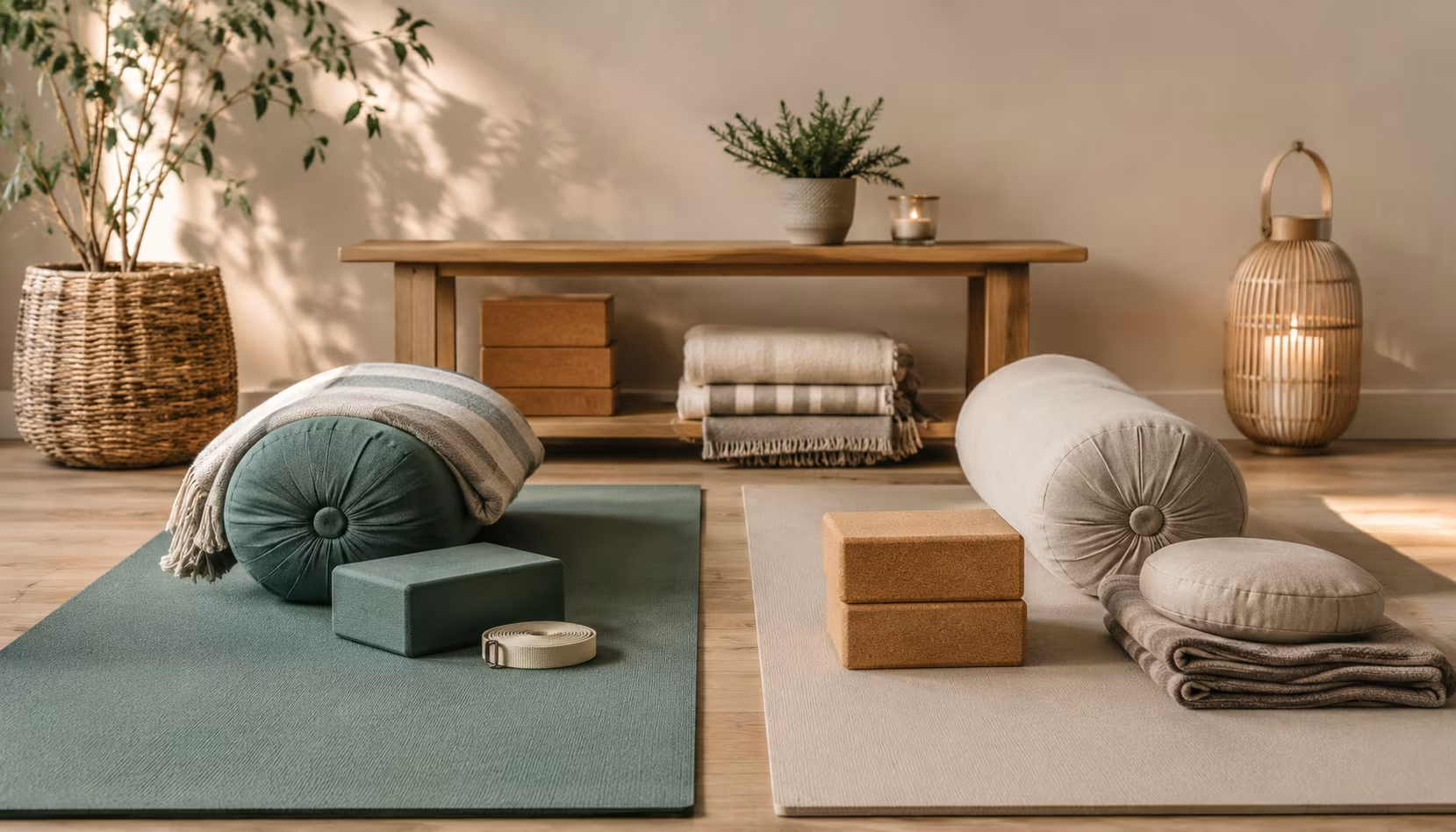
A typical restorative pose involves elaborate propping: a bolster supporting the spine, blankets folded under specific body parts, blocks supporting the head or limbs at exactly the right height. The body is arranged so that the targeted shape (say, a gentle backbend or a hip opener) is achieved without any muscular effort. The student lies in the pose for 5 to 20 minutes, ideally falling into a state somewhere between deep relaxation and waking sleep.
What this does physiologically: extended parasympathetic activation. Heart rate drops. Heart rate variability increases. Blood pressure decreases. Cortisol levels reduce. The recovery effects compound over the duration of the pose in a way that brief relaxation doesn't replicate. A 20-minute supported reclining pose produces nervous system effects that a 5-minute relaxation can't match.
For people in chronic stress states — sustained sympathetic activation, sleep disturbance, recovery-impaired conditions like fibromyalgia or long COVID — restorative yoga is one of the most useful interventions available outside clinical care. The research base is small but consistent: studies have shown reductions in fatigue, improvements in sleep, and reductions in symptoms of anxiety after regular restorative practice.
The skill of the restorative practitioner is the skill of staying still and allowing nervous system regulation to happen, not the skill of getting into demanding shapes. This makes the practice extraordinarily accessible — there's no flexibility requirement, no strength requirement, and almost no learning curve for the physical positions themselves. The hard part is the stillness, which is its own challenge.
What yin yoga is doing
Yin yoga, in its modern form, was developed primarily by Paul Grilley in the 1980s and 1990s, drawing on the work of taoist yoga teacher Paulie Zink and on Grilley's own study of anatomy. The style explicitly differentiates itself from "yang" practices (vinyasa, ashtanga) by targeting different tissues.
The theoretical basis: muscle tissue responds well to brief, repeated stretching but doesn't permanently lengthen much from it. Connective tissue (fascia, ligaments, joint capsules) responds better to sustained low-load tension over time. The yin claim is that to actually change the properties of connective tissue, you need to hold positions for several minutes with light tension applied to the targeted area.
The mechanism is partly speculative. The properties of fascia and how they respond to loading are still an active area of research, and the specifics of what yin practice actually changes are not fully established. What does seem to be true: sustained light tension applied to connective tissue does produce small permanent changes in tissue length and properties over time, with the effects appearing over weeks to months. The same kind of loading is used in physical therapy for joint mobilization.
A typical yin pose: a butterfly fold (sitting with the soles of the feet together, knees out, folding forward over the legs), held for 3 to 5 minutes with a sense of clear sensation in the inner thighs and lower back. The hold is mostly passive — the body weight does the work, with minimal active engagement. The sensation should be in the connective tissue around the hips, not in the muscle belly.
Other common yin poses include the dragon (a deep lunge), the saddle (kneeling and reclining back), the seal (a sphinx-like backbend), and the swan (a deep hip opener). Each targets connective tissue around specific joints. Most yin sequences hit a few major areas — hips, lower back, shoulders — over a 60 to 90 minute class.
The key practical differences
A few specific distinctions that show up in practice.
Sensation level
Restorative: minimal to zero physical sensation. The body is supported so completely that no stretch is felt. Yin: moderate, clear sensation in the targeted tissue. Not pain, but unmistakable stretching feeling that's worked into rather than escaped from.
Use of props
Restorative: extensive props, often elaborate setups with multiple bolsters and blankets. Yin: minimal props, used sparingly to enable the position rather than to eliminate sensation.
Hold duration
Restorative: 5 to 20 minutes per pose, with a class consisting of perhaps 4 to 6 poses total. Yin: 3 to 5 minutes per pose typically, with more poses per class.
Active engagement
Restorative: zero. Total surrender to the support. Yin: minimal, but some active engagement around the joints to maintain the targeted tension and protect the structures.
Mental orientation
Restorative: drift, soften, dissolve. Allow the mind to disengage along with the body. Yin: stay present with the sensation, observe the changes over the duration of the hold, notice resistance arising and passing.
Goal of the pose
Restorative: nervous system regulation. Yin: tissue change and the meditative experience of staying with sustained sensation.
Appropriate for
Restorative: nearly everyone, including the elderly, ill, anxious, postnatal, or post-injury. Yin: most healthy adults, but inappropriate for hypermobile bodies (which are already loose at end-range and don't need more), pregnancy after first trimester (specific positions only), or people with significant joint issues.
These differences are clear in principle but blurry in practice. Many studio classes labeled "yin" do something closer to restorative, or vice versa. Many teachers blend the styles in ways that have value but produce neither pure benefit. Knowing what each is supposed to do helps you sort out what you're actually doing.
Who each one is for
Restorative yoga is for almost anyone who could benefit from explicit, dedicated nervous system recovery. Specific populations who get particular benefit:
People in chronic stress states. The cumulative parasympathetic activation from regular restorative practice can interrupt the sympathetic dominance that characterizes chronic stress, in ways that brief relaxation doesn't.
People recovering from illness. The metabolic and immune effects of parasympathetic activation support recovery in ways that gentle exercise doesn't replicate.
People with anxiety disorders. The structured, predictable, demand-free environment of a restorative class can be a kind of behavioral exposure that the nervous system gradually learns from.
People with chronic fatigue, fibromyalgia, or autoimmune flares. Traditional exercise can worsen symptoms in these populations; restorative practice can be done without producing post-exertional malaise.
Postnatal women in the early months. The combination of physical rest, parasympathetic activation, and time to attend to the body is uniquely suited to early postnatal recovery.
People who have trouble sleeping. An evening restorative practice produces nervous system effects that significantly support sleep onset.
Yin yoga is for healthy adults interested in connective tissue and joint mobility, who can hold sustained sensation with attention. Specific populations who get particular benefit:
People with chronically tight hips, shoulders, or backs from postural patterns. Yin loading addresses the connective tissue that bears the postural load.
Athletes whose sport restricts certain ranges of motion. Yin can address the long-term restrictions that build up from repetitive sport-specific loading.
People interested in meditation but who find pure seated practice difficult. The attention to physical sensation provides an anchor that abstract meditation doesn't.
People who like challenge but aren't drawn to vigorous practice. Yin is mentally demanding even when physically slow.
People who prefer not to do they style is appropriate for. Each has its place. Trying to use one for the other's purpose disappoints in predictable ways.
How to know if you're doing yin wrong
The most common errors in yin practice, in order of consequence.
Too much intensity
Yin should produce sustained moderate sensation, not aggressive stretching. If you're white-knuckling through every pose, the loading is too high, and you'll likely produce protective tightening rather than tissue change. The sensation should be one you can settle into and stay with for the full duration. If three minutes feels impossibly long, the pose is too aggressive for your current capacity.
Too much muscular engagement
Yin works on connective tissue partly because the muscles are off. If you're holding the pose with active muscle engagement, you're stretching the muscle (which doesn't need much) rather than loading the connective tissue (which is the goal). The principle: find the position, then relax everything that doesn't need to be on.
Hypermobile bodies doing classical yin
People who are already very flexible (especially those with joint hypermobility syndromes) are bad candidates for classical yin practice. The end-range loading that's productive for tight tissue can be destabilizing for already-loose tissue. If you can casually fold yourself into shapes that strain your less-flexible friends, modify yin substantially or skip it.
Holding past the body's signals
Numbness, sharp pain, or tingling in the limbs are signs to come out of the pose. The traditional yin instruction to "stay with discomfort" is sometimes taken too far. Discomfort yes; nerve symptoms no.
Treating yin as stretching
Yin works through different mechanisms than active stretching. The two have different effects. If your goal is faster gains in active flexibility, yin is not the most efficient path. If your goal is gradual change in connective tissue properties and a meditative experience of sustained sensation, yin is well-suited.
How to know if you're doing restorative wrong
The errors in restorative practice are different.
Too active
If you're feeling the pose as a stretch or as work, the props aren't doing enough or you're holding tension. The point is total support and total release. Add more props. Soften.
Too brief
A 5-minute hold doesn't get to the depth of nervous system effects that 15 minutes does. The accumulating parasympathetic shift takes time. If you're cycling through poses every five minutes, you're missing the actual benefit of the practice.
Trying to meditate
Restorative is not meditation. The mind can wander, drift, or even briefly sleep. The nervous system effects don't require sustained focused attention. Trying to maintain a meditation practice during restorative often produces effort that interferes with the relaxation effect.
Skipping props because they feel like too much fuss
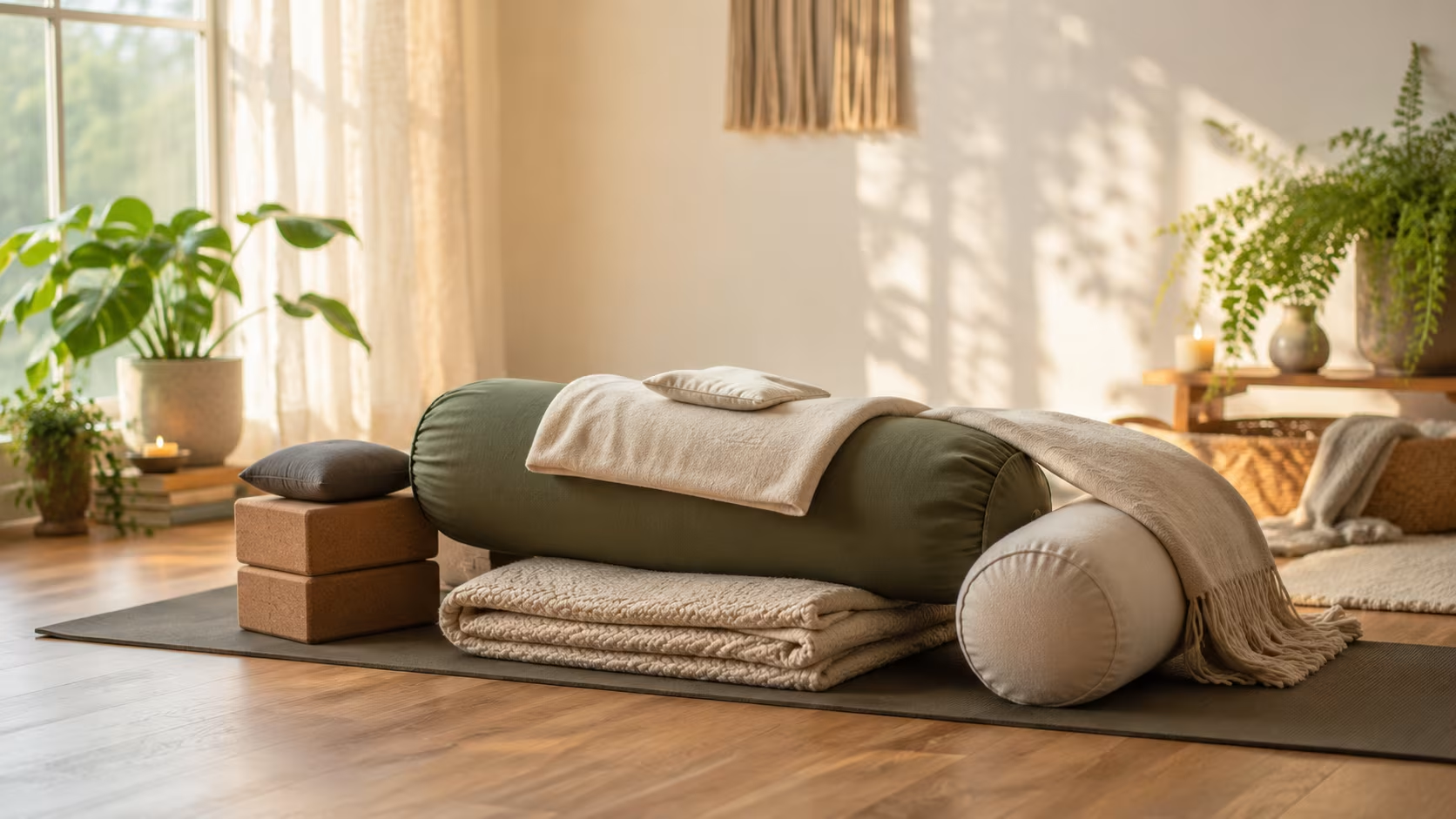
The props are the practice. A pose without proper propping isn't restorative; it's a stretch held for too long. Take the time to set up properly.
Treating it as a backup for harder practice
Restorative isn't the consolation prize for not doing vinyasa. It's a different practice with its own benefits, and treating it as a lesser version of "real" yoga misses what it can do.
Combining them in a practice
A complete yoga practice can include both, used for different purposes.
Restorative once a week, ideally on a high-stress day or during a recovery period, gives the nervous system explicit dedicated time to drop into deep parasympathetic activation. The cumulative benefit of this kind of weekly practice over months is substantial — improved sleep, improved stress tolerance, reduced reactivity.
Yin once or twice a week, separately from harder physical practice, addresses connective tissue and provides a meditative experience that complements the more dynamic forms of yoga. The progression in yin appears over months as connective tissue gradually changes properties.
Mixing them in the same session, while common in studio classes, is a compromise that doesn't fully serve either purpose. A 90-minute session that mixes some yin holds with some restorative supported poses won't produce the sustained nervous system depth of a full restorative class or the connective tissue work of a focused yin class. It will be pleasant. It will not do as much as either pure form would.
For a balanced weekly yoga practice, two sessions of dynamic asana (vinyasa or hatha), one session of yin, and one session of restorative gives a complete coverage of physical, connective tissue, and nervous system work. This is more than most casual practitioners do, but it's a reasonable target for someone serious about the discipline.
Sources
Lasater, J. (2011). Relax and Renew: Restful Yoga for Stressful Times. Rodmell Press.
Grilley, P. (2002). Yin Yoga: Outline of a Quiet Practice. White Cloud Press.
Cohen, B. E., Chang, A. A., Grady, D., & Kanaya, A. M. (2008). Restorative yoga in adults with metabolic syndrome: A randomized, controlled pilot trial. Metabolic Syndrome and Related Disorders, 6(3), 223–229.
Innes, K. E., & Selfe, T. K. (2016). Yoga for adults with type 2 diabetes: A systematic review of controlled trials. Journal of Diabetes Research, 2016, 6979370.
Schleip, R., & Müller, D. G. (2013). Training principles for fascial connective tissues: Scientific foundation and suggested practical applications. Journal of Bodywork and Movement Therapies, 17(1), 103–115.
Streeter, C. C., Gerbarg, P. L., Saper, R. B., Ciraulo, D. A., & Brown, R. P. (2012). Effects of yoga on the autonomic nervous system, gamma-aminobutyric-acid, and allostasis in epilepsy, depression, and post-traumatic stress disorder. Medical Hypotheses, 78(5), 571–579.
Cramer, H., Lauche, R., Hohmann, C., Lüdtke, R., Haller, H., Michalsen, A., Langhorst, J., & Dobos, G. (2013). Randomized-controlled trial comparing yoga and home-based exercise for chronic neck pain. Clinical Journal of Pain, 29(3), 216–223.
Frequently Asked Questions
Can I do yin yoga every day?
Probably not, if the holds are deep. Yin yoga loads connective tissue at end-range, and connective tissue takes longer to recover than muscle. Three or four sessions a week is the upper end for most practitioners. Restorative yoga, with its much lower tissue demands, is much more daily-friendly.
Are these classes good for beginners?
Restorative yoga is excellent for beginners — there's no flexibility requirement, the props do the work, and the only real skill is staying still. Yin yoga is harder for beginners than its slow pace suggests. The long deep holds require some body awareness to do safely; rushing into deep yin without a base can produce joint or ligament problems.
Do you need yoga blocks and bolsters for these classes?
For restorative yoga, yes — the props are central to the practice. Most studios provide them. For home practice, a few firm pillows, folded blankets, and a yoga block will substitute for purpose-built equipment. Yin yoga requires less equipment; a block and a blanket are usually enough.
Will yin yoga make me more flexible?
Over time, yes, but slowly. Yin works by loading connective tissue (fascia, ligaments, joint capsules) under sustained light tension, which gradually changes its properties. The flexibility gains are real but appear over months rather than weeks. Active stretching produces faster gains; yin produces different ones.



0 Comments
Leave a comment
Your email won't be published. Required fields are marked with *.