


Peter Gollwitzer is a social psychologist at New York University whose research on goal pursuit began in the 1990s with a deceptively simple observation: people who set specific plans for when, where, and how they would act on a goal followed through at significantly higher rates than people who set the same goal without that specificity. He called the specific plans "implementation intentions": if-then formulations that link a situational cue to a behavioral response.
The basic structure is "When situation X occurs, I will do behavior Y."
Rather than "I will exercise more this week." An implementation intention reads: "When I arrive home from work on Monday, Wednesday, and Friday, I will immediately change into workout clothes before sitting down."
This sounds trivially obvious. The research on it is not trivial. A 2006 meta-analysis by Gollwitzer and Sheeran in Advances in Experimental Social Psychology analyzing 94 independent studies across health behavior, academic performance, and interpersonal goals found that implementation intentions had a medium-to-large effect size on goal achievement, significantly larger than goal-setting alone. A later 2016 update maintained this finding across even more studies. This is one of the more replicated findings in behavior change research, which is notable in a field where replication is not universal.
What the evidence shows
The mechanism is well-understood. Implementation intentions work through two primary pathways:
Automaticity
When you repeatedly link a cue to a response ("when X, then Y"), the associative memory between them strengthens. Over time, encountering the cue begins to automatically trigger preparation for the behavior without requiring active deliberate decision-making. This is why the morning alarm of a consistent gym-goer triggers a behavioral sequence (gym bag, coffee, out the door) almost without conscious effort. Implementation intentions are essentially a deliberate instruction to your associative memory system to begin that automaticity formation from day one.
Prospective memory
One of the primary failure modes in behavior change is not resistance or motivation failure; it's simply forgetting to do the intended thing when the relevant moment arrives. A 2011 study in Psychological Science found that implementation intentions dramatically improved prospective memory performance (remembering to do something at a future point in time) in contexts ranging from medication adherence to screening test scheduling.
The research has been extended specifically to exercise adherence. A frequently cited 2002 study by Milne, Orbell, and Sheeran in the British Journal of Health Psychology divided participants into three groups: control (just asked to track exercise), goal-setting only (asked to set an exercise goal), and implementation intention (asked to set a goal AND write a specific when-where-how plan). Exercise rates over the subsequent two weeks: control 29%, goal-setting 39%, implementation intention 91%. The magnitude is striking and has been approximately replicated in subsequent studies.
A 2015 systematic review in Preventive Medicine examining implementation intentions specifically for physical activity behavior found consistent positive effects across 28 trials. Effects were moderated by specificity: vague when-then plans ("when I have time, I will exercise") produced smaller effects than specific ones ("when my alarm goes off at 7 AM on Tuesday, I will drive to the gym on High Street and run on the treadmill for 25 minutes").
The technique also has evidence for:
- Medication adherence (a 2011 review in Social Science and Medicine)
- Dietary change, specifically fruit and vegetable consumption
- Cancer screening completion rates
- Reducing automatic prejudiced responses (cuing counter-stereotypical responses)
Important caveats: implementation intentions are not equally effective for all behavior types. They work better for behaviors that have a clear situational cue that reliably occurs (arriving home, morning alarm, a commute) and worse for behaviors that are highly context-dependent or require complex multi-step preparation without a fixed trigger. They also don't replace motivation; if the goal is deeply unimportant to the person, the technique does little.
How to apply it
The method requires specificity in four dimensions: when, where, how, and for how long. The more concrete each element, the more effective the plan.
Step 1: Start with the goal
Identify the specific behavior you want to make consistent. Not "exercise more," but "complete three 30-minute strength training sessions per week." The goal needs to be behaviorally concrete before you can build an implementation intention around it.
Step 2: Identify your strongest and most reliable cue
The best cues are events that happen reliably without your control: waking up, arriving at a specific location, finishing a specific regular activity (finishing lunch, ending a work call, leaving the office). Avoid cues that depend on your own motivation or the absence of other demands ("when I feel like it").
Step 3: Write the if-then statement
Formula: "When [specific reliable cue], I will immediately [first step of the behavior]."
Note that the behavior specified should be the first step, not the full routine. "When my Monday alarm goes off at 6:30 AM, I will immediately put on my gym clothes" is better than "When my Monday alarm goes off at 6:30 AM, I will immediately complete my full workout and cool-down." Getting dressed is the action that breaks inertia; the rest follows.
Step 4: Stack behaviors where possible
Habit stacking (appending new behaviors to existing habits) leverages existing strong associative memory. "After I make my morning coffee, I will immediately take five minutes to write in my planning journal" uses a deeply established behavior (coffee) as an anchor cue.
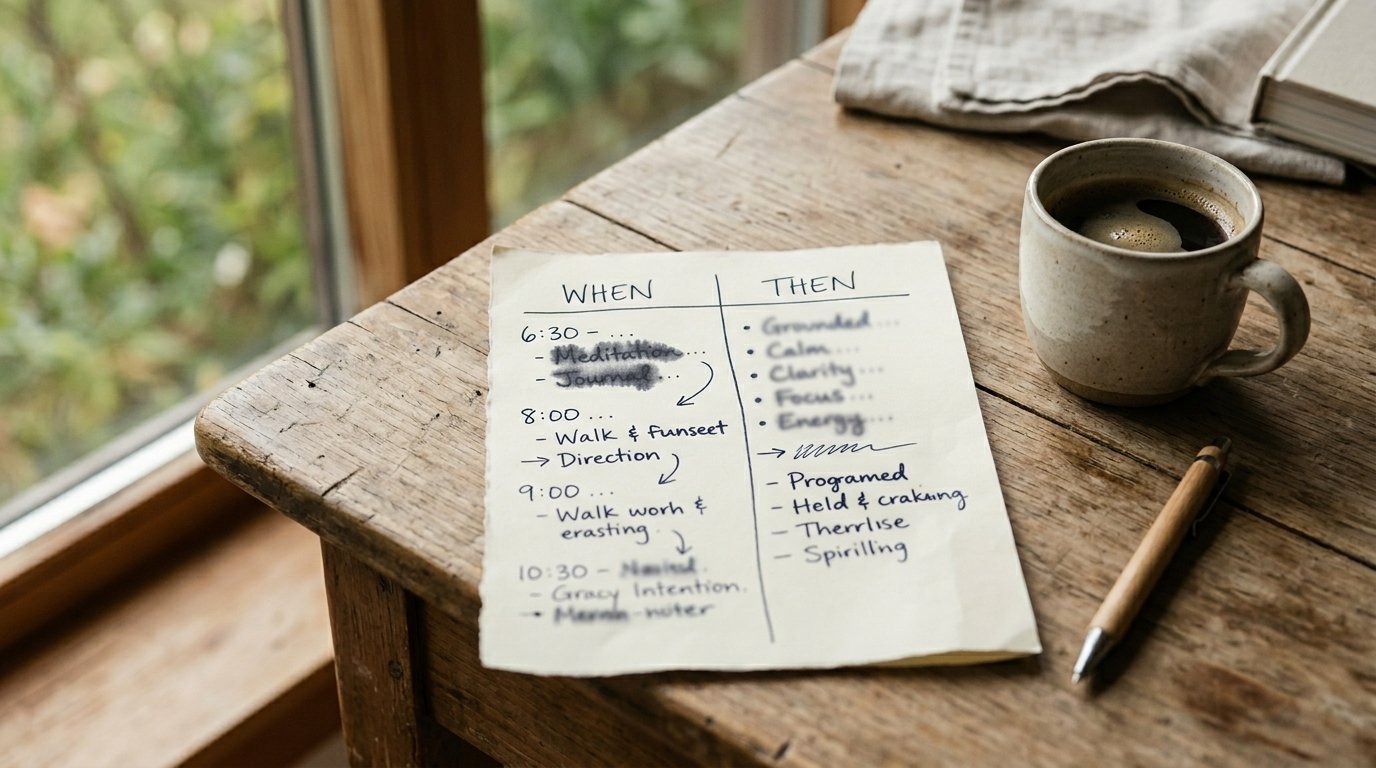
Step 5: Write it down physically
Handwriting the if-then statement is associated with better prospective memory encoding than typing. Keep the written plan where the cue occurs: on the bathroom mirror if the cue is waking up, at your desk if it's the end of the workday.
Beginner version
Write one implementation intention for your most important behavior change goal this week. One specific when-then statement. Don't try to plan every behavior simultaneously.
Progression (week three and beyond)
Once the first behavior shows a consistent three-week streak, add a second implementation intention for a related behavior. Keep the plan visible. Reassess the specificity of the cue if follow-through is inconsistent; usually the problem is cue vagueness.
When it breaks
Coping planning is an extension of the technique for anticipated obstacles. Add: "And if [anticipated obstacle], then I will [alternative action]." For example: "When my alarm goes off at 6:30 AM, I will immediately put on my gym clothes, and if I feel too tired, I will put on my gym clothes anyway and decide once I'm dressed."
Common mistakes
Specifying the outcome rather than the first behavior
"When my alarm goes off, I will work out for 45 minutes" specifies the outcome. The implementation intention should specify the first, smallest concrete action that initiates the behavior chain. That might be putting on shoes, drinking a glass of water, or opening the relevant app.
Using emotional or motivational states as cues
"When I feel motivated, I will exercise" is not an implementation intention; it's goal-setting. Cues must be external situational triggers that occur independently of your motivation state. The technique is specifically designed to bypass the need for motivation at the moment of action.
Creating too many simultaneous plans
The executive function demand of maintaining multiple active if-then links simultaneously can reduce the effectiveness of each. Research suggests concentrating on one to three specific if-then plans at a time, establishing them before adding more.
Not revisiting when the plan isn't working
If follow-through is failing despite having a plan, the diagnostic question is: is the cue reliable? Is the behavior specified at the right level of concreteness? Is there a competing if-then association that's overriding the new one ("when I get home, I sit on the couch" may be an older, stronger plan than "when I get home, I change into workout clothes").
Treating the written plan as complete
The plan needs to be reviewed and kept visible until automaticity develops. A forgotten implementation intention rapidly decays. The written plan on the bathroom mirror is not decoration; it's the spaced repetition mechanism that builds the associative link.
When to see a professional
Implementation intentions are a self-application cognitive technique with no meaningful clinical risk. However, if you consistently cannot follow through on health behavior goals despite genuine effort and planning, and this pattern is longstanding, it may reflect deeper executive function difficulties (ADHD), depression-related amotivation, or ambivalence about the goal itself that warrants discussion with a therapist, psychiatrist, or health psychologist. Motivational interviewing is a clinical technique specifically designed for ambivalence about behavior change and is highly evidence-supported. A coach or therapist trained in behavioral health can also help with behavior-change planning at a more individualized level than self-application.
Frequently asked questions
How long before the plan becomes automatic?
The associative link between cue and behavior strengthens meaningfully within two to four weeks of consistent enactment, but individual variation is high. A 2010 study by Lally and colleagues in the European Journal of Social Psychology found habit formation timelines ranging from 18 to 254 days depending on the person and the behavior's complexity. Focus on specificity and consistency of the cue rather than waiting for a specific number of days.
Does this work for stopping a behavior, not just starting one?
Yes, with modification. For inhibitory goals (not checking social media, avoiding an afternoon snack), the if-then plan specifies a competing response rather than a new behavior: 'When I feel the urge to check social media at my desk, I will stand up and get a glass of water.' The competing behavior must be specific, immediately accessible, and reliably incompatible with the unwanted behavior.
Can I use this for multiple goals at once?
Limiting to one to three active if-then plans at a time is recommended based on research on executive function demand. Maintaining too many simultaneous plans can reduce the effectiveness of each by competing for prospective memory resources. Establish the first plan's automaticity (consistent enactment for three to four weeks) before adding a second. Stack new behaviors onto existing ones where possible.
What if the cue doesn't happen on some days?
The plan is suspended for that day; there's no failure state. The technique creates a conditional response, not a rigid obligation. Missing the cue is different from failing the behavior. If the cue is occurring inconsistently, that's a signal to find a more reliable situational trigger rather than to feel that the method isn't working. Review whether the cue is something that happens regardless of your motivation or schedule.
Sources and verification
Check current details with these primary or subject-authority sources before acting on the information.





0 Comments
Leave a comment
Your email won't be published. Required fields are marked with *.